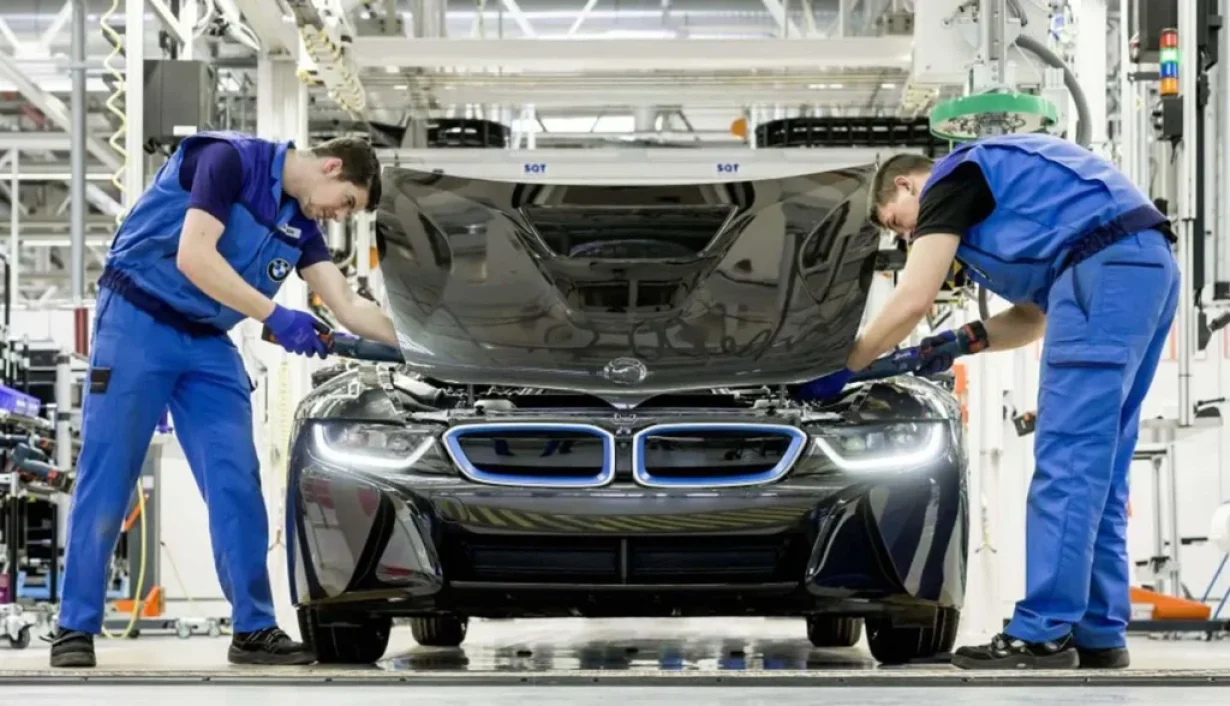

The German automotive manufacturing industry has long been recognized as a global benchmark for efficiency and technological innovation. Whether it’s Volkswagen, BMW or Mercedes-Benz, these brands are renowned for their precision manufacturing and superior quality. However, as digital manufacturing (Industry 4.0) continues to advance, more and more German car companies are introducing radio frequency identification (RFID) technology to improve transparency and efficiency throughout the supply chain. From the assembly line to the showroom, RFID is quietly changing how car manufacturer Germany operate.
Overview of RFID technology
RFID, or Radio Frequency Identification, is a technology that recognizes the identity of objects through radio waves. It consists of three main components:
| Components | Brief description of function |
| RFID Label | Chip attached to an object to store information |
| RFID Reader | Reads label data and transmits it to the system |
| Back-end system | Analyzes data and responds |
Compared with the traditional bar code, RFID has the advantages of reading without line of sight, being readable over long distances, and having a large data capacity.、
Supply Chain Challenges for Car Manufacturer Germany

Although German automakers are world leaders in lean manufacturing and quality control, they still face the following challenges in actual operations:
- Complex tracking of parts from a wide range of sources: a car consists of more than 30,000 parts on average, many of which come from multiple suppliers outside of Europe, and the complexity of cross-border procurement and transportation processes makes it easy for information to be isolated and lost.
- Lack of real-time data and lagging response: There are many nodes in the supply chain, and it is difficult for traditional systems to obtain the status of each link in a timely manner, resulting in a lack of real-time decision-making basis in production planning and inventory allocation.
- High material identification error rate: Using manual barcode scanning to identify parts is prone to errors, especially during peak production periods or night shift operations.
- High cost of assembly line errors: If certain core components are installed incorrectly, the entire vehicle must be disassembled and inspected again, seriously affecting efficiency and brand reputation.
- Difficulty in quality traceability: Once a faulty product is found, if the production batch and supplier of the faulty part cannot be accurately traced, the recall cost will increase exponentially.
- Counterfeiting in the aftermarket: Especially high-value spare parts have been counterfeited for a long time, posing a threat to consumer safety and eroding brand profits.
Key Application Scenarios for RFID in Car Manufacturer Germany
RFID is gradually replacing traditional paper labels and barcode systems in all aspects of car manufacturer Germany to play the following important role:
| Application Stages | RFID Usage | Effectiveness Improvement |
| Parts Inventory | Unique RFID labels are affixed to each parts package to realize automated identification and record warehousing | Reduce the error rate of manual entry to less than 0.1%, and improve the efficiency of warehousing by 35% |
| Warehouse Management | Intelligent shelves combined with read-write devices to realize automatic inventory counting | Realize 24-hour real-time inventory visualization and increase inventory accuracy to 99.8% |
| Production Assembly | RFID labels are bound to the VIN code of the vehicle model, automatically guiding workers or robots to assemble the parts | Ensure 100% matching between parts and models, reducing assembly error rate by 80% |
| Workstation Scheduling | Dynamic workstation and equipment deployment to avoid bottlenecks | Overall production line operation efficiency increased by 10-15% |
| Quality Inspection | Quickly match each part’s historical data with labels | Improve inspection efficiency by 30% and reduce missed inspection items |
| Finished Product Outbound | Each vehicle is read by RFID to automatically compare the configuration of the vehicle with the order before it is shipped out | Reduce shipping error rate to 1 in 10,000 |
| Dealer Showroom | RFID labels help to quickly inventory the status of showroom vehicles and test drives | Monthly inventory time reduced from 3 days to 0.5 days |
In addition, RFID plays a key role in scenarios such as raw material recycling, transportation tracking, and vehicle inbound customs clearance.
Comparison of RFID Applications of Main German Automotive Brands
German automakers have integrated RFID technology into their manufacturing and logistics systems to varying degrees. The following is a comparison of the applications of several major brands:
| Brands | Application Tier | Label Type | RFID Functionality Features | Achievements |
| BMW | From parts to complete vehicles | UHF labels, metal compatible labels | Workstation and part matching, workers wear RFID labels to match operations | Logistics efficiency increased by 25% and manual assembly errors decreased by 90% |
| Volkswagen | Mainly in warehousing and quality control | Printable and rewritable labels, environmentally friendly labels | RFID tags are seamlessly connected to MES systems and can be recycled | Millions of euros saved annually in paper costs, 50% reduction in lost parts |
| Mercedes-Benz | Full process deployment with global plant coverage | Metal inlay labels, high temperature resistant labels | Combination of RFID and digital twins for real-time feedback on production status | Shortened vehicle delivery cycle by an average of 15%, and reduced after-sales complaints about fake parts by 70% |
| Porsche | High-end customization | Customized NFC+UHF dual-frequency labels | Owners can check the source of parts and manufacturing records via APP upon delivery | Enhance customer trust and high-end service experience |
How can RFID enhance after-sales service and anti-counterfeiting capabilities?
In Germany, where the automotive aftermarket is an important part of brand maintenance and customer loyalty, RFID technology offers new tools to improve the quality of aftermarket services and combat counterfeiting:
- Creating a digital identity for spare parts
Each original spare part is labeled with a unique RFID ID, which is tied to the production lot, manufacturing plant, and quality control records. By reading the RFID, it can be quickly verified whether it is an original and genuine product.
- Digitization of after-sales maintenance records
After each repair and replacement, the service centre can synchronously upload the RFID code of the replacement parts to the main system, forming a “digital medical record” of the vehicle and improving the transparency of service.
- Prevent the circulation of unauthorized parts
The encrypted information in RFID tags can only be read by brand-authorized equipment, making it difficult to copy counterfeit parts and realize “anti-counterfeiting means anti-sale”.
- Enhance consumer trust
Through the mobile app or display screen, consumers can scan and check the source and installation time of key parts used in vehicles, thus enhancing their trust in the brand.
- Support Intelligent Recall
Once there is a problem with a certain batch of parts, the brand can quickly check the affected vehicles through the RFID data, and accurately recall the parts to save time and cost.
The value of RFID in the after-sales scenario is not only anti-counterfeiting but also in creating a transparent, efficient and trust-driven service ecosystem.
RFID Implementation Considerations and Recommendations
| Recommendation | Reason |
| Prioritize deployment at supply chain bottlenecks | Improve return on investment |
| Choose metal-compatible labels for engines or frames | Avoid read / write failures |
| Integrate RFID system with ERP / warehouse system | Improve overall efficiency |
| Regularly check RFID label status | Ensure data accuracy |
RFID implementation is not a one-day process, but with proper planning, initial results can be achieved in 3-6 months.
Conclusion
German manufacturing is known for its precision, reliability and innovation, and RFID technology is the key driving force to push it into the era of “smart manufacturing”. From every screw on the assembly line to the gleaming car in the showroom, RFID makes everything visible, controllable and traceable. For automakers, RFID is not just a management tool, but a strategic bridge to sustainability, digitization and globalization.
As a professional RFID solution provider, rfidlabel.com will continue to provide customized, efficient and environmentally friendly products and services to global automotive customers.
Recommended Product
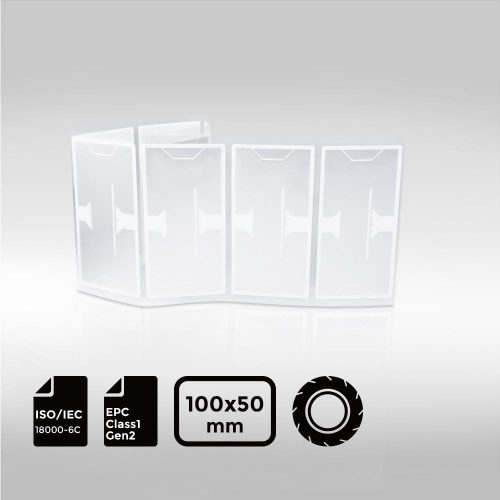
NXP UCODE® 9 PET RFID UHF Tire Label | 100×50mm

The 100×50 mm NXP UCODE® 9 RFID UHF Tire Label is a high-performance RFID label for tire tracking and management. Built with NXP UCODE® 9 chip, this UHF RFID label provides enhanced read range, fast encoding speeds, and excellent reliability in challenging environments.
This RFID tire label is engineered to withstand pressure and exposure to rubber products, making it an ideal solution for tire manufacturing, inventory management, and life-cycle tracking. The 100*50 mm size balances readability and discreet integration into the tire structure. It is designed for embedding or surface application on rubber materials. It is fully compliant with ISO 18000-6C and EPC Class1 Gen2 standards. Each Label has a unique TID and cannot be changed. It is ideal for tire manufacturers, distributors, and fleet management companies seeking an efficient and automated tracking solution.