
Flag RFID Labels
Flag Design, Achieving Signal Clarity On Uneven Surfaces
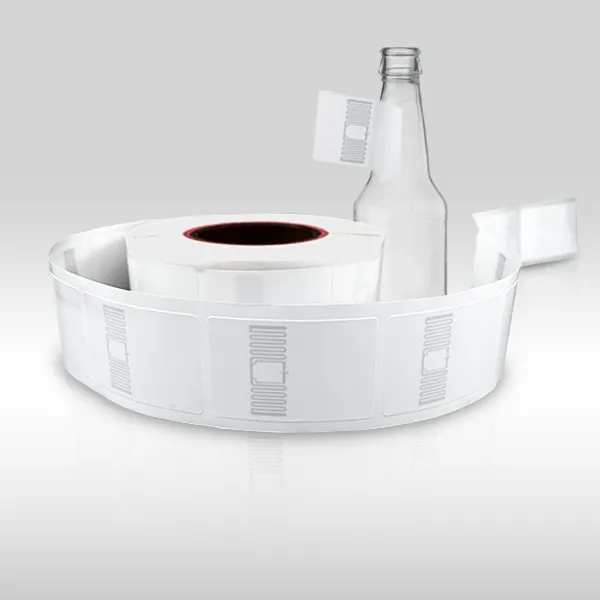
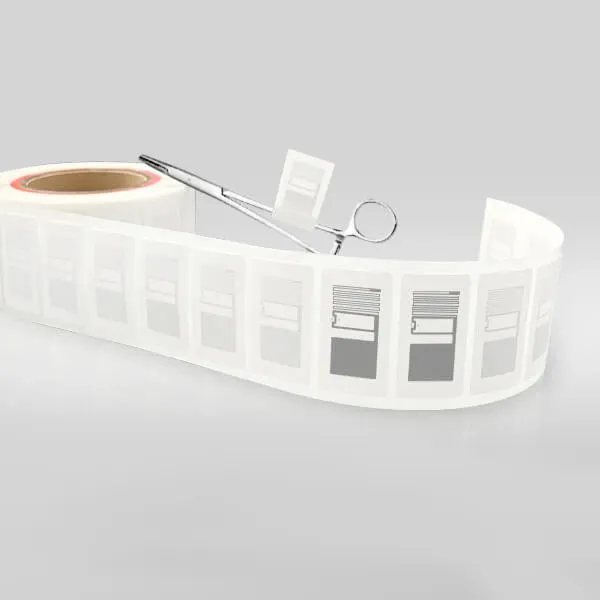

What's Flag RFID Label?
The Flag RFID Label is a specially designed RFID label featuring a chip that is suspended from the surface of the object, similar to the shape of a “flag”, which solves the problem of limited performance in certain environments, especially on metal surfaces and in other scenarios with strong interference signals. This design solves the problem of the limited performance of ordinary RFID labels in some specific environments, especially metal surfaces and other scenes with strong interference signals. The core feature of the Flag RFID Label is its “hanging” design, i.e., a portion of the label protrudes from the object’s surface. This design avoids direct contact between the RFID antenna and the object’s surface and significantly improves signal transmission efficiency.

Key features of Flag RFID Label
Unique hanging design
A portion of the label hangs outside the target surface, allowing a certain distance between the antenna and the object (e.g., metal). This design avoids shielding or absorption of the signal by the object and significantly improves read performance. The label reduces signal interference caused by metal reflections or other high-dielectric materials, ensuring more stable signal transmission.
Superior read performance
Supports both UHF and HF and is compatible with RFID application protocols such as EPC Gen 2 and ISO 18000-6C worldwide. The Flag RFID Label allows for longer read ranges in specific environments than traditional attachable tags and is often used in applications where remote reading is required. It supports simultaneous reading of multiple tags in high-density environments (anti-collision technology).
Wide range of surface adaptability
Optimized for metal surfaces and ideal for marking metal items. For example, for labeling tools, equipment or IT assets. The label’s flexible material and design allow it to fit curved, uneven or specially shaped surfaces, ensuring stability and performance after installation. It can be used on surfaces made of plastic, glass, wood, ceramics and more, covering a wide range of application scenarios.
Data security and privacy protection
This label supports data encryption to prevent unauthorized reading and data leakage. In addition, it has strong anti-jamming capability and can work stably in electronic noise environments. The label can integrate anti-counterfeiting technologies, such as encrypted serial numbers, for product authentication and traceability.

Benefits of Flag RFID Label
Application flexibility
The Flag RFID Label’s hanging design allows superior performance in metallic environments. Compared to traditional RFID labels, it solves the problem of signal reflection or shielding, making it ideal for tagging metal items. Due to the label’s flexible and structural design, it can be attached to curved, irregular or high dielectric material (e.g., glass, plastic) surfaces without additional equipment adjustments. Whether the material is wood, plastic or ceramic, Flag RFID Label works efficiently and is suitable for diverse industrial or commercial needs.
Excellent signal performance
The label antenna is located away from sources of interference, such as metal or high-density objects, increasing signal strength and ensuring stable performance in complex environments. Flag RFID Label has a longer read range in the UHF range compared to ordinary attached labels, meeting the need for remote tracking. Multiple labels can be read at the same time, enabling efficient bulk data collection even in dense stacks of items.
Improve operational efficiency
Flag RFID Labels can be easily applied to asset management, inventory counting and other scenarios to realize quick location and information updates. The real-time data transfer capability of RFID technology reduces errors caused by manual recording and improves data transparency and visualization. In supply chain or logistics management, Flag RFID Label can update the inventory status in real-time, avoiding additional costs due to management errors.
Enhance product protection and data security
The label design effectively reduces electromagnetic interference, ensures the stability of data transmission, and is suitable for use in high-noise industrial environments. Supports data encryption and access control functions to prevent unauthorized reading and is suitable for scenarios requiring high security, such as the marking of medical devices or financial assets. Product anti-counterfeiting and traceability can be achieved through unique ID and encryption technology, which is especially suitable for brand protection and certification of high-value goods.
Significant cost-effectiveness
While performance is close to on-metal RFID labels, Flag RFID Label is more economical and cost-effective in large-scale applications. Through automation and remote management, Flag RFID Label reduces the need for manual labour, thereby lowering overall operating costs. The high durability and superior performance of the label reduce the frequency of replacement and maintenance, resulting in long-term economic benefits for the organization.
Durable for harsh environments
The Flag RFID Label is resistant to harsh environments such as high temperatures, humidity, dust and chemical corrosion, making it suitable for industrial manufacturing, medical and outdoor logistics scenarios. The label surface is scratch- and tear-resistant, maintaining stable performance even under mechanical vibration or frequent operation.
Main applications of Flag RFID Label

Asset management

Retail Optimization

Medical industry

Library and documentation management
FAQs
Yes, many Flag RFID labels support writable storage, which means that after the label is first activated and data is written, the user can modify the information in the label as needed. This feature is useful for scenarios where data needs to be updated on a regular basis.