In today’s highly digital and global business environment, automated data collection technology has become a key technology in many industries. Such as supply chain management, inventory control, and logistics. As a contactless data transmission method, RFID (Radio Frequency Identification) technology has penetrated many fields. Among them, the ISO 18000-3 standard is specifically for RFID systems in the 13.56 MHz band. It is widely used in short-range item tracking, identity verification and other scenarios. This guide will provide you with a comprehensive introduction to the relevant content of ISO 18000-3. It helps users have a deep understanding of its technical principles, advantages, application scenarios.
What is the ISO 18000-3 standard?
ISO 18000-3 is an important part of the International Organization for Standardization (ISO) 18000 series of standards. It is designed to regulate air interface communications for global RFID systems. ISO 18000-3 is specifically applicable to RFID systems in the high frequency (HF) band. Especially operating at the frequency of 13.56 MHz. Unlike other RFID standards, ISO 18000-3 pays special attention to short-distance and contactless data exchange. So it has significant advantages in applications such as ticketing, access control, and logistics tracking.
Overview of the ISO 18000 series of standards:
| Standards | Frequency range | Main application scenarios |
| ISO 18000-1 | Basic structure | Define common requirements for RFID systems |
| ISO 18000-2 | Low Frequency (LF), 125-134 KHz | Animal identification, automotive safety |
| ISO 18000-3 | High Frequency (HF), 13.56 MHz | Access control, payment, ticketing |
| ISO 18000-4 | Microwave, 2.45 GHz | High-speed transportation management |
| ISO 18000-6 | Ultra High Frequency (UHF), 860-960 MHz | Logistics, supply chain management |
Technical principles of ISO 18000-3 standard
- Air Interface Communication
The core of the ISO 18000-3 standard lies in its air interface protocol, which defines how RFID readers and tags communicate with each other. It performs non-contact data transmission through electromagnetic fields in the 13.56 MHz frequency band. When an RFID tag enters the range of the reader’s electromagnetic field, the antenna inside the tag senses the field. It converts it into electrical power, which causes the chip on the tag to start functioning. It is exchanging information with the reader.
- Mode A and Mode B
The ISO 18000-3 standard contains two different communication modes, mode A and mode B. These two modes support different coding and modulation methods respectively to meet diverse application requirements.
- Mode A: Uses Manchester encoding and ASK modulation and is widely used in consumer electronics and retail industries.
- Mode B: Adopting different modulation and coding schemes, it is mainly used in logistics and supply chain management scenarios.
| Mode | Encoding method | Modulation method | Main application scenarios |
| Mode A | Manchester encoding | ASK modulation | Access control, payment systems |
| Mode B | Specific encoding | Specific modulation | Logistics, asset management |
- Data transmission and storage
In ISO 18000-3, tags can store a few to hundreds of bytes of data. It can be a unique ID, item-specific information, or other important tracking information. The data transmission rate usually depends on the requirements of the application scenario. For more complex applications, such as logistics or medical asset tracking. The data transfer rates and storage capacity requirements are higher. In applications such as payment or access control, brief and rapid data exchanges are more important.
History and development of ISO 18000-3 standard
- The necessity of RFID standardization
With the increasing demand for RFID technology for global applications. The incompatibility of RFID systems from different manufacturers and countries has become a major problem. This not only hinders the promotion and application of technology but also limits the expansion of the RFID market. To solve this problem, the International Organization for Standardization began to develop a globally unified RFID standard in the late 1990s. It ensures interoperability between different devices and promote the popularization of RFID technology.
The ISO 18000 series of standards came into being, covering the application specifications of RFID technology in different frequency ranges. The purpose is to provide a unified set of technical standards for global RFID applications. It makes all types of equipment compatible globally.
- Publication of ISO 18000-3 standard (2004)
In 2004, ISO officially released the ISO 18000-3 standard. It is specifically targeted at RFID systems operating in the 13.56 MHz high-frequency (HF) band. The release of ISO 18000-3 marks the entry of high-frequency RFID technology into the era of standardization. Especially for short-distance, high-reliability data transmission needs. The standard provides a globally unified framework.
The release of ISO 18000-3 aims to address the global compatibility of RFID systems, especially equipment across different countries and manufacturers. Standardized protocols allow companies more flexibility in selecting suppliers and help reduce procurement and operating costs. This standard specifies two main patterns: Mode A and Mode B to support diverse application scenarios.
- Revision and extension of standards
With the continuous expansion of application scenarios and the rapid advancement of RFID technology. The ISO 18000-3 standard was revised for the first time in 2009. This revision aims to improve the flexibility and applicability of the standard. Further improving data transfer rates, tag reading distances and overall system reliability. Especially in terms of security, the revision adds support for higher-level encryption and authentication protocols. It responds to the growing demand for payment and security applications.
The 2009 revision also further optimized Mode A and Mode B to make them more adaptable in different application scenarios. For example, Model A is widely used in consumer markets such as retail and payment systems. Model B is more suitable for complex industrial applications such as logistics and supply chain management.
Product categories of ISO 18000-3 standard
The ISO 18000-3 standard covers RFID systems operating in the 13.56 MHz High-frequency band. It supports many different types of RFID products. According to different application scenarios and needs, ISO 18000-3 product categories can be divided into tags, readers and antennas. These products are unique in their functionality and can be combined to meet a variety of commercial and industrial needs. Below is a detailed description of the ISO 18000-3 product categories.
1. RFID Tag
RFID tags are the core part of the RFID system. They are mainly responsible for storing information and communicating with readers. ISO 18000-3 specifies two main working modes, Mode A and Mode B. They support different types of labels to adapt to different application requirements.
- Passive RFID tags: Passive tags are widely used in applications. Such as asset tracking, access control systems, ticketing systems, and inventory management in the retail industry. Due to their low cost and long service life. These labels become the most common type of product in the ISO 18000-3 system.
- Active RFID tags: Active tags are suitable for applications that require long-distance reading or run in complex environments. Such as asset tracking, warehousing management, medical equipment management, etc.
2. RFID Reader
RFID reader is the key equipment in the ISO 18000-3 system. It responsible for sending signals to tags and receiving data returned from tags. According to different application requirements and reading distances, readers can be divided into the following categories.
- Fixed readers: Fixed readers are usually installed at doorways, passages or checkpoints. They are suitable for large-scale, fixed-position item tracking and management. Such as warehouse entrances and exits, logistics centers and so on. It is mainly used in access control systems, logistics management, industrial automation and so on.
- Handheld readers: Handheld readers are portable devices that allow operators to move freely to scan tags in different areas. This type of reader is commonly used in inventory management, on-site inspection and other occasions that require flexible operation. It is suitable for retail inventory management, asset tracking, inspection and so on.
- Desktop readers: Desktop readers are usually used for tag reading and writing in close proximity. They are commonly used in identity verification, access control management and other scenarios. They are compact and suitable for desktop operation. It can be used in access control management, ticketing systems, office desktops and so on.
- Integrated readers: Integrated readers are usually embedded in other devices. Such as self-service terminals, cash registers or vending machines, to realize automated reading functions. Examples include self-service terminals, retail cash registers, and public transportation systems.
3. RFID Antenna
RFID antennas are responsible for transmitting electromagnetic wave signals between the reader and the tag and are an integral part of the RFID system. The types of ISO 18000-3 antennas vary according to application requirements.
- Fixed Antenna: Fixed antennas are usually used with fixed readers and are suitable for covering a wide reading area in large premises. Its application scenarios are warehouse entrances and exits, logistics corridors, large industrial sites, etc.
- Portable antenna: Portable antenna is usually used with handheld readers to provide flexible mobile reading capability, suitable for operation in dynamic or complex environments. It can be used for inventory management, asset tracking, mobile inspection, etc.
Key Benefits of ISO 18000-3 standard

ISO 18000-3 is an international standard for 13.56 MHz high-frequency (HF) radio frequency identification (RFID) systems. It shows many advantages in multiple application areas, especially in close-range data reading, data transmission accuracy and system security are very prominent. The following is a detailed description of the main advantages of ISO 18000-3.
- Global applicability and broad compatibility
As an international standard, ISO 18000-3 is widely accepted and applied around the world. Its 13.56 MHz frequency band is not strictly restricted by national spectrum regulations and is suitable for global RFID systems, allowing companies to use the same RFID technology and equipment in different countries and regions, thereby simplifying the complexity of cross-border operations.
- High reliability and data accuracy
The high frequency (13.56 MHz) operating frequency of the ISO 18000-3 standard makes it more reliable and accurate in short-distance data transmission. Because high-frequency RFID systems have stronger anti-interference capabilities, especially in environments containing metals or liquids, the accuracy of data reading far exceeds that of other low-frequency or ultra-high-frequency systems.
- Support large-capacity data storage
RFID tags supported by the ISO 18000-3 standard are capable of storing large amounts of data. High-frequency tags usually have a larger storage capacity than low-frequency or ultra-high-frequency RFID tags. This allows it to be used to store complex information such as product details, batch numbers, production dates, maintenance records, etc.
- Fast Transmission Rates
Another significant advantage of the ISO 18000-3 standard is its efficient transmission rate. The fast data transfer rates of HF RFID systems allow communication between tags and readers to be completed in a short period of time. This is important for application scenarios where large amounts of tag data need to be processed quickly.
- Ideal for short-range reads
ISO 18000-3 high-frequency system is suitable for short-range reading and communication. Although its reading range is not as extensive as ultra-high frequency (UHF) systems, its short-range communication is more stable and accurate, especially in crowded, object-intensive scenarios.
- Strong anti-interference capability
Due to the excellent anti-interference ability of the HF system (13.56 MHz), ISO 18000-3 labels are able to remain stable in complex physical environments, such as metal, liquid and other environments. Compared with LF and UHF systems, ISO 18000-3 RFID tags perform much better when facing problems such as metal interference and humid environments.
- High Data Security
ISO 18000-3 supports a variety of encryption and authentication mechanisms to ensure the security of data transmission. This makes it especially useful in application scenarios where sensitive data needs to be secured, such as access control, electronic payment, identification, etc.
Application scenarios for ISO 18000-3 standard

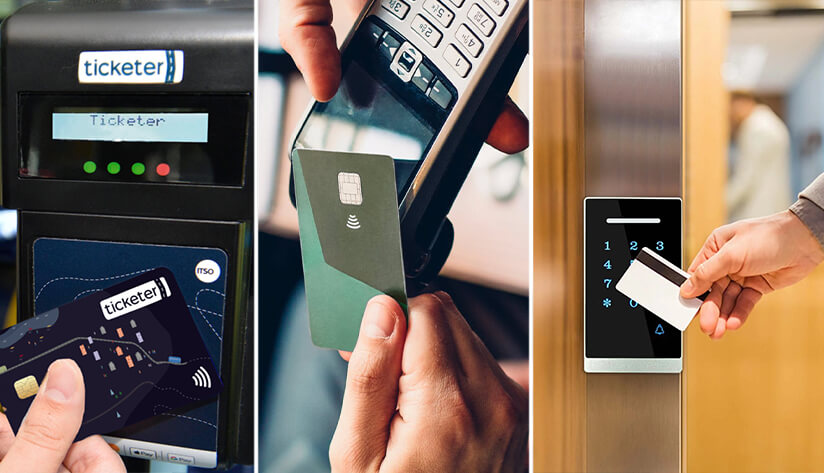
- Identification and Access Control
ISO 18000-3 standard high-frequency RFID technology is commonly used in identification and access control management. Due to the stability and security of its short-range reading, it is widely used in the access control systems of office buildings, schools, hospitals, hotels and other places.
Applications: Employee cards, visitor cards, student ID cards, etc. can be used to realize access control management through ISO 18000-3 RFID cards. The system can accurately recognize the user’s identity and ensure the security of the premises.
- Retail Inventory Management
ISO 18000-3 RFID technology is very important in the retail industry, especially in inventory management. 13.56 MHz frequency band ensures bulk reading of tags on shelves, which helps retailers visualize inventory take quick stock counts, and reduce manual operations and errors.
Applications: RFID tags are widely used for merchandise management in apparel retail and supermarkets. Retailers can quickly scan merchandise information through readers to understand inventory levels and optimize the replenishment process.
- Medical Device and Pharmaceutical Management
The ISO 18000-3 standard is widely used in the medical industry. High-frequency RFID tags are used to manage medical equipment, medicines and patient identity information in hospitals to ensure the correct use of equipment and medicines and reduce operational errors.
Applications: Tracking and management of medical equipment, drug inventory management, patient wristbands and so on. Hospitals can use the RFID system to know the location, usage and maintenance records of equipment in real-time to ensure medical safety.
- Library and archive management
The ISO 18000-3 standard is very useful in library management and archive management. By attaching RFID tags to books or archive materials, a fast borrowing and returning process can be realized, reducing manual operations and improving management efficiency.
Applications: In libraries, after books are tagged with RFID tags, the process of borrowing and returning books requires only a simple scan, and records are completed automatically. In file management, tags can help to quickly find the required documents and reduce search time.
- Transportation System and Ticket Management
Ticket management in the transportation system is one of the important application scenarios of ISO 18000-3 technology. Public transportation systems such as subways, buses, trains, etc. usually use RFID cards as electronic tickets, and passengers can quickly enter and exit the station by swiping the card, avoiding the complicated operation of paper tickets.
Applications: Urban transportation card, train ticket, bus card, etc. Passengers only need to bring the RFID card close to the reader, and the system will be able to recognize the passenger’s identity and perform automatic fare deductions.
- Electronic Payments and Smart Cards
ISO 18000-3 RFID technology is widely used in electronic payment systems, especially in proximity payment scenarios. Smart cards (e.g., bank cards, public transportation cards, parking cards) enable fast and secure e-payment through built-in RFID chips.
Applications: Credit cards, debit cards, e-wallets, membership cards, etc. Users just need to bring the card close to the POS machine or other reading devices to complete the payment without inserting or swiping the card.
- Logistics and Supply Chain Management
In logistics and supply chain management, the ISO 18000-3 standard RFID technology can track the movement of goods in warehouses, transportation and distribution. High-frequency RFID tags can be used to tag goods, and readers can scan these tags in bulk to keep track of inventory status in real-time.
Applications: Warehouse management, transportation tracking, logistics and distribution. The tag can store detailed information about the item, including production date, destination, batch, etc., which helps logistics enterprises to understand the flow of goods in real-time and ensure the transparency of the supply chain.
- Exhibition and Event Management
ISO 18000-3’s high-frequency RFID technology is also used for personnel management at large events. RFID tags can be embedded in the exhibitors’ ID cards or wristbands, and through the reader, the exhibitors’ information can be quickly scanned to record their entry and exit, which is convenient for the organizers to control and manage the flow of people.
Applications: Exhibition admission cards, concert admission tickets, event tickets, etc. By wearing an ID card or ticket with an RFID chip, participants can quickly pass through the ticket gate and reduce the waiting time.
- Asset Management and Tracking
The application of the ISO 18000-3 standard in asset management, especially in enterprises and government organizations, helps companies track and manage high-value assets in real-time. With RFID tags, assets can be accurately tracked in terms of usage, storage location and maintenance records.
Applications: Office equipment, company vehicles, IT equipment, etc. With RFID tags, managers can know the location and usage status of these assets in real-time, preventing loss and unauthorized use.
- Production and Manufacturing Process Management
In the manufacturing industry, ISO 18000-3 RFID tags are commonly used for tracking and automated management of production processes. Factories can use RFID technology to monitor the progress of each step in the production line to ensure that products are completed on time and human error is reduced.
Applications: Production line management in industries such as automobile manufacturing, electronics assembly, and food processing. Each production part is tagged with an RFID label, which is read by a reader to record its processing progress and optimize production efficiency.
Comparison between ISO 18000-3 and other protocols
The ISO 18000-3 standard is one of the more widely used high-frequency (HF) standards in RFID systems. The main operating frequency band is 13.56 MHz, supporting short-distance efficient data transmission. In order to help customers better understand the characteristics of ISO 18000-3 and its application scenarios, it is necessary to compare it in detail with other common RFID protocols. These protocols include ISO 18000-6 (UHF), ISO 18000-2 (LF) and other wireless technologies such as NFC and Bluetooth.
| Categories | ISO 18000-3 | ISO 18000-2 | ISO 18000-6 | NFC | Bluetooth | Wi-Fi |
| Operating frequency | 13.56 MHz | 125 – 134.2 kHz | 860 – 960 MHz | 13.56 MHz | 2.4 GHz | 2.4 – 5 GHz |
| Reading distance | 10 cm to 1m | A few centimeters to 30 cm | 1 m to 12 m | Within 10 cm | A few meters to 100 m, depending on the version | 10 m to 100 m |
| Data transmission speed | Moderate | slower | Rapid | Faster, supports peer-to-peer communication | Very fast | Very fast |
| anti-interference capability | Good for metal and liquid environments | Extremely strong, suitable for metals, liquids and extreme environments | Highly affected by the environment, metals and liquids can interfere with the signal | Good | Affected by Wi-Fi and other 2.4GHz devices | Susceptible to interference, especially in congested network environments |
| Application scenarios | Medical, access control, library, payment, ticketing, etc. | Animal identification, industrial equipment management, automotive anti-theft systems | Logistics, supply chain management, warehouse management, etc. | Mobile payment, smart phone interaction, access control, etc. | Headphones, smart home devices, wireless sensors, etc. | LAN connectivity, smart home, IoT applications |
Global usage and regulations of ISO 18000-3 standard
1. Global usage distribution
Due to the high compatibility and international standardization of ISO 18000-3, this standard is widely adopted in many countries and regions around the world. Its application is mainly concentrated in the following areas.
- Europe: ISO 18000-3 standards are widely adopted by several EU countries as a basic technology for smart cards and contactless payments in public transportation systems, especially in urban transportation systems.
- Asia: Japan, South Korea, China and other countries have the very common application of ISO 18000-3 standards in the fields of public transportation, payment systems and access control management. China also adopts this standard for product tracking and management, especially in the retail, logistics and manufacturing fields.
- North America: The standard is also widely used in the fields of payment systems and identification, especially in the field of contactless payments for credit and debit cards.
2. Relevant global regulations
- EU: In the EU, the application of the ISO 18000-3 standard must comply with the EU Radio Equipment Directive (RED, 2014/53/EU). According to the directive, RFID devices that use the 13.56 MHz frequency band are classified as low-power devices and can be used without a special license. However, equipment manufacturers need to ensure that the electromagnetic compatibility and safety of their equipment meet EU requirements and pass CE certification.
- United States: In the United States, the 13.56 MHz band is classified as an unlicensed band by the Federal Communications Commission (FCC). Equipment manufacturers need to pass FCC certification to ensure that their transmit power is below the limits specified in the FCC Part 15 rules to ensure that it does not interfere with other equipment and communication systems. In addition, all RFID devices must obtain FCC certification before being sold on the U.S. market.
- China: The National Radio Regulatory Commission (SRMC) is responsible for radio management in China. The 13.56 MHz frequency band in the ISO 18000-3 standard belongs to the specified frequency band for short-range wireless communication equipment and does not require special permission. However, the equipment must pass the SRMC certification test to ensure that its transmit power and frequency stability comply with national standards.
- Japan: Japan’s radio wave law classifies the 13.56 MHz band, allowing it to be widely used in Japan as a low-power device. Manufacturers need to ensure that the equipment complies with Japan’s Radio Equipment Technical Benchmark Certification (TELEC Certification) and complies with relevant regulations on maximum transmit power.
- Other regions: Canada, Australia, South Korea and other countries and regions also allow the free use of RFID equipment in the 13.56 MHz band, but equipment manufacturers still need to comply with the transmit power limits and relevant certification requirements of various countries.
3. Data Privacy and Security Compliance
In addition to restrictions on the use of radio spectrum, ISO 18000-3 may also involve data privacy issues in some application scenarios. Especially in the transmission of sensitive data such as payment systems, access control systems, etc., the requirements for data protection differ from country to country.
- EU GDPR (General Data Protection Regulation): In the EU, any application that uses RFID devices to collect personal data needs to comply with the GDPR. Organizations using ISO 18000-3-compliant RFID systems need to ensure that user data is encrypted and handled properly to prevent data leakage.
- USA: Privacy protection regulations in the USA are more decentralized and are usually dictated by state laws. When using ISO 18000-3 for payment or authentication, organizations need to ensure compliance with regulations such as the California Consumer Privacy Act (CCPA).
- China: China’s Cybersecurity Law and Personal Information Protection Law also impose high-security requirements for the use of RFID technology in payment and access control. Systems utilizing the ISO 18000-3 standard should comply with these regulations to ensure secure data storage and transmission.
Conclusion
The ISO 18000-3 standard provides a harmonized technical basis for global RFID systems, especially in the 13.56 MHz band, where it demonstrates strong application potential. From access control to payment systems, from asset tracking to smart cities, ISO 18000-3 has a wide range of applications. As technology continues to advance and the Internet of Things becomes more widespread, ISO 18000-3 will play an even more important role in the future. Whether you are an enterprise-level user or an individual developer, understanding and mastering the ISO 18000-3 standard is critical to maintaining a competitive edge in the modern digital business environment.
If your business has a need for RFID solutions, contact us at RFIDLabel and we will provide you with customized and efficient RFID products that will help your business gain more efficient management and tracking.