


RFID printing can use either direct thermal or thermal transfer methods. The right choice depends on how long the label must stay readable, what material is used, and where the RFID label will be applied.
Many RFID projects focus first on the chip, antenna, adhesive, and read range. Those details are important, but the printed surface should not be ignored. A label may still be readable by an RFID reader, while the printed barcode, SKU, serial number, or text becomes faded or unreadable.
For RFID labels, printing is not only about appearance. It is part of identification, scanning, sorting, and traceability.
What Is Direct Thermal RFID Printing?
Direct thermal RFID printing does not use ribbon, ink, or toner. The printer head heats a special thermal label material, and the heated area turns dark to form the image.
This method is simple and cost-effective. Since no ribbon is required, there are fewer consumables to manage. It is often used for short-term labels such as shipping labels, retail labels, supermarket price labels, temporary warehouse labels, and short logistics labels.
The main weakness is durability. Direct thermal print can fade or darken over time, especially when exposed to heat, light, friction, or poor storage conditions. Once the barcode loses contrast, scanning may become unreliable.
Direct thermal RFID labels are suitable when the label only needs to last for a short handling cycle.
What Is Thermal Transfer RFID Printing?
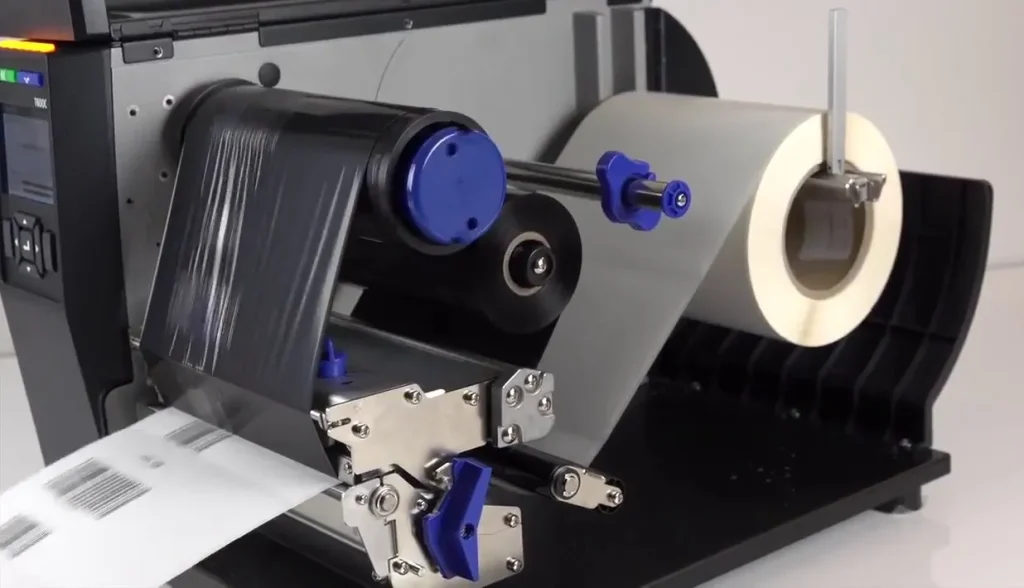
Thermal transfer RFID printing uses a ribbon. The printer head heats the ribbon, and the ink layer is transferred onto the label surface.
This method usually creates a more durable print. It also works with more label materials, including coated paper, PET, PP, PVC, synthetic labels, hang tags, and some textile materials.
Thermal transfer RFID printing is commonly used for RFID asset labels, product labels, warehouse shelf labels, industrial labels, apparel hang tags, cold-chain labels, and labels that need long-term readability.
The trade-off is cost. Thermal transfer RFID printing requires both labels and ribbon. The ribbon also needs to match the label material. Paper labels may use wax or wax-resin ribbon, while PET, PP, PVC, cable labels, jewelry labels, or asset labels often need resin ribbon.
Direct Thermal vs Thermal Transfer: Key Differences
| Item | Direct Thermal RFID Printing | Thermal Transfer RFID Printing |
| Ribbon | Not required | Required |
| Cost | Lower consumable cost | Higher consumable cost |
| Label life | Shorter | Longer |
| Material options | Limited | Wider |
| Durability | Lower | Higher |
| Best for | Short-term labels | Durable labels |
| RFID use | Shipping, retail, temporary tracking | Asset labels, industrial labels, product tracking |
The simplest difference is this: direct thermal is easier and cheaper, while thermal transfer is more durable and flexible.
When to Use Direct Thermal RFID Labels
Direct thermal RFID labels are a good fit when the printed information does not need to last long.
- They are suitable when:
- The label is used indoors.
- The label has a short life cycle.
- The barcode is only needed temporarily.
- The label will not face strong heat or sunlight.
- Low consumable cost is more important than long-term durability.
Typical examples include shipping labels, temporary logistics labels, short-term warehouse labels, and some retail labels.
If the label needs to stay readable for months or years, direct thermal RFID printing is usually not the safest option.
When to Use Thermal Transfer RFID Labels
Thermal transfer RFID labels are better when print durability matters.
They are more suitable when:
- The label needs long-term readability.
- The label uses PET, PP, PVC, or other synthetic materials.
- The print may face rubbing, moisture, cleaning, or heat.
- The label is used for fixed assets or durable products.
- The barcode, serial number, or product information must remain clear.
For manufacturing, healthcare, electronics, logistics, apparel, asset tracking, and industrial identification, thermal transfer RFID printing is often the more reliable choice.

Do Not Choose by Printer Cost Alone
Direct thermal RFID printing usually looks cheaper because it does not require ribbon. For short-term labels, that can be the right decision.
But if the label becomes unreadable too early, the cost may appear later: relabeling, rescanning, manual checking, shipment delays, or traceability gaps.
Thermal transfer RFID printing costs more at the beginning, but it can reduce these risks when the label needs to last longer.
Summary
RFID printing should match the label’s real use.
Direct thermal RFID printing is simple and cost-effective for short-term RFID labels. Thermal transfer RFID printing requires ribbon, but it supports more materials and provides better print durability.
For temporary shipping, retail, or logistics labels, direct thermal RFID printing may be enough. For asset tracking, product identification, synthetic materials, industrial use, or long-term barcode readability, thermal transfer RFID printing is usually the better choice.
Before production, confirm the label material, printing method, printer model, application environment, and RFID encoding needs together. This helps avoid faded print, unreadable barcodes, and unnecessary relabeling later.
For more RFID label printing guidance, label material selection, and custom RFID label solutions, visit rfidlabel.com.
Recommended Product

4″x2″ 860-960MHz UHF RFID Label Impinj® Monza® 4D

Introducing our 4″x2″ UHF RFID Label, a fusion of size and technological excellence featuring the highly capable Impinj® Monza® 4D chip. Operating in the 860-960MHz frequency range, this label offers unparalleled read and write performance. Designed for versatility, its PP Synthetic Paper surface is fully compatible with thermal transfer label printers. Whether you’re in logistics, healthcare, or retail, you’ll find this label is built for precision, speed, and durability.



