


Introduction
In today’s fast-paced business environment, organisations are facing unprecedented challenges, particularly in asset tracking, inventory management, and supply chain optimisation. To meet these challenges, effective identification and tracking technologies have become critical. Traditional labels, such as barcodes, have long been the industry standard. However, as environments become more complex, the need for more advanced and reliable solutions increases. This paper will provide an in-depth examination of the differences between flag tag RFID technology and traditional tags, shedding light on why RFID has demonstrated superior adaptability in complex environments.
1. Limitations of Traditional Labels
Traditional labels, most commonly bar codes, read information through optical scanning. They play an important role in many applications, such as retail merchandise checkout and simple inventory management. However, the inherent characteristics of traditional labels limit their use in certain complex scenarios.
Key limitations of traditional labels include:
Line-of-sight requirements: Bar codes must be in the scanner’s line of sight in order to be read. This means operators need to manually align each label, which is inefficient in large quantities or hard-to-reach areas.
Single Read: Only one barcode can be read per scan. For scenarios where multiple items need to be identified at the same time, this can significantly increase time and labour costs.
Vulnerable to Damage: Barcodes are easily damaged by wear and tear, dirt or moisture, and once damaged, the information is unreadable, resulting in data loss and operational disruption.
Limited storage capacity: barcodes can only store a small amount of information, usually the product ID, limiting their functionality for applications that require more detailed data, such as production dates, lot numbers or maintenance history.
Lack of Dynamic Update Capability: Once printed, the information on the barcode cannot be changed. Any updates require reprinting and replacing the label, which is time-consuming and a waste of resources.
2. Flag tag RFID technology: a powerful tool for complex environments

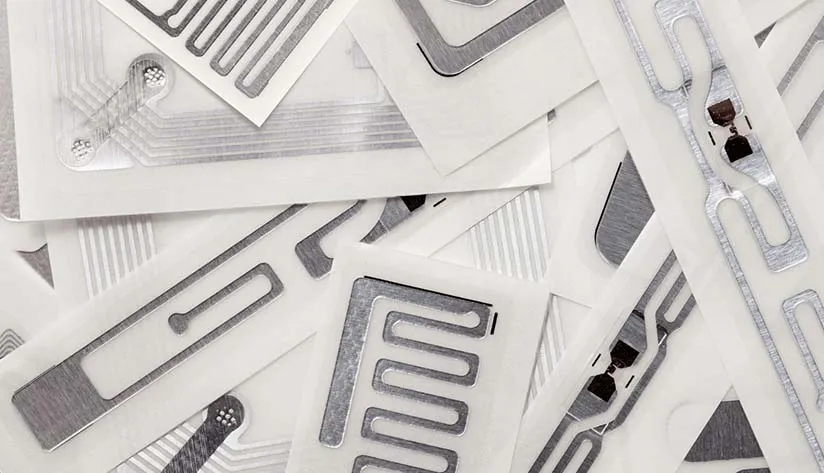
Radio Frequency Identification (RFID) technology identifies specific targets and reads and writes relevant data through radio waves. Unlike traditional tags, RFID systems consist of an RFID tag (containing a microchip and antenna), an RFID reader and a data processing system. This contactless identification technology brings significant advantages to complex environments.
Flag tag RFID, a special form of RFID tag, is designed to perform well on metal surfaces or in liquid environments. Its unique structure allows a portion of the antenna to “float out” of the tag body, thus avoiding metal or liquid interference with the RF signal and ensuring reliable reads in these challenging environments.
Key benefits of RFID technology include:
Non-line-of-sight reading: RFID tags do not need to be in the reader’s line of sight to be recognised. This allows items inside boxes, on shelves, or in hard-to-reach locations to be quickly and accurately identified, greatly improving efficiency.
Batch Read Capability: RFID readers can simultaneously identify hundreds of tags in a short period of time. This is an unmatched advantage of traditional tags for large-scale inventory counts, logistics tracking and asset management.
High durability and environmental resilience: RFID tags are often encapsulated in robust materials that make them resistant to harsh environments such as moisture, dust, temperature extremes and chemical attack. Flag tag RFID is even more specifically optimised for metal and liquid environments.
Greater Data Storage Capacity: RFID tags can store much more information than barcodes, ranging from a few hundred bytes to several kilobytes. This allows for richer data to be carried per item, supporting more granular management.
Data Readability: Many RFID tags are read-write, which means the information on the tag can be updated at any time. This provides great flexibility for dynamic inventory management, production process tracking and asset lifecycle management.
Enhanced Security: RFID tags can encrypt data and are tamper-evident, reducing the risk of counterfeiting and theft.
3. Flag Tag RFID vs. traditional tags: why RFID is better for complex environments?
The table below provides a detailed comparison of the different aspects of RFID technology versus traditional tags, highlighting the unique advantages of RFID in complex environments:
| Features | Traditional labels (barcodes) | Flag labels RFID | Complex environment suitability | Benefits Description |
| Reading method | Optical scanning, line-of-sight required | Radio waves, no line-of-sight required | Extremely high | Penetrating, reads in obscured or dirty environments |
| Reading speed | Individual reads | Fast batch reads | Very high | Significantly improves inventory and tracking efficiency |
| Data capacity | Limited (typically tens of bytes) | Large (hundreds to thousands of bytes) | High | Can store more detailed product and logistics information |
| Read/Write | Unchangeable | Read/Write (some types) | Very high | Information can be updated in real time, adapting to dynamic management |
| Durability | Susceptible to damage (abrasion, stains, moisture) | High (waterproof, dustproof, temperature resistant) | Very high | Adaptable to harsh industrial environments, reducing label damage rates |
| Anti-counterfeiting | Weak | Strong (encryption, unique ID) | High | Reduces the risk of counterfeiting and improves product traceability security |
| Cost | Low | Relatively high | Medium | High initial investment, but compensated by long-term operational efficiency |
| Application Scenarios | Retail Checkout, Simple Inventory | Supply Chain Management, Asset Tracking, Smart Manufacturing, Medical, Apparel, Transportation | Very High | Suitable for scenarios requiring high efficiency, high accuracy, and harsh environment adaptability |
| Metallic/liquid environments | Susceptible to interference and difficult to read | Flag tag design for high interference immunity | Very high | Specifically optimized to ensure stable operation in challenging media |
Conclusion
In today’s rapidly changing business landscape, there is a growing need for efficient and reliable identification and tracking solutions. Traditional tags, while still valuable in some applications, have become increasingly limited in complex environments. In contrast, flag tag RFID technology is ideally suited to meet these challenges with its non-line-of-sight reads, bulk identification, high durability, high-capacity storage, and superior performance in metallic and liquid environments.
Choosing RFID, especially flag tag RFID optimised for specific environments, means companies can achieve more accurate inventory management, more efficient supply chain operations, more reliable asset tracking, and stronger data security. While the initial investment may be higher than with traditional tags, the long-term rewards that RFID offers in terms of increased operational efficiency, lower labour costs, fewer errors and improved overall business agility make it a highly valuable investment.
We invite you to visit our RFIDLabel website to learn more and discuss how you can leverage RFID technology to optimise your business operations and get ahead of the curve in complex environments.
Recommended Product





