


The landscape of modern commerce is undergoing a profound transformation, and at the heart of this change is the strategic adoption of RFID in retail industry. This technology is not merely an incremental upgrade; it is a foundational shift that redefines inventory accuracy, supply chain visibility, and the overall customer experience. We, as experts in RFID solutions, see firsthand how this technology is empowering retailers to move beyond the limitations of traditional barcode systems, creating a truly “connected store” environment.
Why Traditional Inventory Methods Fall Short
For decades, manual stock counts and barcode scanning have been the standard. However, these methods are inherently prone to human error and offer only a snapshot of inventory at a single point in time. This lack of real-time visibility leads to significant challenges:
- Stockouts and Overstocking: Inaccurate counts result in lost sales from empty shelves or increased carrying costs from excess inventory.
- Shrinkage: Identifying the source of lost or stolen goods becomes a complex, time-consuming investigation.
- Labor Intensity: Employees spend valuable time counting instead of serving customers or fulfilling online orders.
The Power of Visibility with RFID
The core advantage of RFID in retail industry is its ability to provide near-perfect, real-time inventory accuracy—often exceeding 98%. Unlike barcodes, RFID tags do not require line-of-sight scanning. A handheld or fixed reader can scan hundreds of items per second, drastically reducing the time required for inventory audits from days to mere minutes.
Streamlining the Supply Chain from Warehouse to Shelf
We utilize high-quality RFID labels and tags to track products the moment they leave the factory floor. This end-to-end visibility is crucial.
| Supply Chain Stage | RFID Benefit |
| Manufacturing | Automated quality control and shipment verification. |
| Distribution Center | Rapid, accurate receiving and sorting of incoming goods. |
| In-Store | Real-time shelf-level inventory and faster cycle counting. |
Case Study: Decathlon’s Global RFID Success
A compelling example of the transformative power of RFID in retail industry is Decathlon, the global sporting goods retailer. They implemented source-tagging, applying RFID tags to products at the point of manufacture. This move resulted in:
- Inventory Accuracy: Improved to over 99%.
- Theft Reduction: A significant drop in shrinkage due to the technology’s dual use for Electronic Article Surveillance (EAS).
- Efficiency: Freed up store staff to focus on customer service rather than inventory counting.
This success story demonstrates that the investment in RFID technology yields substantial returns in operational efficiency and loss prevention.
Beyond Inventory: Enhancing the Customer Experience
The benefits of RFID in retail industry extend directly to the consumer. Accurate inventory supports “Buy Online, Pick Up In Store” (BOPIS) and ship-from-store models, ensuring customers get what they want, when they want it. Furthermore, interactive fitting rooms and smart shelves, powered by RFID, can offer personalized product recommendations, elevating the in-store shopping journey.
The Future of Retail is Connected
The widespread adoption of RFID in retail industry is inevitable. As tag costs continue to decrease and the technology becomes more integrated into enterprise resource planning (ERP) systems, it will become the standard for any retailer serious about efficiency and customer satisfaction.
Conclusion
We believe that leveraging RFID technology is the single most effective way to future-proof your retail operations. If you are seeking high-quality, customizable RFID cards, tags, or labels to begin your own transformation, we invite you to explore our comprehensive solutions. Visit rfidlabel.com today to learn more about how we can help you achieve unparalleled inventory accuracy and operational excellence.
FAQs
What is the difference between UHF RFID and HF RFID for retail applications?
UHF (Ultra High Frequency) RFID is typically used for supply chain and inventory management due to its long read range (up to several meters) and fast reading speed, making it ideal for scanning entire boxes or pallets. HF (High Frequency) RFID has a shorter range and is often used for payment, access control, and item-level tagging where close proximity is required, such as in smart fitting rooms or loyalty programs.
How does RFID help with loss prevention (shrinkage) in retail?
RFID tags can function as a highly effective Electronic Article Surveillance (EAS) system. When an item with an active tag passes through a reader at the store exit without being properly deactivated (i.e., purchased), an alarm is triggered. Because every item is uniquely identified, this system is far more precise than traditional EAS, helping to pinpoint exactly what was stolen and when.
Recommended Product
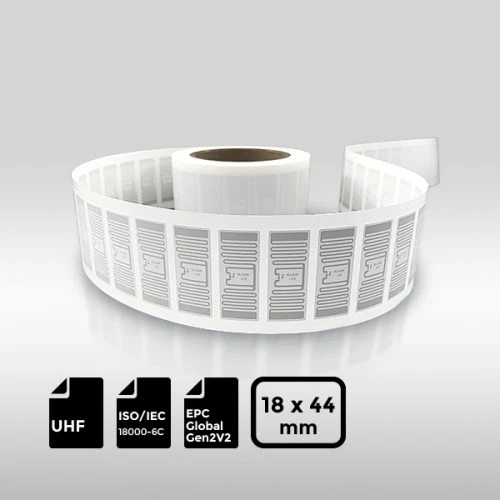
ARC Certified Impinj® M730 Coated Paper RFID Label 44x18mm

This ARC-certified RFID tag for Walmart is designed for clothing retail, supply chain management, and brand protection. Fully compliant with ISO/IEC 18000-6C and EPCglobal Gen2v2 standards, it delivers stable performance and accurate tracking. Passing the ARC certification tests, the label ensures quality and reliability in large-scale retail operations. Ideal for use in retail chains such as Walmart and Dillard’s, it helps streamline inventory management, improve supply chain visibility, and maintain brand integrity.
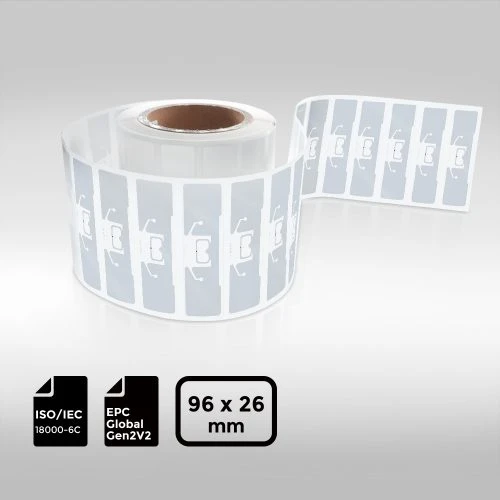
Avery Dennison® ARC Certified Impinj® M830 UHF RFID Label | 96×26mm
The 96×26 mm Avery Dennison® ARC Certified Impinj® M830 RFID Label is designed for reliable item-level identification in retail, logistics, and supply chain applications. Built with the advanced Impinj® M830 chip, this UHF RFID label delivers stable read performance, fast inventory capture, and dependable data accuracy across high-volume RFID operations. With its ARC-certified inlay, it provides a practical solution for inventory management, shipment tracking, retail tagging, and supply chain visibility.
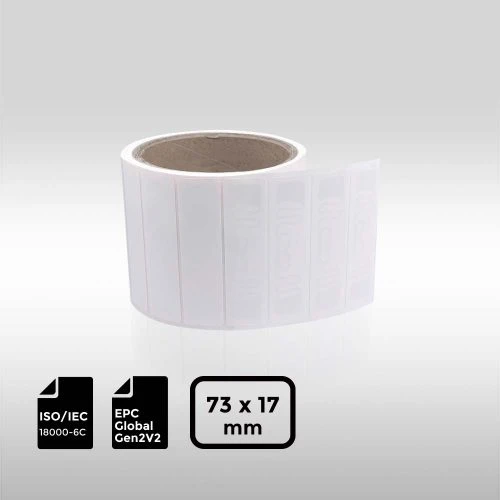
ARC Certified Impinj® M830 RFID Label | 73×17mm
This 73×17 mm ARC-certified Impinj® M830 RFID label is ideal for tagging apparel, footwear, accessories, jewelry, electronics, and toys. Fully compliant with ISO/IEC 18000-6C and EPCglobal Gen2v2 standards, its inlay has passed ARC certification tests. Widely used in retail chains like Walmart and Dillard’s, the label ensures reliable performance, smooth inventory management, and easy in-store deployment.



