RFID smart packaging works best when the label is matched to the package material, not just the chip specification. In our experience, many projects succeed or fail at the packaging stage because paperboard, plastic film, glass, and metal each affect readability, adhesion, durability, and encoding stability in different ways. When we plan RFID smart packaging, we start with the surface, the packaging shape, and the supply chain workflow.
Why Packaging Material Comes First in RFID Label Selection
A good RFID label is not only an inlay. It is a combination of antenna design, face material, adhesive, and application method. For RFID smart packaging, the same inlay can perform very differently on a corrugated carton versus a foil pouch.
The assessment content includes:
- Surface material
- Curved or flat structure
- Presence of metal or liquid
- Required read distance
- Printing and branding needs
- Manual or automatic labeling process
Best RFID Label Choices by Packaging Material
Paperboard and Corrugated Boxes
Paper packaging is usually the easiest starting point for RFID smart packaging. Cartons, sleeves, and shipping boxes generally support stable UHF RFID performance because paper does not heavily interfere with radio waves.
- Best choice: standard UHF RFID paper labels
- Recommended use: retail packaging, outer cartons, logistics cases
- Why it works: easy converting, strong printability, scalable for high-volume application

Plastic Packaging
Plastic pouches, PET containers, and shrink-wrapped packs are common in food, cosmetics, and personal care. Here, adhesive strength and label flexibility matter as much as RFID reading.
- Best choice: PET RFID labels with packaging-grade adhesive
- Recommended use: bottles, pouches, clamshell packs
- Why it works: better conformity on curved surfaces and improved label retention during transport
Glass Bottles and Jars
Glass itself is manageable, but many glass-packed products also contain liquid, which can reduce RFID performance. Placement becomes critical.
- Best choice:On-Liquid RFID Labels
- Recommended use: beverage bottles, sauces, cosmetics jars
- Why it works: proper placement can improve readability without changing the package design too much
Metalized or Foil Packaging
Foil pouches, metal lids, and metallized films are the hardest environment for standard labels. In these cases, RFID smart packaging needs an on-metal or spacer-based construction.
- Best choice: On-metal RFID labels or labels with insulating layers
- Recommended use: pharma packs, specialty foods, electronics packaging
- Why it works: isolates the antenna from the conductive surface and protects read performance
Quick Selection Table
| Packaging material | Recommended RFID label type | Main benefit |
| Paperboard carton | Paper RFID label | Cost-effective, stable reading |
| Plastic bottle or pouch | PET RFID Labels | Better adhesion and conformability |
| Glass bottle or jar | On-Liquid RFID Labels | Better performance near liquids |
| Foil or metalized pack | On-metal RFID Labels | Reliable reading on conductive surfaces |
How We Recommend Buyers Decide
Start with the packaging line
If labels are applied automatically, consistency of release liner, thickness, and adhesive matters.
Test the final packed product
We always recommend testing the label after filling, sealing, and stacking, because RFID smart packaging behaves differently before and after products enter real distribution conditions.
Match the label to the business goal
For inventory speed, UHF is often the better fit. For consumer interaction, NFC may be the right layer. Some packaging programs combine both depending on the brand objective.
Reference Case
Conclusion
Choosing RFID labels by packaging material is the fastest way to reduce testing cycles and improve read performance in real operations. When RFID smart packaging is built around the actual package structure, brands gain better consistency, smoother application, and stronger commercial results. After reading this guide, buyers can move forward with more confidence and explore suitable RFID labels, custom options, and project support at rfidlabel.com.
FAQs
1. Can one RFID label design work on all packaging materials?
Usually no. A label that performs well on cartons may underperform on glass, liquid-filled packaging, or foil structures.
2. Should we choose UHF or NFC for packaging?
UHF is usually better for inventory and logistics, while NFC is better for smartphone interaction, authentication, and consumer engagement.
Recommended Product
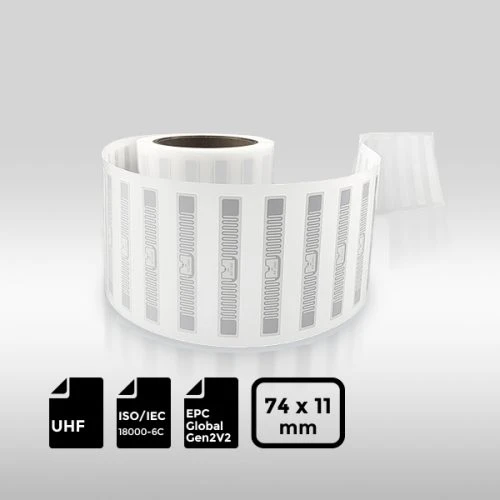
ARC Certified Impinj® Monza® R6-P Coated Paper RFID Label U6C

The ARC-certified Impinj® Monza® R6-P RFID label offers high-performance tracking with extended read range and improved memory. Fully compliant with ISO/IEC 18000-6C and EPCglobal Gen2v2 standards, it ensures product authenticity, brand protection, and reliable data transfer. Widely used in retail chains like Walmart and Dillard’s, this label supports efficient inventory management, supply chain visibility, and smooth in-store operations.

ARC Certified NXP UCODE® 9 Coated Paper RFID Label H97
This ARC-certified RFID label, equipped with NXP UCODE® 9, can be used in clothing retail, supply chain management, and brand protection. Fully compliant with ISO/IEC 18000-6C and EPCglobal Gen2v2 standards, its inlay has passed all ARC certification tests. Widely applied in retail chains like Walmart and Dillard’s, it ensures accurate item tracking, reliable performance, and smooth in-store operations.
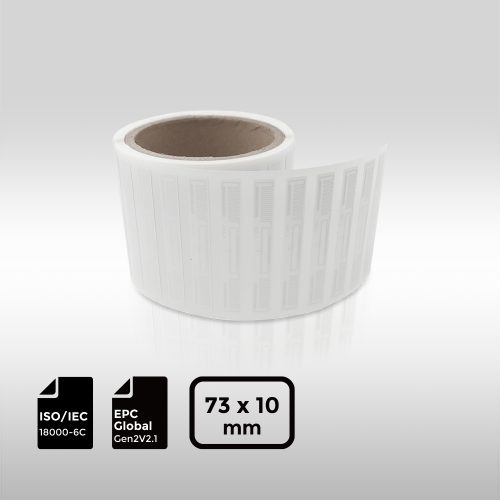
Avery Dennison® ARC Certified NXP® UCODE® 9 RFID Label | 73×10mm
The AD Longbow U9 ARC-certified RFID label is a narrow-format solution for space-limited retail and industrial applications worldwide. With its ultra-compact 73×10 mm size and NXP UCODE® 9 chip, it delivers reliable read/write performance even in challenging conditions. Its adaptive capabilities make it effective on difficult-to-tag or low-detuning materials like cardboard and plastic and in close-coupled applications, supporting inventory management, supply chain tracking, and brand protection for large retail systems like Dillard’s.