


There are fake goods everywhere. Every major business, from cosmetics to medicines to clothing and cooking oil, suffers greatly as a result of fake goods. One study estimates that in 2018, the world economy suffered losses of $323 billion as a result of counterfeit goods. Forbes claims that the biggest global criminal enterprise is counterfeiting. By 2022, it is expected that the counterfeit market will rise to $2.8 trillion and eliminate 5.4 million employees. Worldwide supply shortages are causing delayed shipments, and counterfeiters may take advantage of this situation to expand their market reach.
How Crypto and NFTs Can Assist
Blockchain uses digital tokens that are generated by each party in the supply chain to confirm its movement to monitor the provenance of an item. The token follows in lockstep each time the object is transferred. A series of transactions recorded on the blockchain mirrors the chain of custody that exists in the real world.
Rather than a piece of paper, a barcode, or a digital file, the token serves as a virtual “certificate of validity” that is considerably more difficult to steal, fake, or hack. The records are reliable and significantly enhance the knowledge available to guarantee supply-chain quality. Blockchain technology has the potential to streamline the auditing procedure. The ledger assigns accountability to the information’s owners while ensuring that each step is verified. On a permission basis, the transactions are open to all parties.
Document Records
In numerous ways, blockchain technology can enhance the management of documents and public data. You may authenticate an event simply by recording it on a blockchain. This is because each document is assigned a unique address and is hashed on a public blockchain. A hash can be thought of as a file’s “fingerprint.” The hash is changed whenever the slightest modification is made to the record. Because hashes recall every update, they are ideal for proving the legitimacy of a document.
This characteristic also applies to copies and storage of the file made by parties other than the author. It serves as independent evidence that a document was originally generated at a particular time and hasn’t been altered since. Just consider how blockchain authentication may possibly eliminate red tape for authenticating financial or legal documents. In addition, as the blockchain keeps track of all transactions, it can assist in registering audit-trail documents for proof of process. This details who made the modifications, when they occurred, and how long each modification was in effect.
Identification
Identity theft threats could be reduced via blockchain authentication. People may authenticate themselves using a distinctive digital identity registered on the blockchain if a key-pair mechanism; similar to the one used for bitcoin wallets, was in place. Users would have distinct addresses and hashes for each attribute to save their data, much like records do. This could consist of details like a name, identifying number, or fingerprints.
Each user may have access to this data using a different password, and any changes to a user’s data would be immediately recorded on the blockchain. When it comes to gaining access to financial and banking information, government services, and even passport control in airports, this may eventually prove to be a practical method of identity authentication.
Clothing
Clothing is the second-worst hit industry by fraudulent goods, according to statistics. Instagram and other well-known platforms are used by counterfeiters to advertise bogus goods masquerading as branded goods. Due to the selling of counterfeit goods, the fashion sector lost more than $50 billion in just 2020.
The garment business is among the most obvious uses of NFTs by combining its originality with RFID chips on expensive goods. We can easily monitor and modify the public ledger that tracks the chain of supply using blockchain and RFID. Suppliers may track their goods at all times and check their status and location. This item’s final ownership can also be changed on the blockchain, ensuring a high resale value in the future.
Food
Food safety is a major concern for both consumers and authorities due to expanding worldwide supply chains. One in ten people globally, according to the estimates of the World Health Organization (WHO), die from food contamination each year. According to the WHO, children under the age of five are most at risk, with 125,000 of them passing away from foodborne illnesses each year.
Although outbreaks may not always be avoided, blockchain technology may help monitor their sources more promptly and stop outbreaks from spreading into epidemics. Distributed ledger technology might provide precise and quick information about possibly contaminated food to retailers and regulators.
Supply of Ready-mixed Concrete
It’s important to keep an eye on the delivery time in specific situations, such when delivering ready-mixed concrete. In addition to precisely recording the moment the concrete-carrying vehicle leaves the plant property, it is necessary to prevent data inaccuracies caused by the “human factor” or purposefully incorrect information. Such an opportunity is provided by the combination of RFID and blockchain.
RFID (Radio Frequency Identification) is a technique for automatically identifying objects that involves using RFID scanners to read or write data from or to so-called RFID tags using radio waves. The makers of various additives, the quarries where sand and gravel are extracted, and the cement manufacturer are all listed under this topic. In the meantime, blockchain technology will also be used to distribute the necessary “ingredients” within the context of earlier transactions. The manufacturer will not be able to utilize materials that do not comply with the standards or incur “double expense” thanks to the integrated and distributed system.
Medicine
2020 saw losses for the pharmaceutical industry of about €10.2 billion as a result of the selling of fake goods. Blockchain technology offers the potential to deliver an effective, secure, and immutable solution for drug tracking and provenance to address the problem of counterfeit medications. With the aid of cryptographic algorithms and restricted access for authorized parties, blockchain technology promotes the implementation of a distributed shared information platform for the storage and exchange of transaction data across the many supply chain stakeholders. As a result, it offers a proactive method for tracking, identifying, and managing fake medications in pharmaceutical supply chains.
Digital Content
Digital content is far more easily replicated than physical stuff, particularly on open platforms. The difference between a decent digital copy and the original is little. By establishing and enforcing true scarcity, NFTs can provide real value for digital content. NFTs, however, have the ability to recognize the original digital content, produce a limited number of clones from it, and then track each replica individually.
By referring to the transaction that was used to make each duplicate and record it on a blockchain network, any app may view that created data and verify that only a limited number of replicas were actually produced. The platform validates the underlying material by creating a distinct digital fingerprint of its contents using a hashing algorithm, a mathematical procedure. By merging this digital fingerprint, content integrity can be improved even more.
Artwork Forgery
In the field of art, provenance may be easily forged, just like it can with all paper documents, and knockoff pieces of art are sold for millions of dollars as originals. Blockchain authentication might drastically cut down on forgery concerns. Certification boards may record and maintain on the blockchain the proofs of authenticity for any artwork. Additionally, the blockchain might be used by active artists to certify and authenticate their work. Any changes in ownership would then be automatically recorded on the blockchain, removing the possibility of falsification.
Conclusion
Businesses can fight counterfeiting to a considerable extent with improved transparency and end-to-end tracking. Businesses across industries are using blockchain to track shipments in real time. Walmart employs blockchain to increase the ecosystem’s level of food supply transparency. Ford, a major automaker, utilizes it to monitor cobalt supply. To protect its chain of custody, FedEx uses blockchain technology. Business use of blockchain is growing as more people become aware of the technology.
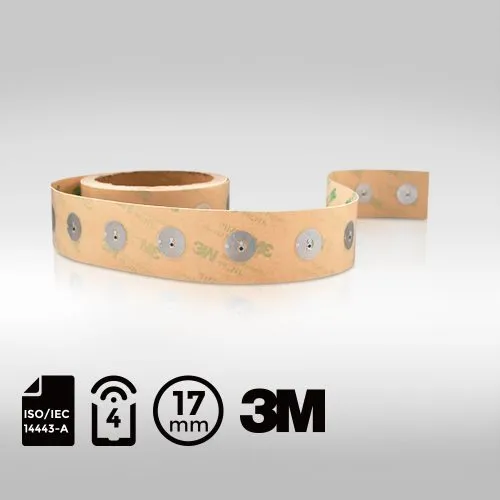
NFC label NXP NTAG® 424 DNA ISO14443A | NFC type 4 | ⌀17mm

Elevate your NFC and IoT applications to new heights with our ⌀17mm NXP NTAG® 424 DNA Label. This label sets a new standard for secure NFC and IoT applications. Engineered for ISO14443A and NFC Type 4 compatibility, it offers AES-128 cryptographic encryption and SUN authentication for unmatched security and real-time user experiences. Ideal for advanced product protection and secure transactions in NFC Crypto Wallets and NFT Marketplaces.

