Radio Frequency Identification (RFID) has completely transformed various industries, from supply chain management to healthcare, providing seamless communication and automatic identification. Understanding the communication protocols behind RFID is crucial for any professional working with this technology. Whether you’re building an RFID-based system or optimizing an existing one, knowing these protocols can significantly enhance the efficiency and performance of your project. In this article, we’ll take a deep dive into the six essential RFID communication protocols you need to know. These protocols are the backbone of RFID communication, enabling accurate, secure, and efficient data transfer between tags and readers. By understanding how each protocol works, you’ll be better equipped to choose the right one for your specific application.
What Is RFID and Why Do RFID Communication Protocols Matter?
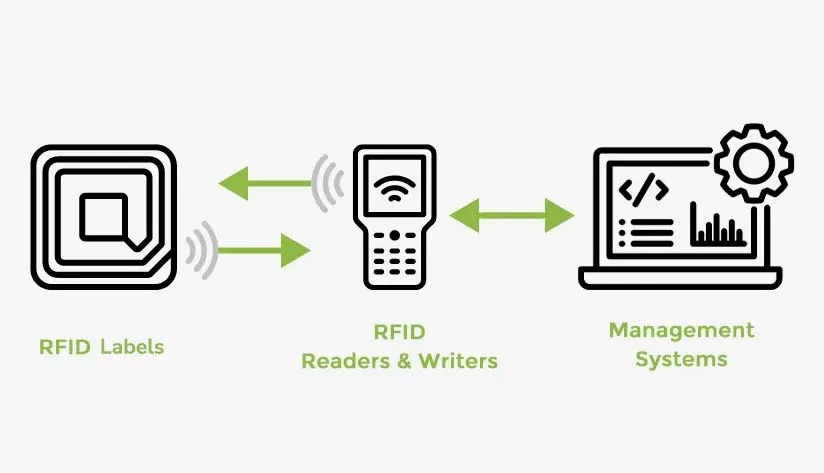
RFID is a technology that uses electromagnetic fields to automatically identify and track tags attached to objects. RFID tags consist of two parts: a chip that stores data and an antenna that transmits data. The reader sends signals to the tag, which responds with the stored information. The efficiency of this communication is determined by the RFID communication protocol, which governs how data is exchanged between the reader and the tag. There are several protocols, each suited to different purposes and industries. Without a standard or optimized communication protocol, RFID systems would experience inefficiencies, data loss, and compatibility issues.
1. ISO/IEC 14443: Proximity Cards
ISO/IEC 14443 is one of the most widely used RFID communication protocols, especially for applications like contactless payment systems, ID cards, and access control. It operates within a range of 10 centimeters to 1 meter and is commonly used for proximity cards, which you often see in public transportation systems and corporate building access.
How ISO/IEC 14443 Works
This protocol works by enabling communication between a card (tag) and a reader using electromagnetic induction. The reader sends a signal to the tag, which responds by transmitting its data back. The system operates in two main communication modes:
- Type A: Uses Amplitude Shift Keying (ASK) modulation and operates at 13.56 MHz.
- Type B: Uses Phase Shift Keying (PSK) and is known for its higher security and efficiency.
Applications of ISO/IEC 14443
- Access Control Systems: Secure entry to buildings or rooms.
- Public Transportation: Smart cards used for subway or bus fare payment.
- Contactless Credit Cards: Quick and secure payment processing.

2. ISO/IEC 15693: Vicinity Cards
The ISO/IEC 15693 protocol is often used in applications that require a longer read range compared to ISO/IEC 14443. It typically operates at a frequency of 13.56 MHz and can work at distances of up to 1.5 meters. This protocol is more commonly found in applications related to asset management, inventory control, and library systems.
How ISO/IEC 15693 Works
ISO/IEC 15693 operates on a low power signal to enable longer communication distances. Unlike the proximity communication found in ISO/IEC 14443, this protocol allows for communication over a distance, providing more flexibility for reading tags from farther away.
Applications of ISO/IEC 15693
- Security Authentication and Identity Verification: Used in access control systems for secure environments, enabling fast and contactless identity verification through NFC technology.
- Interactive Marketing and Customer Experience: Enhances customer engagement in retail by allowing users to scan tags for personalized promotions, product details, and loyalty rewards.
- Smart Access Control: Provides contactless and secure entry for buildings and restricted areas, ensuring only authorized users gain access.

3. EPCglobal Class 1 Gen 2: Ultra High Frequency (UHF)
The EPCglobal Class 1 Gen 2 protocol, often known as Gen 2 or UHF RFID, operates in the ultra-high frequency (UHF) spectrum, typically ranging from 860 MHz to 960 MHz, making it perfect for long-range and high-speed communication. This protocol offers high data transfer rates and substantial memory storage, which is why it’s a popular choice in logistics and supply chain management.
How EPCglobal Class 1 Gen 2 Works
Unlike low-frequency RFID protocols, UHF RFID operates in the microwave frequency range, enabling faster data transmission and larger read ranges—up to 12 meters or more. The reader sends a signal to the RFID tag, which then responds with its unique identifier and any stored data.
Applications of EPCglobal Class 1 Gen 2
- Supply Chain Management: Monitoring the movement of goods in real time.
- Inventory Control: Large-scale inventory management systems.
- Asset Tracking: Tracking large assets across vast distances.

4. ISO/IEC 18000-6C: UHF RFID for Item-Level Tagging
The ISO/IEC 18000-6C protocol is commonly used for item-level RFID tagging and operates in the UHF spectrum (860 MHz to 960 MHz), similar to EPCglobal Class 1 Gen 2. However, it’s specifically designed for supply chain and retail applications, enabling high-speed and long-range communication.
How ISO/IEC 18000-6C Works
This protocol is designed for item-level tracking, allowing for the tagging of individual items for inventory control, asset tracking, and product movement tracking. It employs backscatter communication, where the RFID tag reflects the reader’s signal to send back data.
Applications of ISO/IEC 18000-6C
- Retail Industry: Streamlining inventory and tracking products on shelves.
- Logistics: Managing items during transportation and warehousing.
- Item-Level Tracking: Tracking individual items in industries like pharmaceuticals and electronics.

5. ISO/IEC 18000-3: High-Frequency (HF) RFID
ISO/IEC 18000-3 is another prominent RFID communication protocol, typically used in high-frequency (HF) systems operating at 13.56 MHz. It’s a versatile protocol that’s well-suited for environments requiring short to medium-range communication (up to 1 meter), often in settings where durability and robustness are essential.
How ISO/IEC 18000-3 Works
The ISO/IEC 18000-3 protocol enables a bi-directional communication system that supports both read and write operations. It’s often used in applications that demand secure transactions and high data integrity, ensuring that information exchange is both reliable and fast.
Applications of ISO/IEC 18000-3
- Payment Systems: Secure payment processing, such as mobile payments and contactless cards.
- Library Systems: Managing and tracking library items efficiently.
- Event Management: Tracking tickets for large-scale events.

6. ISO 11784/11785: Animal Identification (134.2 kHz)
The ISO 11784 and ISO 11785 protocols are tailored for animal identification, such as livestock, pets, and wildlife. Operating at a low-frequency (LF) of 134.2 kHz, these standards define the structure of the identification codes stored in RFID tags and the communication between the reader and tag.
How ISO 11784/11785 Works
- ISO 11784: Specifies the structure of the identification code, which includes a country code, animal identifier, and an optional additional code. This ensures each animal can be uniquely identified.
- ISO 11785: Defines the technical aspects of how the RFID system works at 134.2 kHz, including two types of modulation schemes: FDX (Full Duplex) and HDX (Half Duplex). In FDX, data is transmitted continuously while receiving power from the reader, whereas HDX uses power stored from the reader’s signal to transmit data in bursts.
Applications of ISO 11784/11785
- Livestock Tracking: Monitoring animal movements for health and safety.
- Pet Identification: Identifying pets through RFID tags for registration.
- Wildlife Monitoring: Tracking wildlife for research and conservation purposes.

Conclusion
In summary, RFID communication protocols are crucial for facilitating smooth interactions between RFID tags and readers. Whether you’re using ISO/IEC 14443 for proximity cards, EPCglobal Class 1 Gen 2 for large-scale logistics, or ISO/IEC 18000-7 for active RFID applications, understanding the subtleties of these protocols helps businesses make informed decisions when implementing RFID systems. By choosing the right protocol, you can ensure the reliability, scalability, and security of your RFID-based applications.
Visit rfidlabel.com for more!
FAQs
1. What are the advantages of using ISO/IEC 14443 for contactless payments?
ISO/IEC 14443 offers a high level of security, speed, and ease of use, which is ideal for contactless payment systems. It allows quick transactions without the need for physical contact, reducing friction in the payment process.
2. Can RFID systems work in environments with metal and liquids?
Yes, RFID systems, especially UHF RFID (like EPCglobal Class 1 Gen 2), can work in environments with metal and liquids, although it may require special tags designed for these conditions.
3. What is the typical range of EPCglobal Class 1 Gen 2?
EPCglobal Class 1 Gen 2 can provide a read range of up to 12 meters, depending on factors like tag design, reader power, and the environment.
4. How does ISO/IEC 18000-6C improve inventory management?
ISO/IEC 18000-6C allows for real-time item-level tracking, which significantly improves inventory accuracy, reduces human error, and enhances the efficiency of inventory control processes.
5. Are there security concerns with RFID communication?
Yes, RFID systems, like any wireless communication technology, can be vulnerable to hacking or eavesdropping. However, advanced encryption and authentication protocols, such as those found in ISO/IEC 14443, can mitigate these risks.
Recommended Products
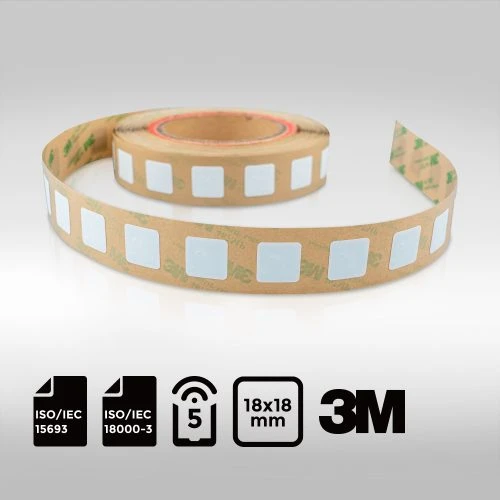
NFC Label 18x18mm NXP ICODE® SLIX | ISO15693 NFC Type-5

Elevate your tracking precision with our exceptionally compact NFC Label, sized at just 18x18mm and featuring the superior NXP ICODE® SLIX chip. Compliant with ISO15693 NFC Type-5 standards, this tiny yet mighty label is crafted with PET material and backed by reliable 3M adhesive. Experience the pinnacle of quality and efficiency in tracking solutions with this standout product.