With the arrival of the Industry 4.0 era, the manufacturing industry has embarked on an unprecedented path of change. As the main driving force for change, RFID technology has shown huge potential and application prospects in different fields. Especially in the field of automobile tyre manufacturing, RFID intelligent labels, as innovative tools for RFID technology, have changed previous production methods and production efficiency. This blog will discuss in depth the specific applications and related advantages of RFID intelligent label in the automotive tyre manufacturing industry.
Introduction of RFID technology
RFID is an automatic identification technology that uses radio waves for data interaction. It mainly consists of tags, readers and background processing systems. Among them, the intelligent label incorporates a microchip and antenna. The reader activates the label through electromagnetic induction and interacts with data. The background processing system performs analysis and identification by receiving read data from the reader.
What are the specific applications of RFID Intelligent labels in tyre production?
- Raw material management
Precise management of raw materials is the key to ensuring product quality during the tyre manufacturing process. In the past, raw material management was mainly completed by manual recording and scanning bar codes. This management method is very inefficient and prone to errors. The production factory introduces an RFID system and combines labels to adhere to each batch of raw materials. Record important information such as the origin, specifications and arrival time of each batch of raw materials in detail.
Using RFID readers, production factories can check the inventory of raw materials. While optimizing material procurement and inventory management, avoid production interruptions or waste caused by raw material shortages or redundancy. At the same time, intelligent labels can monitor the use of raw materials by manufacturing factories. Thereby ensuring the professionalism of the production process and product quality.
- Production process monitoring
RFID labels are suitable for supervising and recording every aspect of tyre production. In particular, it records key data about the tyre production process. For example, during the mixing process, labels can be combined with sensors to record parameters such as mixing time, mixing temperature, and mixing pressure. This allows each batch of rubber compound to be made by standard process requirements. In addition, during the forming process, the label can also record the time of preform forming, operator information, etc.
On the other hand, RFID technology can be used to monitor tyre vulcanization. Vulcanization is crucial for the production of tyres. An RFID reader is preset on each mould to monitor the vulcanization time and temperature of each tyre promptly. Thereby ensuring the consistency and stability of the vulcanization process.
- Finished product tracking and management
The use of RFID technology to manage finished products can effectively improve the efficiency of tyre tracking and management after leaving the factory. By attaching smart labels to each tyre, carefully record the tyre production information, quality inspection results and factory date. Combined with the use of readers, factories can obtain detailed information about tyres and achieve accurate management of finished products.
In addition, RFID technology enables automatic warehousing and warehousing management of tyres in the production factory. It is conducive to reducing the possibility of errors in manual operations and labour costs. More importantly, the full life cycle management of tyres can also be accomplished by RFID systems. On this basis, the inventory quantity and usage status of finished tyres can be queried. The efficiency and accuracy of warehousing management have also been greatly improved.

What are the advantages of RFID technology?
- Improve production efficiency
By introducing RFID technology, tyre production efficiency has been significantly improved. Whether it is the management of raw materials and the supervision of the production process, or the tracking of finished products. Smart labels can automatically collect and transmit product information, thereby reducing the time and error of manual operations. This can not only optimize the production process but also improve production efficiency.
Production factories can use labels to supervise the tyre production process and promptly discover and improve problems in the production process. This can largely ensure that each batch of products produced can meet quality requirements. At the same time, labels are used to record production information for each tyre. Achieve product traceability and improve product quality inspection levels.
- Increased data management
RFID technology can help production factories complete the automatic collection and management of production data and provide accurate data support for future production strategies. By analyzing production data, factories can optimize the process and details of the production process. While improving production efficiency, it also ensures product quality. In addition, RFID technology enables the visualization of production data. Effectively improve the transparency and control of production management.
Conclusion
The introduction of RFID intelligent labels has changed the way car tyres are produced in the past. By improving production efficiency, improving product quality and enhancing data management. It has brought unprecedented opportunities and prospects to the tyre manufacturing industry. Although there will still be many difficulties in the practical application process, these difficulties can be solved with the continuous improvement and expansion of technology. In the future, RFID technology will push the tyre manufacturing industry towards a more intelligent and automated path.
After reading this blog, if you are interested about our RFID intelligent labels, you can visit our official website (rfidlabel.com) to find out more information. If you want to get solutions for 4RFID intelligent labels, please contact our sales experts, who will provide you with the suitable solutions and professional purchase suggestions according to your needs.
Recommended Product
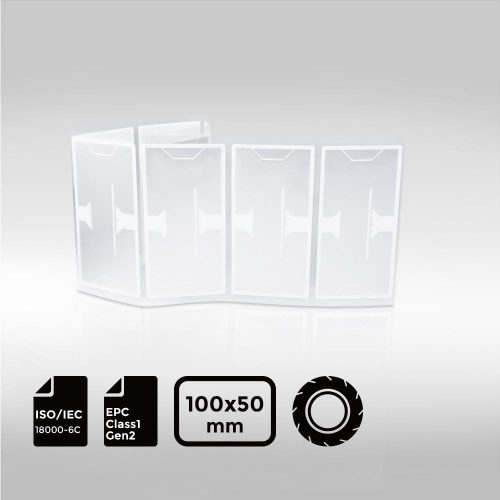
NXP UCODE® 9 PET RFID UHF Tire Label | 100×50mm

The 100×50 mm NXP UCODE® 9 RFID UHF Tire Label is a high-performance RFID label for tire tracking and management. Built with NXP UCODE® 9 chip, this UHF RFID label provides enhanced read range, fast encoding speeds, and excellent reliability in challenging environments.
This RFID tire label is engineered to withstand pressure and exposure to rubber products, making it an ideal solution for tire manufacturing, inventory management, and life-cycle tracking. The 100*50 mm size balances readability and discreet integration into the tire structure. It is designed for embedding or surface application on rubber materials. It is fully compliant with ISO 18000-6C and EPC Class1 Gen2 standards. Each Label has a unique TID and cannot be changed. It is ideal for tire manufacturers, distributors, and fleet management companies seeking an efficient and automated tracking solution.