


You need another batch of MIFARE Classic 1K RFID labels. The chip family, memory size, and label dimensions match your previous order. Is that enough?
One specification still needs checking: 4-Byte vs 7-Byte UID. These numbers describe the chip’s identifier length, not its storage capacity. Ordering the wrong version can cause problems when labels are registered or used in your existing system.
This guide focuses on MIFARE Classic RFID labels with these identifier options. Not every RFID chip family offers both versions.
4-Byte vs 7-Byte UID: What Changes?
UID stands for Unique Identifier. It is used during the contactless identification and selection process. The identifier belongs to the chip inside the label.
| Specification | 4-byte version | 7-byte version |
| Identifier length | 4 bytes | 7 bytes |
| Hexadecimal characters, excluding separators | 8 | 14 |
| Illustrative format | 12 34 AB CD | 04 12 34 56 78 9A BC |
| MIFARE Classic EV1 terminology | 4-byte NUID | 7-byte UID |
These examples show formatting only.
The NXP MIFARE Classic EV1 1K datasheet lists both identifier options. Both are available within the 1K family: a longer UID does not provide more application memory.
Label dimensions are a separate specification, too. The outside appearance of a label cannot tell you its UID length.
Why Is the 4-Byte Version Called NUID?
NUID means Non-Unique Identifier. Unlike a unique identifier, a NUID is not guaranteed to be globally unique; the same value can exist on different chips.
The limited identifier space of four bytes is important background, but avoid treating every historical 4-byte identifier as a NUID. For a particular product, follow its datasheet.
The practical question is how the application handles identifiers, including possible duplicates. NXP’s MIFARE product and handling of UIDs application note explains the identifier types and considerations for systems using different UID lengths.

Will Both Versions Work in the Same System?
Possibly—but do not assume they will.
Imagine replacing labels in an equipment identification system. The reader detects a new 7-byte label, but the software was configured to store only four bytes. Reading the chip successfully does not prove that registration, database matching, and everyday operation will work.
Before changing versions, confirm:
- Reader support: Can the reader and its firmware handle the required UID length?
- Software support: Does the application accept and preserve the full identifier?
- Data requirements: Does the system also depend on protected memory, keys, or a specific data layout?
Matching UID length alone does not guarantee compatibility. A blank label may still need encoding or personalization before use.
Also, a 7-byte UID does not automatically make a label more secure. Identifier length cannot replace authentication.
How to Check the Labels You Already Use
Start with a label that works reliably in your system. Use a compatible reader and diagnostic software to identify the chip and report its UID length.
In a complete hexadecimal display, eight characters represent four bytes and fourteen represent seven bytes. Ignore spaces and colons. Do not judge by the number of digits in a decimal ID: its displayed length can vary.
Save the diagnostic report or screenshot for your supplier. Then test replacement samples through the actual workflow, including enrollment and data access—not just a quick scan.
For adhesive labels, test on the intended surface as well. Correct UID handling and reliable RF performance are separate checks.

What to Include in Your RFID Label Inquiry
“MIFARE Classic 1K label” leaves room for misunderstanding. A clearer specification is:
MIFARE Classic EV1 1K RFID label, 4-byte NUID, 30 × 30 mm, with encoding requirements confirmed separately.
Include your required quantity, application, mounting surface, and reader model. If you are unsure about the identifier version, provide information from a working label rather than guessing.
Browse our NXP MIFARE Classic RFID labels to review the chip specifications.
If you’re unsure whether you need 4-byte or 7-byte RFID labels, you’re welcome to contact us at rfidlabel.com. Share your current label’s chip information and application requirements, and we can help confirm the specifications and discuss samples for testing.
Recommended Product
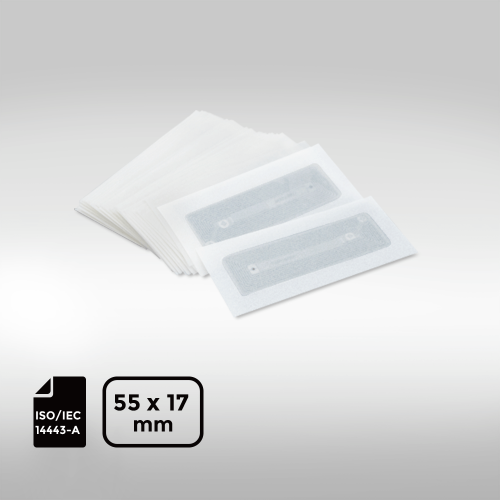
ISO14443A 13.56MHz RFID sticker 55x17mm NXP MIFARE Classic® EV1 1K | S50

Discover seamless and secure tracking with our ISO14443A 13.56MHz RFID Sticker, sized at a convenient 55x17mm. Engineered with the state-of-the-art NXP MIFARE Classic® EV1 1K | S50 chip, this RFID sticker offers top-tier performance for data reliability and security. Ideal for asset management, event tracking, and access control systems, this is the optimal solution for modern identification needs.
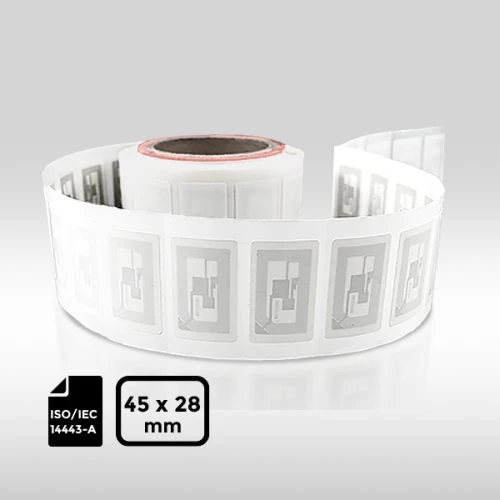
ISO14443A 13.56MHz RFID Label 45x28mm NXP MIFARE Classic® EV1 1K | S50
Introducing our 45x28mm ISO14443A 13.56MHz RFID Label, the ultimate solution for reliable and secure tracking. Engineered with the renowned NXP MIFARE Classic® EV1 1K | S50 chip, this label sets the standard in data integrity and security. Perfect for asset management, access control, and more. Make the smart choice for uncompromising performance.



