

In the world of wireless communication, what is frequency hopping and how does it play a pivotal role in modern technology? Originally developed by the military to secure communications, this ingenious technique is now at the heart of many systems we use daily, including the robust and reliable RFID (Radio Frequency Identification) systems that power countless industries. At RFIDLabel, we leverage this technology to provide our clients with superior RFID solutions that are both resilient and efficient.
Understanding the Basics of Frequency Hopping
So, what is frequency hopping exactly? In simple terms, it’s a method of transmitting radio signals by rapidly switching a carrier among many frequency channels, using a pseudorandom sequence known to both the transmitter and receiver. Think of it as a secret, coordinated dance between the RFID reader (the transmitter) and the tag (the receiver). They both know the steps—the sequence of frequencies—and change channels in perfect sync. This rapid and random-like switching makes the signal highly resistant to interference and interception.
This method, known as Frequency-Hopping Spread Spectrum (FHSS), is a cornerstone of modern wireless technology. It allows multiple RFID readers to operate in the same area without interfering with one another, a critical feature in busy environments like warehouses, retail stores, and large-scale events.

How Does It Work in an RFID System?
In a typical UHF (Ultra-High Frequency) RFID system, the reader needs to communicate with potentially hundreds or even thousands of tags. In a crowded radio environment, signals from other devices like Wi-Fi routers, cell phones, or even other RFID readers can cause significant interference. This is where frequency hopping becomes a game-changer.
Here’s a simplified breakdown of the process:
- Defined Frequency Band: The system operates within a specific range of frequencies (e.g., the 902-928 MHz band in North America).
- Hopping Sequence: The reader follows a programmed pseudorandom channel sequence within this band.
- Synchronized Switching: The reader rapidly hops from one frequency to another according to this sequence, transmitting a short burst of data on each channel.
- Tag Response: The RFID tags in the vicinity listen across the entire band and respond to the reader’s signal, no matter which frequency the reader uses.
This constant movement across the frequency spectrum is what is frequency hopping’s greatest strength. If one channel becomes noisy or jammed, the system quickly hops to the next clear channel in the sequence and keeps communication running with minimal loss.
Frequency-Hopping RFID Label Checklist
- Protocol: Complies with ISO/IEC 18000-6C and EPCglobal Gen2v2.
- Operating Frequency: Covers your regional band (ideally stated as 860–960 MHz, or explicitly 902–928 MHz / 920–925 MHz, etc.).
- Inlay/Label Type: Uses an inlay tuned for the correct regional band (e.g., US/EU/CN tuned).
Common UHF Tag ICs for FHSS Readers
In real-world deployments, UHF RFID labels built with the following IC families generally work well with readers that use frequency hopping:
- Impinj Monza series: Monza R6 / R6-P, Monza M730/M750, etc.
- NXP UCODE series: UCODE 8/9, UCODE DNA (often used for higher security/authentication applications).
- Alien Higgs series: Higgs-3, Higgs-EC, etc.
- EM Microelectronics: Certain UHF Gen2 ICs/solutions used for specific industrial or specialized applications.
The Unstoppable Advantages of Frequency Hopping in RFID
The implementation of frequency hopping in RFID systems offers a multitude of benefits that make them incredibly robust and versatile. These advantages are crucial for businesses like Walmart, which rely on RFID for massive-scale inventory management where accuracy and reliability are non-negotiable.
| Advantage | Description |
| Interference Avoidance | By not staying on a single frequency, the system can easily sidestep interference from other RF devices, ensuring a stable and reliable connection. |
| Enhanced Security | The pseudorandom nature of the frequency changes makes it extremely difficult for unauthorized parties to intercept or eavesdrop on the communication. |
| Increased Capacity | Multiple RFID systems can coexist and operate in the same physical space without interfering with each other, a concept known as Code-Division Multiple Access (CDMA). |
| Regulatory Compliance | In many regions, regulations limit the amount of time a device can transmit on a single frequency. Frequency hopping ensures compliance with these rules while maximizing performance. |
A Real-World Example: The U.S. Department of Defense
The U.S. Department of Defense (DoD) was one of the earliest and most significant adopters of RFID technology, using it to track vast quantities of supplies and assets across its global supply chain. In a 2004 mandate, the DoD required its suppliers to use passive UHF RFID tags on all shipments. The use of frequency hopping was critical to the success of this initiative, enabling reliable tag reading in challenging and often chaotic RF environments, from bustling warehouses to active military zones. This large-scale implementation demonstrated the power and necessity of what is frequency hopping in ensuring data integrity and operational efficiency.

Why This Matters for Your Business
Understanding what is frequency hopping is more than just a technical curiosity; it’s about recognizing the foundation of a reliable and scalable RFID solution. It means fewer missed reads, more accurate inventory data, and ultimately, a more efficient supply chain.
At RFIDLabel, we specialize in providing high-quality, customizable RFID tags and labels that are designed to excel in these demanding environments. Our products are built to work seamlessly with frequency-hopping readers, ensuring that you get the performance and reliability you need to optimize your operations.
Conclusion
Frequency hopping is the invisible engine that makes modern RFID systems unstoppable. Its ability to combat interference, enhance security, and allow for scalable deployments is what makes RFID technology a cornerstone of efficient, data-driven business operations. Whether you are tracking inventory in a massive warehouse, managing assets in a hospital, or streamlining your retail supply chain, a robust RFID system built on the principles of frequency hopping is your key to success.
If you are ready to explore how our advanced RFID solutions can benefit your business, we invite you to browse our range of products at rfidlabel.com. Our team of experts is here to help you find the perfect RFID cards, tags, and labels to meet your unique needs and unlock new levels of efficiency.

FAQs
Can frequency hopping be used in any type of RFID system?
Frequency hopping is primarily a feature of UHF (Ultra-High Frequency) RFID systems. Low Frequency (LF) and High Frequency (HF) systems typically operate on a single, fixed frequency and do not employ this technique. The long read ranges and high data transfer rates of UHF RFID make it more susceptible to interference, which is why frequency hopping is so crucial for its performance.
How does the pseudorandom sequence for frequency hopping get created and shared?
The pseudorandom sequence is generated by an algorithm and is typically pre-programmed into the RFID reader’s firmware. While the sequence appears random, it is deterministic, meaning the reader knows the entire path of frequency hops. The RFID tags, being passive, do not need to know the sequence in advance. They are designed to beable to receive signals across the entire frequency band. When the reader transmits on a specific frequency, the tag responds on that same frequency. The rapid hopping ensures that even if a tag misses a transmission on one frequency, it will likely catch the next one on a different frequency, maintaining robust communication.
Recommended Product
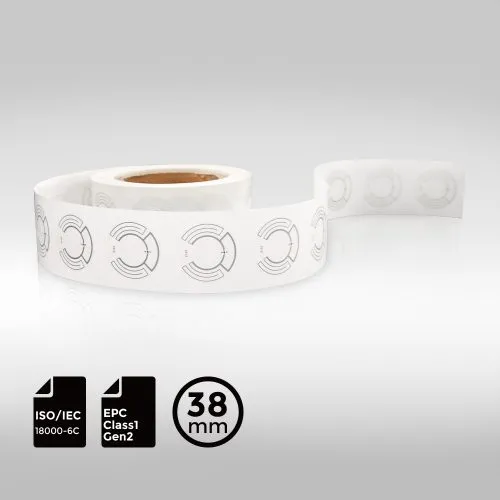
Alien Higgs® 9 PET RFID Round Wet Inlay

The Alien Higgs® 9 RFID round wet inlay is embedded with the advanced Alien Higgs® 9 chip to ensure high-precision reading, compliant to GS1 Class 1 Gen 2 and ISO/IEC 18000-6C, ensuring stable reading capability of the label in various environments. Achieve efficient tracking and management.
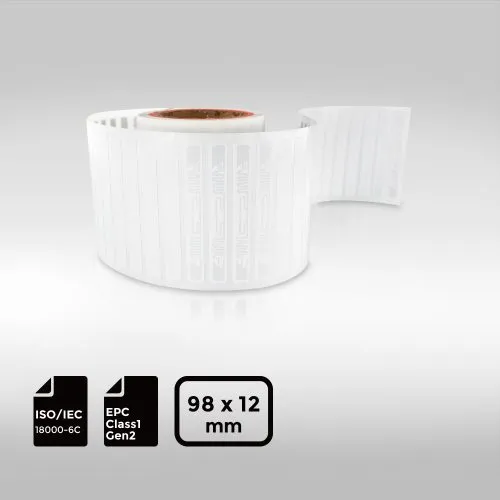
UHF RFID Label Alien Higgs® 9 98x12mm | ISO18000-6C
The Alien Higgs® 9 RFID self-adhesive label is embedded with the advanced Alien Higgs® 9 chip to ensure high-precision reading, compliant to GS1 Class 1 Gen 2 and ISO/IEC 18000-6C, ensuring stable reading capability of the label in various environments. It comes with self-adhesive label and can be easily installed without additional tools for efficient tracking.
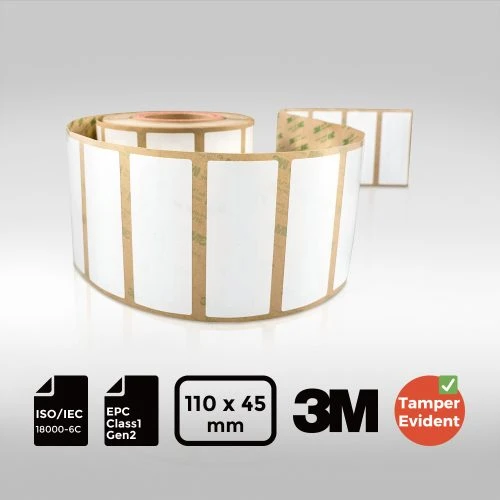
UHF RFID Windshield Label with Security Cuts 110x45mm | Alien Higgs® 9
The Alien Higgs® 9 RFID windshield label is designed to enhance your vehicle tracking capabilities. Embedded with the advanced Alien Higgs® 9 chip, the label compliant to GS1 Class 1 Gen 2 and ISO/IEC 18000-6C to ensure high-accuracy reading. Equipped with a strong and durable 3M467 adhesive, it provides a strong adhesion, perfectly combining security and efficient tracking. In addition, the label adopts a tamper-evident security cuts design, which cannot be used once removed to protect your information security.



