With the continuous development of medical testing technology, data accuracy and sample management efficiency have become the core issues of concern for hospitals and testing organizations. RFID (Radio Frequency Identification) technology, as a highly efficient, secure, contactless means of information collection and tracking, is changing how samples are managed in modern laboratories. This blog will provide an in-depth analysis of how RFID technology can enhance the accuracy and automation in any lab test now, focusing on a product designed specifically for laboratory environments: the AZL-SLIX-NLACR-LAB-4087 laboratory label. This label is our RFIDLabel’s professional-grade solution for laboratories, packaged with the industry-leading SLIX chip.
Challenges to Laboratory Sample Management
In traditional laboratory management, sample management and process control mostly rely on manual operation and paper records, which is prone to the following problems:
| Type of issue | Common occurrence |
| Mismatch of samples | Label paste error, handwriting blur, duplicate numbers |
| Different data | Barcode scanning failures, data entry delays |
| Non-transparent process | Difficulty in tracking samples from collection to reporting |
| Inefficient operation | Time-consuming search for samples, cumbersome statistical information |
| Frequent human errors | Forget to record, confusing operation, unclear process |
These problems not only affect work efficiency but also jeopardize the accuracy of test results and patient safety.
How Does RFID Technology Change the Medical Testing Process?
RFID is a wireless communication technology that can read and write data on labels without direct contact. It is an effective alternative to traditional barcodes and has the following advantages in the laboratory environment:
| Comparison dimension | Barcode | RFID Label(AZL-SLIX-NLACR-LAB-4087) |
| Reading Method | Requires scanner contact or alignment | Non-contact, supports batch reading |
| Readability | Vulnerable to contamination, scratching, blurring and failure | Anti-pollution, anti-corrosion, waterproof |
| Data capacity | Limited, can only store codes | Supports thousands of bytes of read and write data |
| Tracking Capacity | Cannot track location | Real-time tracking of location, time, usage history |
| Lifespan | Disposable, easily damaged | Multiple use, can work in extreme environments |
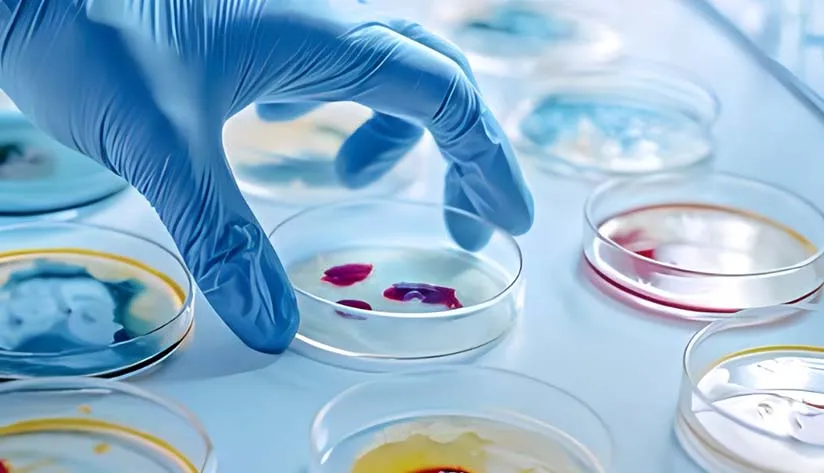
RFID in Medical Testing in Different Scenarios
1. Specimen Collection Stage: To Prevent Label Confusion
In the traditional specimen collection, manual writing or printing barcode is prone to identification errors or fall off, RFID labels have uniqueness and non-replicability, and have stronger environmental resistance, when the label is contaminated, scratched or refrigerated can still be accurately read, great reducing the collection of confusion and cross-infection risk.
Comparison between traditional tags and RFID labels in the collection phase.
| Comparison dimension | Barcode Label | AZL-SLIX-NLACR-LAB-4087 RFID Label |
| Information reading method | Visual/Scanning | No contact required, RFID inductive reading |
| Anti-pollution ability | Easily detached or blurred | Resistant to chemical corrosion, moisture and freezing |
| Operational efficiency | Medium | High-speed batch collection, automatic recording |
| Risk of confusion | High | Almost zero |
2. Laboratory Analysis Stage: Improve Tracking Accuracy and Operational Efficiency
Laboratory environments are characterized by high-precision equipment and automated processes, which require a high degree of data accuracy. RFID technology can work with automatic identification systems to achieve the following goals:
Automated sorting: Through the RFID reader to identify the test tube label information, the system automatically classified flow to the corresponding analysis module.
Temperature and time tracking: Used in conjunction with the temperature and humidity sensor module, real-time recording of sample status and uploading to the system.
Tracking the responsible person: Each reading can record the operator’s identity, forming a complete data chain.
List of advantages of RFID labels integrated with LIMS (Laboratory Information Management System).
| Integrated function | RFID System Integration | Traditional System |
| Automatic data entry | Yes | No |
| Traceability of operation logs | Yes | No |
| Sample partition management | Support for automation | Manual Management |
| Highly efficient abnormal alarm handling | Real-time notifications | Delayed Feedback |
| Ability to interface with laboratory robots | Strong | Weak |
3. Storage and Transportation Phase: The Whole Visualization of Cold Chain Tracking
Some samples need to be stored at low temperatures for a long period or transported to third-party testing organizations, and the visual management function of RFID labels combined with the sensing module can be used to monitor storage temperature fluctuations and avoid degradation of the samples:
Monitor storage temperature fluctuations to avoid sample degradation;
Record every storage/transportation operation point in time and relevant personnel;
Quickly take inventory to improve sample turnover efficiency;
Especially the AZL-SLIX-NLACR-LAB-4087 laboratory labels, with a temperature range of -20°C to +50°C and strong adhesion, can still read data stably even under low temperature or high humidity for a long time.
4. Report Generation and Sample Destruction: Closed-Loop Management to Eliminate Responsibility Blind Spots
RFID labels not only through the entire life cycle of the sample but also to promote the laboratory to achieve closed-loop tracking management:
Sample destruction records synchronized to the LIMS system;
Destruction operations are confirmed by RFID verification;
Automatic generation of complete disposal reports for compliance audits.
In the increasingly regulated global healthcare market (e.g. US FDA, EU IVDR), the adoption of RFID total process management can greatly enhance compliance.

AZL-SLIX-NLACR-LAB-4087 Laboratory Labeling Profile
- Product Name: AZL-SLIX-NLACR-LAB-4087
- Size: 40mm×8.7mm
- Antenna Size: 35mm×6.2mm (Narrowest single-side size antenna design in the ICODE series)
- Chip Type: NXP ICODE SLIX
- Material: nylon, acrylic adhesive (polymer chemical resistant labeling material)
- Environment: Low-temperature refrigeration (up to -20°C), chemical corrosion, high humidity
- Frequency Range: 13.56MHz (HF high frequency)
- Support Protocol: ISO 15693
- Read Range: up to 1.5 meters (depending on reader and environment)
The label is designed for laboratory sample bottles, blood bags, examination tubes, centrifuge tubes and other containers, supporting multi-point reading, real-time tracking and resistance to strong acid and alkali corrosion. The entire label is made of medical-grade material, so it can be applied in demanding labs like embryo culture.
AZL-SLIX-NLACR-LAB-4087 Application Scenario Analysis
1. Identification of Test Tubes and Sampling Bottles
Quick and accurate identification is critical during the sample collection phase. Traditional paper labels and barcodes are prone to peeling off or damage in humid or cold environments, resulting in loss of information.
Advantages of AZL-SLIX-NLACR-LAB-4087:
Labels are made of high-adhesive medical adhesive material, which can be firmly attached to curved surfaces, such as glass test tubes, centrifuge tubes, and plastic bottles;
Compact size can be customized as a round/oval shape, and will not block the sampling observation window;
Stable and readable in humid, alcohol-sterilized and frozen environments;
Each label has a unique ID code, avoiding sample confusion and cross-contamination.
2. Experimental Refrigerated Boxes and Sample Storage Management
A large number of samples in the laboratory need to be stored at low temperatures for a short or long period of time, and they need to be regularly inventoried and retrieved.
Advantages of AZL-SLIX-NLACR-LAB-4087:
Adheres to the surface of the refrigerated box and is suitable for a wide range of plastic, metal or foam materials;
Still be read normally even under harsh conditions such as frost and low-temperature condensation;
Support batch reading function, with RFID handheld devices, can be multiple storage box inventory at the same time;
After connecting with the LIMS system, it can quickly locate the position of samples and the remaining storage period.

3. Sample Transfer Box and Cross-Departmental Flow
In medical testing, samples often need to be transferred between departments or even across the region (eg: from the collection point to the third-party laboratory). Traditional paper labels cannot withstand frequent handling and harsh transportation environments.
Advantages of AZL-SLIX-NLACR-LAB-4087:
Adheres to the surface of the sample shipping box and can be used as a shipping container ID;
Can be combined with mobile RFID reader to realize sample flow track record;
Combined with NFC function to support cell phone APP scanning and reading, suitable for small collection points without special equipment;
UV sunscreen material can be selected to adapt to outdoor handling or light environment.
4. Safety management of high-risk samples
Some samples are bio-hazardous, such as infected blood, tumour tissues and so on. The management requires both safety and traceability.
Advantages of AZL-SLIX-NLACR-LAB-4087:
The label surface layer can be selected from impermeable and high-temperature sterilization-resistant materials, which can withstand autoclave treatment;
Label data support encryption and permission level reading to prevent unauthorized reading of information;
Each reading can be recorded, realizing “who moved the sample, when moved” full record;
Labels can be bound with the personnel identification card to achieve two-way matching between the sample and the responsible person.
5. Safety Management of High-Risk Samples
When the samples are used up, they must be destroyed in a compliant manner and complete records must be kept. Traditional manual record-keeping is time-consuming and error-prone.
Advantages of AZL-SLIX-NLACR-LAB-4087:
Labels record the time of destruction, the identity of the destroyer and the operating equipment;
Destruction data can be automatically scanned and recorded into the LIMS system through RFID;
Used in conjunction with disposable destruction equipment, the sample life cycle can be a closed loop;
All destruction records can automatically generate compliance reports for regulatory filing and quality audits.
In Summary:
| Application segment | AZL-SLIX-NLACR-LAB-4087 Core Values |
| Tube/bottle labeling | Strong, waterproof, unique ID to avoid mixing samples |
| Storage and refrigeration management | Resistant to low temperature, anti-corrosion, support batch inventory |
| Interdepartmental transfer tracking | Remote reading, full-process recording, cell phone scanning support |
| Hazardous Sample Safety | Encrypted reading and writing, anti-penetration, identity binding, compliance monitoring. |
| Sample Destruction and Archiving | Automatically generate records, improve audit efficiency, realize closed-loop management. |
Conclusion
With the increasing sophistication of medical testing, the efficiency and security of sample management a key factors in determining the quality of testing, and the use of RFID technology, especially high-performance lab labels such as the AZL-SLIX-NLACR-LAB-4087, is becoming the standard in the industry.
If you are looking for a reliable, secure, environmentally resistant and easy-to-deploy laboratory RFID tagging solution, contact us rfidlabel.com today to learn more.
Recommended Product
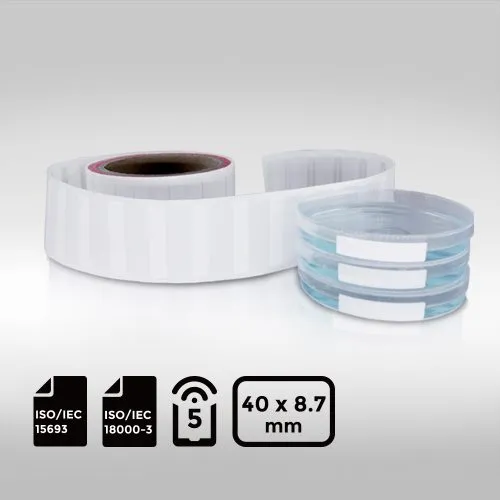
NXP ICODE® SLIX Lab Specimen Tracking RFID Label | 40×8.7mm

Track your laboratory samples using the NXP ICODE® SLIX RFID label, with an exceptionally compact height of just 8.7 mm, making it especially suitable for small laboratory containers. This label is made from medical-grade materials that provide excellent chemical corrosion resistance, and it uses acrylic adhesive for optimal adhesion, to meet the sample management needs of high-standard laboratory environments like embryo cultivation.