


With the rapid development of Internet of Things (IoT) technology, RFID (Radio Frequency Identification) solutions are widely used in various industries. As part of the RFID industry, STMicroelectronics, with its rich semiconductor experience and innovative technology, has launched the ST25TN series of chips. With its excellent performance, security and reliable communication capability, this series of chips is fully utilized in various fields such as smart cards, IoT, access control and so on. This guide will provide users with a detailed introduction of ST25TN series chips to help them fully understand the potential of this series of chips.
Overview of ST25TN series chips
The ST25TN series chips are integrated circuit products designed by STMicroelectronics specifically for NFC (Near Field Communications) and RFID. The chip provides reliable non-contact communication capabilities and is suitable for a variety of application scenarios that require high efficiency, security, and low power consumption. Whether it is smart cards, access control systems, or asset tracking and tag management in the IoT, the ST25TN chip can provide a stable and economical solution.
The design goal of the ST25TN series of chips is to support application scenarios that require strong performance and low power consumption. The chip adopts the ISO/IEC 14443 Type A standard, complies with the NFC Forum Type 2 label specification, and can operate stably at a frequency of 13.56 MHz. Its features include support for remote data reading and writing, low-power design, and data protection and encryption capabilities, making it suitable for RFID applications that require high security and long life.
Technical Principles of ST25TN Series Chips
The ST25TN series chips communicate contactless data with the reader and writer through the principle of electromagnetic induction. The antenna module integrated inside the chip generates induced current when interacting with the electromagnetic field of the RFID reader, supplies power and transmits data.
Key Technical Features:
| Operating frequency | 13.56 MHz |
| Storage Type | Non-volatile EEOROM/NVM, supports multiple reads and writes |
| Communication protocol | Supports ISO/IEC 14443 Type A protocol and is compatible with NFC Forum Type 2 |
| Energy consumption performance | Extremely low power consumption for passive(no power supply needed)applications |
| Reading range | Read ranges of a few centimeters to dozens of centimeters can be achieved in typical applications |
| Data transmission rate | Supports 106 Kbps data transfer speed to ensure smooth data transmission |
This design, based on electromagnetic induction and data encryption technology, ensures that the ST25TN series chips provide a secure and fast communication experience in NFC and RFID applications.
History and development of the ST25TN series chips
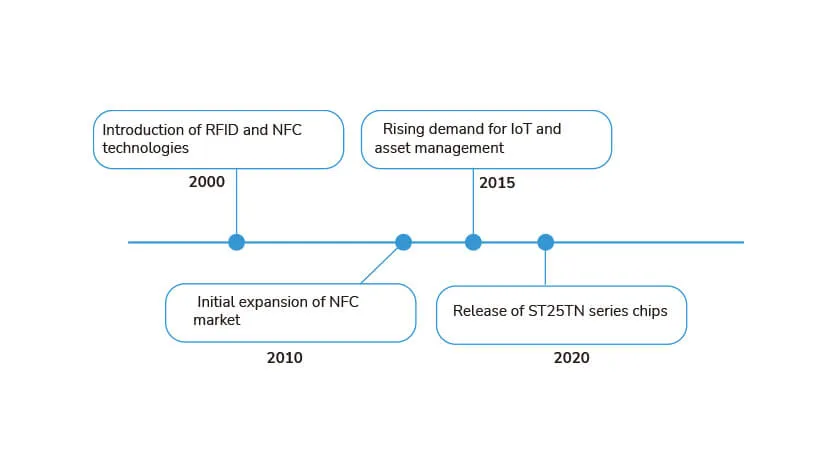
The history and development of the ST25TN series of chips can be traced back to STMicroelectronics’ long-term research and development accumulation in the fields of NFC and RFID, as well as the growing global demand for these technologies. The release of the ST25TN series marks an important milestone for STMicroelectronics’ continued innovation and progress in this field. The following are the key nodes in the historical development of the ST25TN series chips.
- Early stage: introduction of RFID and NFC technologies
Early 2000s: ST began to actively develop NFC technology, focusing on combining contactless communications with a variety of semiconductor applications, particularly in the areas of smart cards, access control and payments. ST’s NFC product line began to take shape during this phase, with partnerships with a number of leading technology companies around the world.
- Around 2010: Initial expansion of the NFC market
2010: ST introduced the first commercial NFC chips supporting smart cards, access control systems and contactless payment functions. This series of products was mainly applied to smartphones, transportation cards and e-ticketing.
At this stage, the main application scenarios of NFC were focused on smart payment and access control, and ST also began to gradually expand its technology to wider areas, such as contactless data communication for IoT devices.
- 2015: Increased demand for the Internet of Things and asset management
2015: ST introduced more miniaturized, low-power NFC chips, particularly suitable for asset tracking, logistics management and IoT end devices. Chips at this stage began to feature higher read ranges and more reliable communication stability.
This laid the technological foundation for the development of the ST25TN series, leading to ST’s NFC chips being able to meet future IoT needs, including large-scale data tracking and fast data interaction.
- 2020: Release of the ST25TN series chips
2020: ST officially launched the ST25TN series chips. This series of chips focuses on contactless communication, low-power operation and efficient data encryption. They comply with the ISO/IEC 14443 Type A standard and support the NFC Forum Type 2 label specification. This chip series is mainly aimed at NFC tags and RFID solutions and has performed well in areas such as smart home, logistics tracking, identity authentication and payment systems.
With its optimized energy efficiency design and enhanced data protection features, the ST25TN series has quickly become the preferred solution in many industries, especially those scenarios with strict requirements for data security and low power consumption.
Categories of ST25TN series chips

The ST25TN series of chips has a wide variety of chips, and each model has been optimized for different application scenarios and needs. This series of chips is mainly used for NFC and RFID applications and is especially suitable for smart tags, asset tracking, identity verification, payment systems and other scenarios. The following are the main types of ST25TN series chips and their functional characteristics.
1. ST25TN01K
The ST25TN01K is the base model in the ST25TN series, designed to meet the needs of basic NFC tagging applications with reliable performance and low power consumption for general asset tracking and smart tagging scenarios.
Main features
- Memory: 1024-bit EEPROM (programmable nonvolatile memory), enough to store a small amount of data and basic application information, such as item ID, product information, etc.
- Communication protocol: Comply with the ISO/IEC 14443 Type A standard and support the NFC Forum Type 2 label specification to ensure compatibility with most NFC readers.
- Security: Provides basic data protection functions for low-risk application scenarios.
- Application scenarios: Logistics, Product labeling, Asset tracking, Simple authentication.
2. ST25TN512
The ST25TN512 is the mid-range model in the series, designed for applications requiring higher storage space and security. Compared to the ST25TN01K, it offers improved data storage capacity and data protection features for scenarios that require more powerful data processing capabilities.
Main features
- Memory: 512-bit EEPROM, suitable for storing a medium amount of data, such as product serial number, production lot, expiration date and other information.
- Communication protocol: Still complies with ISO/IEC 14443 Type A standard, ensuring stable near-field communication capability.
- Anti-cloning function: Provides more advanced anti-cloning technology for high-value product tracking and authentication where counterfeiting needs to be prevented.
- Application scenarios: High-value asset tracking, Product anti-counterfeiting certification, E-ticketing, Smart packaging and consumer product labeling.
3. ST25TN01KB
The ST25TN01KB is a model designed for improved security and versatility and is suitable for application scenarios requiring a high degree of data protection. This model adds additional security features, such as more complex data encryption and access controls, ensuring it provides greater security in applications involving sensitive data.
Main features
- Memory: 1024-bit EEPROM, enough to handle more data information.
- Communication protocol: It also complies with ISO/IEC 14443 Type A standards and supports NFC Forum Type 2 tags.
- Security: In addition to the basic anti-cloning technology, the ST25TN01KB adds a higher level of data encryption and access rights control for applications involving sensitive data.
- Anti-interference capability: The enhanced anti-electromagnetic interference design allows the chip to maintain stable performance in complex environments.
- Application scenarios: High security access control, Intelligent payment system, E-passport and identity authentication, Medical device labeling.
4. ST25TN512B
The ST25TN512B is an upgraded version of the ST25TN512 with higher security and higher storage performance. It is particularly suitable for scenarios where data protection and communication stability are more demanding.
Main features
- Memory: 512-bit EEPROM, similar to the ST25TN512, but with higher write speed and data storage stability.
- Communication protocol: Comply with ISO/IEC 14443 Type A standard to ensure communication with all NFC-compatible devices.
- Security: Further, improved data encryption and anti-cloning capabilities allow it to withstand more complex attacks and data theft.
- Application scenarios: Enterprise-class authentication system, Access control in intelligent buildings, Financial transactions and payment cards, Security tracking and supply chain management.
5. ST25TN01K-P
The ST25TN01K-P is a low-power model designed for wearable and small IoT devices. This model emphasizes ultra-low power consumption and a miniaturized design, making it ideal for scenarios with stringent requirements for battery life and device size.
Main features
- Memory: 1024-bit EEPROM for storing basic data.
- Communication protocol: Supports the ISO/IEC 14443 Type A standard to ensure compatibility with existing NFC infrastructure.
- Extremely low power consumption: Specially optimized energy management technology ensures long-term operation in a battery-powered environment.
- Application scenarios: Wearable devices, Smartwatches and health tracker, Internet of Things sensors, Medical devices.
6. ST25TN512-P
The ST25TN512-P is a higher storage version of the ST25TN01K-P, featuring higher storage space while maintaining low power consumption characteristics for devices that need to store more data but still have power consumption requirements.
Main features
- Memory: 512-bit EEPROM provides medium-capacity data storage.
- Communication protocol: Support ISO/IEC 14443 Type A to ensure compatibility with existing NFC devices.
- Low power consumption: It is especially suitable for IoT devices and sensor applications that require power consumption.
- Application scenarios: Mini-labeling in asset management, Environmental monitoring sensors, Remote health monitoring devices. Smart home devices.
| Categories | Memory size | Power wastage | Security |
| ST25TN01K | 1024-bit | General | Basic protection |
| ST25TN512 | 512-bit | General | Anti-cloning technology |
| ST25TN01KB | 1024-bit | General | Enhanced encryption and access control |
| ST25TN512B | 512-bit | General | Advanced encryption and anti-cloning technology |
| ST25TN01K-P | 1024-bit | Low | Basic protection |
| ST25TN512-P | 512-bit | Low | Basic protection |
Performance and Advantages of ST25TN Series Chip

1. Efficient Data Communication
The ST25TN series chips support the ISO/IEC 14443 Type A standard, one of the most widely adopted NFC/RFID communication protocols in the world, ensuring compatibility with existing card readers and NFC devices.
- Data Transmission Rate: Supports data transfer rates up to 106 kbps, enabling fast and efficient handling of high-volume communication needs.
- Low Latency: Extremely low communication latency ensures real-time data reading and writing operations, especially in high-speed processing and transaction scenarios.
- Stability: The ST25TN chip maintains stable data transmission in a variety of complex environments, whether in industrial warehouses, smart homes, or outdoor environments, the chip can provide stable communication performance.
- Wide compatibility: Compatible with most NFC and RFID infrastructures, the ST25TN chip is universal in the global market and can be seamlessly integrated with existing devices.
- Adaptable to a wide range of application environments: High-speed transmission and low latency make it especially useful in logistics tracking, identity authentication, product anti-counterfeiting and other scenarios that require rapid data exchange.
2. Low power design
In many NFC and RFID applications, power consumption is a key factor affecting long-term system stability, especially in the IoT and wearable devices. The ST25TN series chips feature an advanced low-power design that allows them to extend the service life of devices in a battery-powered environment.
- Ultra-low power consumption: The ST25TN chip is optimized to have low energy consumption in standby and working modes, making it especially suitable for battery-powered equipment for long-term use.
- Power management: The chip has built-in intelligent power management functions, which can dynamically adjust power consumption based on actual communication needs to further save energy.
- Extend device life: In wearable devices, IoT sensors and asset tracking tags that require long-term operation, low-power performance significantly extends the device’s battery life.
- Environmental benefits: Low-power design not only helps reduce energy consumption but also supports application scenarios that use renewable energy to power, which is in line with current sustainable development trends.
3. Storage capabilities and data management
The ST25TN series chips are available in a variety of models with different memory sizes and are suitable for different data storage needs. Through efficient memory management, these chips can read and write data quickly and reliably, ensuring data integrity and security.
- EEPROM storage: The ST25TN chip uses EEPROM storage technology and provides storage capacity from 512 bits to 1024 bits, meeting needs from simple identification to complex data processing.
- Fast write and read: EEPROM storage technology supports fast read and write operations and performs well in scenarios where frequent data updates are required.
- Flexibility: Available in multiple memory capacity options, allowing it to meet the needs of different applications, whether it’s small product tags or large asset management systems.
- Data persistence: The durability and stability of EEPROM storage ensure long-term reliable data retention, suitable for important identity authentication and asset tracking applications.
4. Enhanced Security
Data security is a core requirement in RFID and NFC applications, especially in scenarios involving payment, authentication, and anti-counterfeiting, and the ST25TN series chips have multiple security measures built in to ensure secure data transmission and storage.
- Anti-cloning technology: The ST25TN family of chips utilizes advanced anti-cloning technology to prevent the duplication and counterfeiting of counterfeit tags, ensuring system security and integrity.
- Data Encryption: Advanced models (e.g. ST25TN01KB) provide enhanced data encryption and access control features to prevent unauthorized access and data tampering.
- Tamper-resistant: The chip is tamper-resistant, detecting and blocking data manipulation attempts to tamper with the tag or chip.
- Secure Authentication: The high-security performance of the ST25TN family of chips makes them the first choice for customers in payment systems, access control and authentication scenarios.
- Protecting intellectual property and brands: Anti-cloning technology ensures that brands can effectively protect their intellectual property and avoid damage to their brand image from counterfeit products.
5. Durability and Reliability
The ST25TN series chips are made of high-quality materials and designed to ensure that they can still work stably in various harsh environments. Whether it is high temperature, low temperature, humidity or electromagnetic interference environment, ST25TN chips can maintain their performance stability.
- Anti-EMI: The ST25TN chip has been specially designed to have excellent anti-EMI capability, which is suitable for use in industrial scenarios or environments with strong EMF interference.
- Temperature resistance: The chip can work under extreme temperatures, adapting to the operating temperature range of -40°C to 85°C.
- Wide range of application scenarios: The ST25TN series of chips are stable at high and low temperatures, as well as in humid environments, ensuring their reliability in the industrial, medical and consumer electronics sectors.
- Long service life: Thanks to the durability of its materials and stable performance, the ST25TN chips can provide long-term stable service in a variety of harsh environments.
Comparison of ST25TN series chips with other chips
The ST25TN series chips have excellent performance in the RFID and NFC fields. To help users understand its advantages, the following is a detailed comparison between the ST25TN series chips and other RFID/NFC chips in the market. We will compare these chips in multiple dimensions, including communication protocols, data transfer rates, power consumption, security, storage capacity and application scenarios, in order to more intuitively understand the different characteristics of each chip.
| Comparative factors | ST25TN series chips | NXP MIFARE Ultralight® | Impinj Monza R6-P | NXP MIFARE Classic® | Alien Higgs 3 |
| Communication protocol | ISO/IEC 14443 Type A | ISO/IEC 14443 A | ISO/IEC 18000-6C | ISO/IEC 14443 A/B | ISO/IEC 18000-6C |
| Data transmission rate | 106 kbps | 106 kbps | Up to 640 kbps | 106 kbps | Up to 640 kbps |
| Power consumption | Low | Moderate | High | Moderate | Moderate |
| Memory capacity | 512-bit to 1024-bit | 512-bit | 128-bit to 2048-bit | 1KB to 4KB | 96-bit to 512-bit |
| Security | Anti-cloning, anti-tampering, encryption support | Basic encryption | Password verification | AES and DES encryption | Basic password authentication |
| Application scenarios | IoT, identity verification, logistics tracking | City transportation card, access control | Logistics, retail inventory management | Transportation card, access control, payments | Low cost asset management, supply chain |
Security analysis of ST25TN series chips

1. Data encryption and anti-cloning mechanism
The ST25TN series chips are equipped with advanced encryption technology to ensure that data will not be illegally intercepted or tampered with during transmission.
- Data encryption support: The chips support a variety of encryption protocols, such as AES encryption (Advanced Encryption Standard), which is used to protect the data stored in the chip. This encryption mechanism ensures that even if the data is intercepted, an attacker cannot read or decrypt the information.
- Anti-cloning technology: The ST25TN chip is equipped with an anti-cloning feature that prevents attackers from forging identities by copying tags through a unique chip identifier (UID) and encryption algorithm. This is crucial for payment systems, identity verification and other scenarios that require high security.
2. Read and write protection
The ST25TN series chips provide read and write permission control, which can be set to read-only, write-only, or have both read and write functions. This access control can be managed through encrypted keys, ensuring that only authorized persons or devices can access or modify data on the chip.
- Read-only mode: Prevent unauthorized modifications, especially when using tags for authentication or asset management, ensuring the integrity of information.
- Password protection: Access to the chip is restricted through password verification. This verification is not only suitable for reading and writing data but can also be used to access different storage areas of the chip.
3. Tamper resist feature
The ST25TN series chips have tamper-resistant protection mechanisms that detect any unauthorized physical or electronic attempt to tamper with data.
- Payment and access control: Ensure that data remains intact and cannot be tampered with even if physical tags are illegally touched or attempted to be modified.
- Asset management: For high-value assets that require long-term tracking, tamper-proof features protect the integrity of RFID tags and ensure that information is not altered during transportation or storage.
4. ISO/IEC 14443 Type A Protocol Security
The ST25TN series chips utilize the ISO/IEC 14443 Type A protocol, which is a global standard widely used in payment, access control and authentication scenarios.
- Cryptographic Key Management: The ST25TN chips support a sophisticated key management system that ensures the chips can securely store and exchange keys during multiple operations.
- Anti-interference and Man-in-the-Middle Attack: Through unique authentication algorithms and protocol design, the ST25TN chip is able to effectively resist a Man-in-the-Middle attack, ensuring that the communication between the chip and the reader will not be intercepted or tampered with by a third party.
5. Data integrity and eavesdropping protection
The ST25TN series chips are also designed with special considerations for data integrity and anti-eavesdropping protection. The chip will verify during the data transfer process to ensure that the data has not been modified or damaged. At the same time, anti-eavesdropping technology is used to ensure that information will not be intercepted or monitored by unauthorized devices during short-range wireless communications.
- Anti-eavesdropping design: Wireless transmission of RFID and NFC is vulnerable to eavesdropping attacks in an open environment. The ST25TN chip prevents unauthorized devices from monitoring communication data through encryption and transmission protocols to ensure data security.
- Data verification mechanism: All transmitted data will be confirmed through a verification algorithm to ensure that the data has no errors or has been tampered with during transmission and to protect the integrity of the data.
6. Flexibility of security architecture
The ST25TN series chips show a high degree of flexibility in security architecture. It can configure different levels of security protection measures according to the needs of different application scenarios.
- Lightweight security: Suitable for common applications that do not involve sensitive data, such as simple inventory management and item tracking.
- Advanced security mode: Suitable for demanding application scenarios such as payment systems, access control and authentication. This model uses more complex encryption and authentication algorithms to ensure the highest level of security.
Conclusion
The STMicroelectronics ST25TN series chips are leading products in the RFID and NFC market due to their efficient performance, low-power design, excellent security and wide range of application scenarios. For organizations in hospitality, retail, logistics, access control and other fields, choosing the ST25TN series chips will bring them smarter management and more efficient operations.
If you are interested in RFID solutions or have any questions, please feel free to contact RFIDLabel, we will provide you with the most professional consultation and support.
Recommended Product
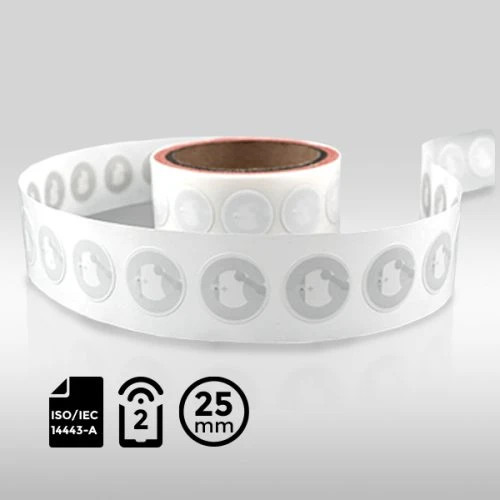
ST25TN01K NFC Label ⌀25mm ISO14443A

Unlock advanced NFC capabilities with our 25mm NST25TN01K NFC Label. Featuring TruST25 digital signature and Augmented NDEF for dynamic messaging, this label offers unparalleled security and flexibility. Compliant with ISO14443A and NFC Forum Type 2 standards, it includes EEPROM for native tap with NFC-enabled phones and a kill feature for user privacy.



