As RFID technology has gained widespread popularity around the world, RFID has changed the way people used to live and work. Whether it is logistics and warehousing, manufacturing, healthcare, retail industry, etc.. They are all affected by RFID technology. However, RFID technology can play a role in this application field, depending on its working frequency band because different working frequency bands will have different reading ranges, data transmission rates and application scenarios. Enterprises then need to know enough about the RFID frequency range when deploying RFID. This blog will delve into the common RFID frequency ranges as well as its advantages, disadvantages, and application scenarios.
Introduction of RFID Frequency
First of all, there are two key parts in the RFID system. One is an RFID label and the other is an RFID reader. Among them, the RFID chip and antenna are embedded in the RFID tag. RFID readers use radio waves to realize data interaction with labels. More importantly, the operating frequency of radio waves determines the communication methods and characteristics of the RFID system.
Generally speaking, RFID systems are mainly divided into the following three types: LF RFID, HF RFID, and UHF RFID. The operating frequency of LF RFID is 125kHz-134.2 kHz. The operating frequency of HF RFID is 13.56MHz. The operating frequency of UHF RFID is 860MHz-960MHz.
Low Frequency RFID: 125kHz – 134.2kHz
Characteristics
LF RFID is usually maintained between 125 kHz and 134.2 kHz. Because of the low operating frequency, the reading range of LF RFID is relatively limited. Its reading range generally does not exceed 10 centimeters. Although LF RFID has a relatively small reading range, it has excellent anti-interference capabilities and can penetrate liquids metals and other media. Therefore, in some specific application scenarios, LF RFID can have excellent performance.
Advantages
First of all, LF RFID is not easily interfered with by environmental factors. For example, environments with metals or liquids. Secondly, the manufacturing cost of LFRFID is relatively low, making it a cost-effective RFID solution.
Disadvantages
Regarding the disadvantage of LF RFID, the most direct one is that its reading range is the smallest compared to other operating frequency bands. It can only be used in close distance applications. In addition, its data transmission rate is also relatively low. If users need to transmit a relatively large amount of data, LF RFID will not be an ideal solution for users.
Application scenarios
LF RFID is widely used in fields such as animal identification, access control and car theft prevention systems. For example, the identity tags of pets and livestock usually use LF RFID labels. This label ensures data stability and reliability. In addition, most of the RFID chips in car keys also use the LF band to avoid interference from metal bodies on communication signals.
High Frequency RFID: 13.56MHz
Characteristics
The operating frequency of HF RFID is usually maintained at 13.56 MHz. Compared with LF RFID, HF RFID has a larger reading range. Its reading range is between 10 centimeters and 1 meter. In addition, the data transmission rate of HF RFID is also faster than that of LF RFID. Although HF RFID also has certain anti-interference capabilities, it is also limited by environmental factors.
Advantages
In addition to supporting faster data transmission rates, HF RFID also has a moderate reading range. Therefore, HF RFID can be used in most application scenarios.
Disadvantages
When HF RFID is used in environments with metals and liquids, its performance will degrade.
Application scenarios
Areas such as library management, public transportation cards and electronic ticketing systems are the main application scenarios of HF RFID. For example, NFC technology is one of the special applications of HF RFID. NFC technology can not only be used for non-contact payments but also enables data interaction between smartphones and other devices. In addition, one of the important applications of HF RFID is electronic passports. Nowadays, more and more countries have embedded HF RFID chips in their passports. Specially used for identity verification and immigration management.
→ Learn more about high frequency RFID label
Ultra-High Frequency RFID: 860MHz – 960MHz
Characteristics
The operating frequency range of UHF RFID is generally maintained between 860 MHz and 960 MHz. In these frequency bands, UHF RFID has an excellent reading range, and this reading range can reach several meters or even ten meters. Also, the transmission rate of UHF RFID will be higher than the other two operating frequencies. So it is ideal for reading and writing large amounts of data quickly.
Advantages
Because UHF RFID has a relatively large reading range, it can be used for large-scale asset tracking. In addition, UHF data transmission rates are relatively high. It can process a large amount of tag data in a short time.
Disadvantages
Compared with the other two operating frequencies, UHF RFID is most susceptible to interference from environmental factors such as metals and liquids. Under the interference of environmental factors, the performance tags of UHF RFID will be seriously affected. The deployment and debugging of UHF RFID systems are also relatively more complex and require more comprehensive and detailed technical support.
Application scenarios
UHF RFID is widely used in logistics management, supply chain tracking and retail inventory management. For example, many large retailers use UHF RFID technology to achieve real-time monitoring of inventory and rapid inventory of goods. In addition, UHF RFID is also widely used in airport baggage tracking systems, helping airlines improve the accuracy and efficiency of baggage processing.
→ Learn more about Ultra-High frequency RFID label
Conclusion
Nowadays, RFID plays a vital role in different applications. the operating frequency of RFID is the main factor that determines the performance and application. Users can only improve the efficiency of their operations if they fully understand and choose the right RFID frequency band. At the same time, enterprises can also get better benefits. In the future, with the innovation of RFID technology, RFID will show unprecedented potential and prospects in more fields. It is hoped that through the comprehensive introduction of the RFID frequency range in this blog, users can have a deeper understanding of the characteristics of different frequency bands and their application scenarios.
After reading this blog, if you are interested about our RFID technology, you can visit our official website (www.rfidlabel.com) to research more information. If you want to get solutions for RFID technology, please contact our sales experts, who will provide you with the suitable solutions and professional purchase suggestions according to your needs.
Recommended Product
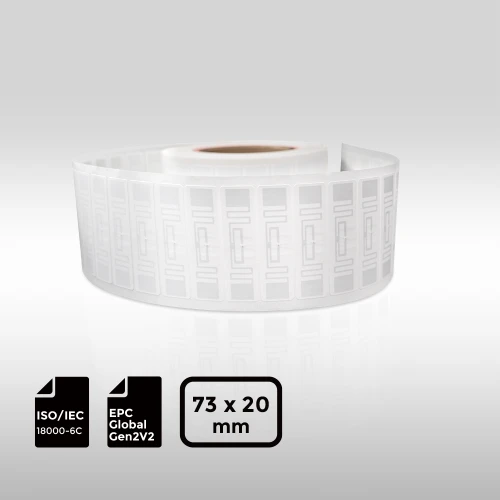
UHF RFID Label Impinj® M730 73×20mm | ISO18000-6C

The M730 RFID Label is a high-performance, versatile label designed for various industrial and commercial applications. Leveraging the advanced Impinj® M730 chip, this label enables solutions for high-speed inventory counting, loss prevention, frictionless self-checkout, and seamless product returns. With a range of EPC and user memory configurations, including cryptographic authentication capabilities, the M730 RFID Label provides unparalleled versatility and security for diverse applications.