


As more and more companies are now embarking on the digital and intelligent transformation path, RFID, as the main tool for enterprise transformation, has changed the overall operational efficiency and cost expenditures of enterprises. Among them, passive RFID labels have become an ideal choice for most companies because of their high-cost performance, long service life and high flexibility. Nowadays, more and more companies want to deploy passive RFID labels, so how to successfully deploy them within the enterprise will be a relatively complicated process. This blog will provide a comprehensive explanation of how users can successfully deploy passive RFID labels in their enterprises to help them achieve their goals.
Overview of passive RFID labels
When companies prepare to deploy passive RFID labels, they need to fully understand the principles of passive RFID labels. First of all, the passive RFID label is not equipped with a power supply inside but is activated by the electromagnetic induction generated by the reader. When the chip inside the label is activated, the label will transmit the internally stored data information and signals back to the reader.
Because passive RFID labels need to rely on external conditions for power supply, their reading range is relatively short. This reading range is usually maintained between a few centimeters and more than ten meters.
Evaluate business requirements and application scenarios
Before deploying passive RFID systems, enterprises need to evaluate them based on their actual business needs and application scenarios. Whether it is inventory management, asset tracking and flow monitoring. Different application scenarios require different types of RFID systems.
- Inventory management: To ensure that RFID labels are accurately identified and tracked in complex warehouse environments, companies should have ultra-high frequency labels with excellent anti-interference performance.
- Asset tracking: For high-value or important assets, use durable and tamper-resistant labels.
- Flow monitoring: The reading range and coverage area of the label will be key to regulating the flow of goods.
Select the right RFID labels and devices
There are many types of passive RFID labels. They vary in terms of materials, label size, operating frequency and functionality. When selecting labels, companies should fully consider the actual application scenarios and also consider the interference of environmental factors such as temperature, humidity, and metal interference.
- Label material: Select the appropriate label material according to the surface material to which the label will be attached. For example, for metal surfaces, specially designed anti-metal interference labels can be selected.
- Working frequency: Select the appropriate frequency band according to the application scenario. Ultra-high-frequency labels are usually suitable for scenarios that require long reading distances, while high-frequency labels are more suitable for close-range, high-security applications.
- Label size: When deploying in limited spaces or small items, you need to choose a label that is small and easy to hide.
Optimize labels and readers placement
To ensure that passive RFID systems are in optimal performance, the arrangement of labels and readers will be crucial.
- Label location: The label should be placed in a position where signals can easily be transmitted to avoid being blocked by interfering objects such as metals and liquids. If possible, the label should be oriented towards the reader’s antenna as far as possible.
- Reader position: Reasonably arrange the position and angle of the reader according to the position and movement path of the label to ensure stable signal transmission. Especially in large warehouse or factory environments, reader coverage and layout angles require detailed planning and testing.
- Avoid interference: Try to avoid sources of interference that may affect the performance of the RFID system, such as other wireless devices, large metal structures, or high-voltage devices. When necessary, shielding measures can be used to reduce external interference.
Conduct pilot testing and optimization
Before large-scale deployments, companies should conduct pilot tests to verify the performance of RFID systems. By testing on a small scale, you can retrieve whether there are potential problems and make timely adjustments.
- Test read rate: Test the read rate of labels in the actual operating environment to ensure that the system can stably identify and read labels. If low reading rates are found in certain locations, you can adjust the placement of the labels or readers.
- Adjust parameters: Adjust the power of the RFID reader, antenna angle and label placement position based on the test results to achieve the best performance.
- Optimize system settings: Data collected during pilot testing can be used to further optimize system settings, such as adjusting the operating frequency of the reader, the coding method of labels, etc.
Conclusion
All in all, deploying passive RFID labels can bring many advantages to enterprises. For example, the improvement of overall operational efficiency, the avoidance of human error, and the improvement of asset tracking capabilities. However, it is by no means easy for companies to successfully deploy passive RFID systems. Only through comprehensive planning and reasonable practice can enterprises successfully deploy and fully utilize its potential and functionality. Even in this fierce market environment, we can maintain excellent competitiveness. In the future, with the continuous improvement of RFID technology. Passive RFID labels will provide additional assistance to enterprises ‘intelligent and digital transformation.
After reading this blog, If you are interested about passive RFID label, you can contact our sales experts, who will provide you with the suitable RFID solutions and the professional products purchase advice according to your needs. Also, you can also visit our official website (www.rfidlabel.com) to browse the relevant information.
Recommended Product
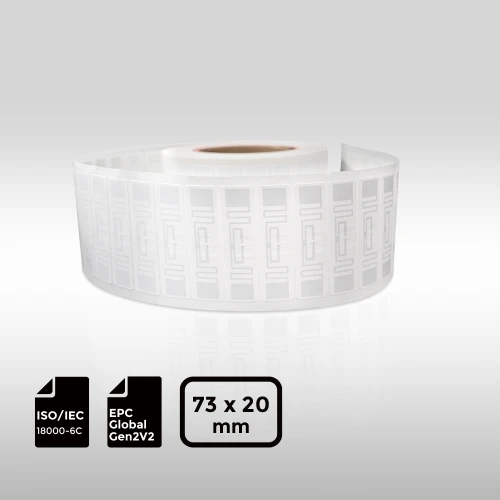
UHF RFID Label Impinj® M730 73×20mm | ISO18000-6C

The M730 RFID Label is a high-performance, versatile label designed for various industrial and commercial applications. Leveraging the advanced Impinj® M730 chip, this label enables solutions for high-speed inventory counting, loss prevention, frictionless self-checkout, and seamless product returns. With a range of EPC and user memory configurations, including cryptographic authentication capabilities, the M730 RFID Label provides unparalleled versatility and security for diverse applications.



