Nowadays, people are promoting the concept of environmental protection and sustainable development, and various industries are constantly exploring more environmentally friendly technological solutions. RFID technology, as a major tool used by modern enterprises for inventory management and asset tracking functions, is also facing challenges and questions caused by environmental issues. Although RFID technology has the potential to risk environmental issues, it has significant positive implications for the sustainability of businesses. This blog will provide an in-depth discussion of the environmental impact of RFID labels and how to reduce the negative impact on the environment and achieve green technology.
What is the environmental impact of RFID label?
RFID labels are made up of three main components, which include the RFID chip, the antenna and the substrate. RFID chips are usually made of silicon. The antenna, on the other hand, uses metallic materials such as silver, aluminum and copper. In addition, the substrate material is usually coated paper, plastic or other composite materials. The use, production and disposal of these materials can have an impact on the environment.
Production and consumption of materials
The production of RFID labels involves the use and processing of different materials. For example, the silicon material used to manufacture chips needs to be extracted from quartz sand. On the other hand, the mining and refining of metals such as copper and aluminum can have a negative impact on the environment. Notably, the process of making composite materials such as plastics can involve the petrochemical sector, adding to the burden and carbon emissions on our environment.
Energy consumption during the use phase
Although RFID labels themselves don’t use a lot of energy, the readers and back-end processing systems we use to activate the tags use electricity to run them. So while RFID technology is widely used, the energy it generates can also have an impact on the environment.
Waste disposal issues
When an RFID label reaches the end of its useful life, it becomes e-waste. For some labels that use metal or plastic, they cannot be degraded in post-processing. Once improperly handled, they will bring a certain degree of negative impact on the environment.
How to reduce the environmental impact of RFID label?
Although RFID labels may have some negative environmental impacts in terms of production, use and disposal, these negative impacts can be significantly reduced with the advent and optimization of innovative technologies. The following are specific strategies for reducing the environmental impact of RFID labels:
Using recyclable materials
The most significant way to reduce the environmental impact of RFID labels is to use recyclable or biodegradable materials. For example, paper or other biodegradable materials are used instead of plastics and metals. In addition, switching to environmentally friendly inks and non-toxic adhesives can also help reduce environmental pollution.
Increasing label durability
By enhancing the durability and extending the life of the labels, the frequency of label replacement can be effectively reduced. This will not only reduce the generation of e-waste. Improving the manufacturing process and design of the labels to ensure that the labels can have excellent performance in complex environments. Thus, the label can be reused for a longer period.
Promoting circular economy
The key to solving the e-waste problem is recyclable and reuse of RFID labels. More and more enterprises are gradually starting to carry out label recycling program. They reclassify and disassemble some of the discarded tags and recycle the valuable materials of the labels. This kind of circular economy effectively reduces the waste of resources and can also bring additional economic benefits for enterprises.
Application of green energy
Businesses should utilize renewable energy sources to reduce their overall carbon footprint when using RFID systems. Examples include renewable energy sources such as solar and wind power. These renewable energy sources can be applied to the energy consumption of RFID readers and back-end processing equipment.
How does RFID technology support sustainable development?
RFID technology not only contributes to reducing the negative impact on the environment but also promotes sustainable business development by improving operational efficiency and reducing waste of resources.
Improve operational efficiency
RFID technology can help businesses to better manage their inventory and track items. This allows businesses to avoid wasting resources due to overproduction. For example, retailers can use RFID labels to regulate the inventory of goods and effectively control the quantity of stock. This reduces the likelihood of resource wastage based on avoiding redundancy or expiry of stock items.
Reduce carbon footprint
Through the use of RFID technology in the logistics and transport industry, transport routes and transport efficiency can be optimized. This reduces carbon emissions and fuel consumption generated by logistics transport. On the other hand, based on reducing the backlog of logistics inventory and improving the efficiency of logistics work, helps logistics enterprises to rationally arrange energy consumption and storage space.
Support circular economy
Using RFID labels, companies can better track and manage their products. Through the recycling and reuse of products, the impact on the environment can be effectively reduced. For example, in the production and recycling of electronic products, RFID labels can help companies identify and classify products for subsequent product recycling.
Conclusion
Although RFID labels play a key role in modern business, their impact on the environment cannot be ignored. By significantly reducing the negative impact of RFID labels on the environment, we can make a sustainable contribution to environmental protection and sustainable development. In the future, with the innovation of RFID technology and the improvement of the production process, RFID labels can make a greater contribution to the environment while achieving business goals for enterprises. So RFID technology is not only a modern management tool but also an important driving force towards green technology.
After reading this blog, if you are interested about our environmental RFID labels, you can visit our official website (www.rfidlabel.com) to find out more information. If you want to get solutions for environmental RFID labels, please contact our sales experts, who will provide you with the suitable solutions and professional purchase suggestions according to your needs.
Recommended Product
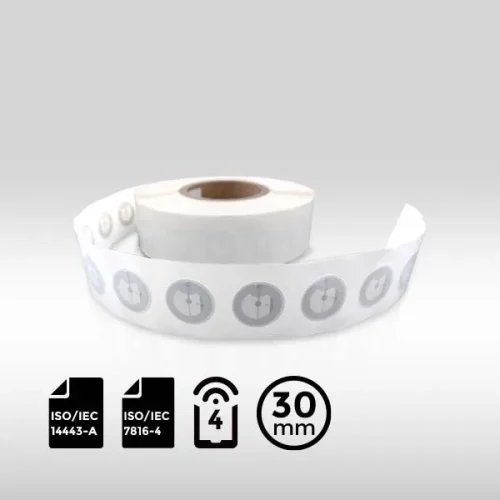
NXP NTAG® 424 DNA Coated Paper NFC label Ø30mm

The NXP NTAG® 424 DNA Eco-Friendly Adhesive NFC label features a sustainable construction with FSC-certified thin coated paper. It uses RPC5 adhesive for strong bonding and is backed by white Glasine C5-FSC liner, making it an environmentally friendly choice for NFC applications without compromising performance or durability.