RF cable connectors play an important role in radio frequency identification (RFID) systems. RF cable connectors play a crucial role in connecting the antenna and reader, ensuring stable and efficient signal transmission. They also directly impact the performance of the entire system and the service life of the equipment. The purpose of this article is to provide comprehensive guidance to help you understand the importance of choosing the right RF cable connector types and how to make informed decisions.
What is an Rf cable connector?
Before we understand the Rf cable connector, we can know what the cable is.
A cable serves as a transmission medium for high-frequency signals. It comprises an inner conductor, an insulating layer, an outer conductor, and an outer sheath. In the RFID system, cables connect the antenna and the reader, transmitting signals from the reader and receiving signals from the tag.
Rf cable connectors are a kind of connectors used to connect cable lines. They usually have connectors and connections that match the cable lines to ensure the quality and stability of signal transmission. The Rf cable connector can connect the cable to the antenna or reader, allowing signals to be transmitted between devices
Common RF Rf cable connector types
- BNC connector
This kind of connector is renowned for its quick connection and disconnection. It is suitable for video signal transmission, test equipment, and broadcasting systems. Because of its ease to use, it has been widely used in these fields.
- SMA connector
SMA connectors have excellent high-frequency performance and are suitable for wireless networks, communication equipment, and microwave systems. Its compact design gives the SMA connector an obvious advantage in the case of limited space.
- N-type connector
N-type connectors are highly regarded for their durability and low loss. They are suitable for wireless communications, radar, and microwave systems. In high-power and outdoor environments, N-type connectors can maintain stable performance.
- TNC connector
The TNC connector adopts threaded connection mode and has excellent anti-vibration performance. This makes it widely used in mobile devices, communication equipment, and industrial applications.
- UHF connector
Suitable for low-frequency and high-power applications, such as radio communications and broadcasting systems. UHF connectors are easy to install and use, providing convenient signaling solutions for these areas.
- MCX and MMCX Connector
These two connectors are known for their compact design and are suitable for space-constrained situations such as mobile devices, GPS systems, and RF modules.
- F-type connector
F-type connector adopts thread connection mode, which is widely used in cable TV and satellite TV connections. In-home and commercial TV systems, F-connectors are very popular because of their wide applicability.
The types of RF Rf cable connectors commonly used in RFID systems are N connectors, SMA connectors, TNC connectors, UHF connectors, and BNC connectors.
How to choose the appropriate RF cable connection types
When selecting the appropriate Rf cable connector, the following factors need to be considered:
- Working frequency of RFID system: different types of connectors are needed at different frequencies to ensure the quality of signal transmission. Common frequencies include low frequency (LF), high frequency (HF), ultra-high frequency (UHF), and microwave band.
- Signal transmission power: a connector that can withstand the power required by the system needs to be selected to ensure the stability and durability of the connector. In general, high-power applications require connectors that can withstand high power.
- Environmental requirements: select the connector with corresponding protective performance according to the actual installation environment. For example, connectors with the characteristics of waterproof, dustproof, and high-temperature resistance need to be selected in outdoor or harsh environment.
- Frequency of cable disconnections and connections: Frequency connections and disconnections require the selection of a durable and easy-to-operate connector type to ensure the life and stability of the connector.
- Cable length: different lengths of cables require different types of connectors to ensure the stability of signal transmission. Longer cables may require low-loss connectors and cables to reduce signal attenuation.
Product Recommendation: UHF RFID 5 meter cable and UHF RFID 15 meter cable
In the practical application of RFID systems, such as large warehouses, logistics centers, large activity places, and parking lots, it is usually necessary to install antennas and RFID readers far apart to achieve wider tag coverage and more stable reading performance. These RFID system application scenarios usually use UHF readers and antennas of 5dbi, 9dbi, and 12dbi.
Our 5-meter cable and 15-meter cable are suitable for UHF RFID readers and have their own TNC interface, which can be directly connected to readers and antennas. They have the following characteristics:
- Wide applicability: both cables are suitable for UHF RFID systems and are compatible with antennas with different gain values to meet the needs of various application scenarios.
- Stable performance: built-in TNC interface, closely connected with the reader and antenna, high signal transmission efficiency, and good stability.
- Reliable quality: made of high-quality materials, durable, even in the case of frequent connection and disconnection can maintain good performance.
- Flexible and convenient: different lengths of cable selection, convenient for users to flexibly match according to the actual needs, to achieve the best RFID system coverage effect.
The 5m cable is suitable for antennas with 5dbi gain. In small or medium-sized warehouses, logistics centers, and other places, the length of this cable is moderate, which can effectively ensure the performance of the RFID system.
The 15m cable is suitable for use with 9dbi and 12dbi high-gain antennas. In large warehouses, logistics centers, and other places that need more coverage, this long cable can ensure stable signal transmission, while the built-in TNC interface is highly matched with readers and antennas, reducing the possibility of signal attenuation and interference.
Conclusion
Choosing the right RF cable connector is critical to the success of the RFID system. Making wise decisions according to the performance characteristics of connectors and application scenarios will help to ensure the stable and efficient operation of the RFID system. If you have any questions or need advice about choosing RF cable connectors, please feel free to contact us.
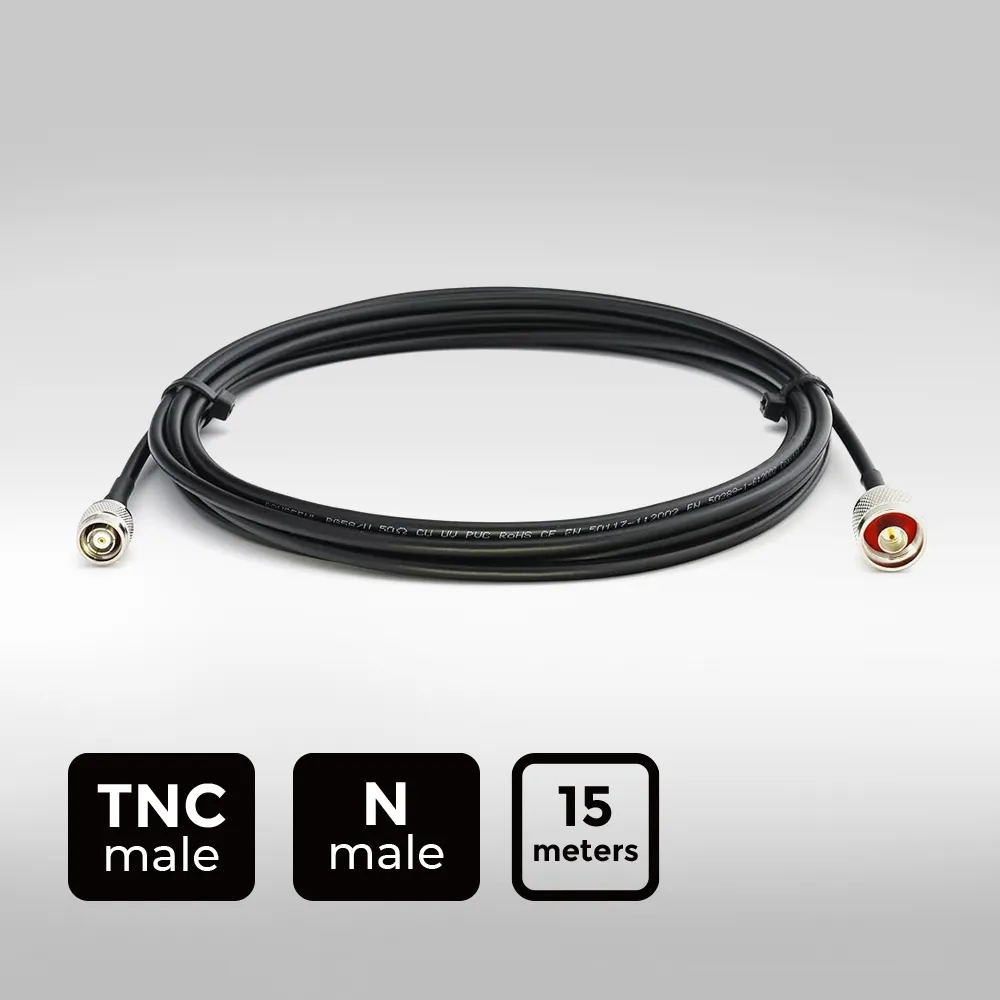
15-Meter Cable for UHF RFID Fixed Reader AZF-M1
RP-TNC male – N male, for AZF-M1 with 9-12 dBi antenna, 15 meters.
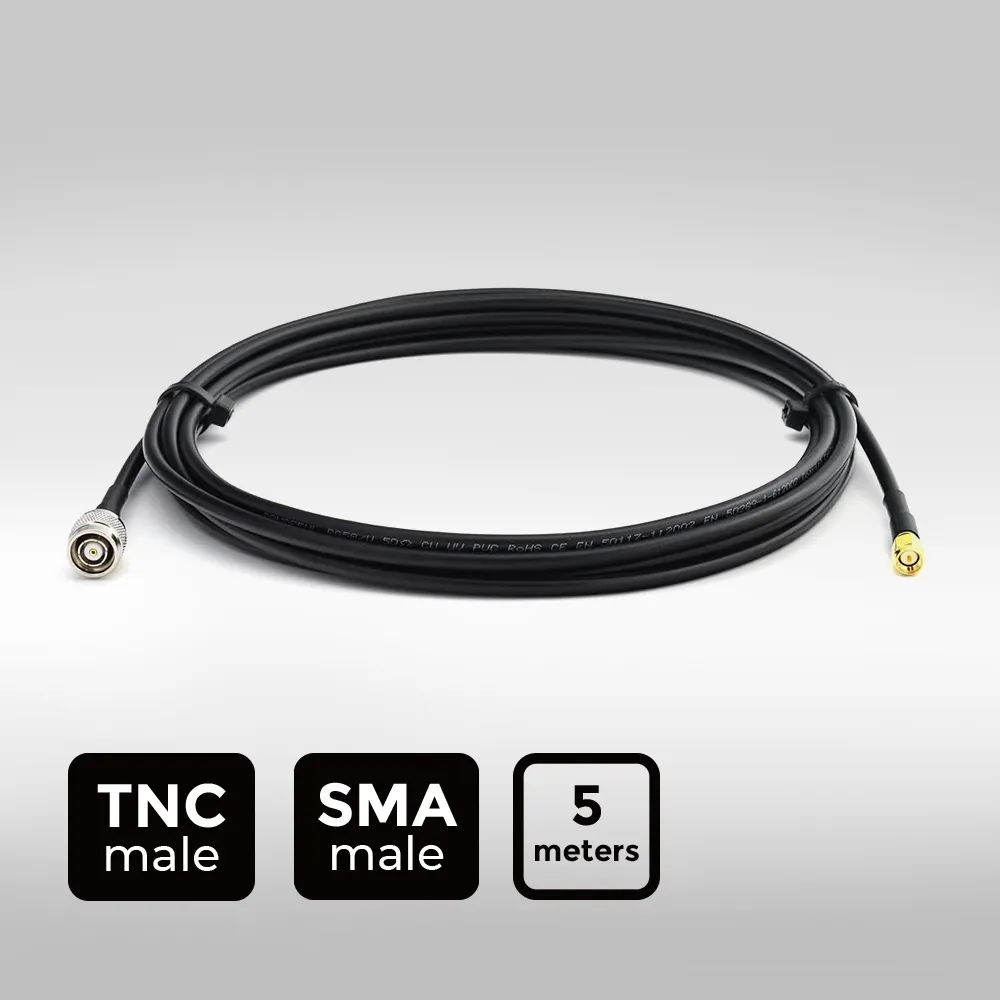
5-Meter Cable for UHF RFID Fixed Reader AZF-M1
RP-TNC male – SMA male, for AZF-M1 with 5 dBi antenna, 5 meters.