


To reprogram NFC tag is a powerful capability that unlocks a world of possibilities for businesses and individuals alike. Whether you’re looking to update information on existing tags, repurpose them for new applications, or simply understand the underlying technology, this comprehensive guide will walk you through the process. We’ll delve into the practical steps of mobile encoding, explore various applications, and provide insights into optimizing your NFC solutions for maximum impact. From marketing campaigns to inventory management, the ability to efficiently manage and update your NFC tags is a game-changer.
Understanding NFC Technology: The Foundation of Reprogramming
Before we dive into the specifics of how to reprogram NFC tag, it’s essential to grasp the fundamentals of Near Field Communication (NFC) technology. NFC is a short-range wireless technology that enables communication between two electronic devices over a distance of 4 cm (1.57 inches) or less. It operates on the principle of electromagnetic induction, allowing for quick and secure data exchange without the need for pairing or complex setup procedures. This makes NFC ideal for a wide range of applications, from contactless payments to data transfer and, of course, interactive marketing.
How NFC Works: A Brief Overview
NFC technology relies on two main components: an NFC initiator (typically a smartphone or an NFC reader) and an NFC target (the NFC tag itself). When the initiator comes into close proximity with the target, an electromagnetic field is generated, powering the passive NFC tag and enabling data transmission. This interaction is what allows you to read information from an NFC tag or write new data to it. The data stored on an NFC tag can vary widely, including URLs, contact information, text, or even commands that trigger specific actions on a smartphone.
Types of NFC Tags and Their Reprogrammability
Not all NFC tags are created equal when it comes to reprogramming. The reprogrammability of an NFC tag depends on its chip type and memory configuration. Most commonly, NFC tags use NTAG series chips (e.g., NTAG213, NTAG215, NTAG216) which are designed for multiple write cycles, making them ideal for applications where data needs to be updated frequently. Other types, like MIFARE Classic, may have more limited reprogramming capabilities or require specialized readers. Understanding the specifications of your NFC tags is crucial for successful reprogramming.

How to Reprogram NFC Tag in 3 Simple Steps: A Mobile Encoding Guide
Now that we have a foundational understanding of NFC technology, let’s get to the core of this guide: how to reprogram NFC tag using a mobile device. The process is surprisingly straightforward and can be accomplished with just a smartphone and a freely available app. This section will provide a step-by-step guide to get you started.
Step 1: Choose the Right App
The first step is to download a reliable NFC tag writer app on your smartphone. There are numerous options available for both Android and iOS devices. Some popular and highly-rated apps include:
- NFC Tools (Android & iOS): A versatile app that allows you to read, write, and program tasks on your NFC tags.
- TagWriter by NXP (Android): Developed by a leading NFC chip manufacturer, this app offers a user-friendly interface and a wide range of encoding options.
- Smart NFC (Android): Another powerful app with advanced features for creating complex NFC tasks.
For this guide, we will use NFC Tools as an example due to its cross-platform availability and comprehensive feature set.
Step 2: Prepare Your NFC Tag and Data
Once you have the app installed, you’ll need to prepare your NFC tag and the data you want to encode. Ensure that your NFC tag is compatible with your smartphone and the app you’ve chosen. The data you can encode is virtually limitless, but here are some common examples:
| Data Type | Description | Use Case Example |
| URL | A web address | Directing customers to a product page or promotional offer |
| Text | Plain text information | Displaying a welcome message or product details |
| Contact | vCard contact information | Sharing your business card digitally |
| Wi-Fi Network | Wi-Fi credentials | Allowing guests to connect to your Wi-Fi network with a single tap |
| Social Media | Links to your social media profiles | Growing your online following |
Step 3: Write to the Tag
With your app, tag, and data ready, it’s time to write to the tag. The process is as follows:
- Open the NFC Tools app on your smartphone.
- Navigate to the “Write” tab or a similar option within the app.
- Select the type of data you want to encode (e.g., URL, Text, etc.).
- Enter the data in the provided field.
- Tap the “Write” button and hold your NFC tag close to the back of your smartphone, where the NFC antenna is located.
- You will receive a confirmation message once the data has been successfully written to the tag.
Congratulations! You have successfully reprogrammed your NFC tag. You can now test it by tapping it with your smartphone to ensure that the new data is read correctly.

Advanced Reprogramming Techniques and Considerations
While the 3-step mobile encoding process covers most basic needs, there are more advanced techniques and considerations when you reprogram NFC tag for specific applications. Understanding these nuances can help you optimize your NFC solutions and overcome potential challenges.
Locking and Unlocking NFC Tags
Some NFC tags can be locked after writing to prevent accidental or unauthorized reprogramming. This is particularly useful for applications where the data should remain static, such as product authentication or permanent signage. Most NFC writing apps offer an option to lock the tag after encoding. Once locked, the tag cannot be reprogrammed without a specific unlock command, which is often not publicly available or requires specialized hardware.
Batch Reprogramming for Efficiency
For businesses dealing with large quantities of NFC tags, manually reprogramming each one can be time-consuming. This is where batch reprogramming comes into play. Specialized NFC readers and software solutions are available that allow you to program multiple tags simultaneously, significantly increasing efficiency. These solutions are often used in manufacturing environments or for large-scale deployments of NFC-enabled products. While beyond the scope of mobile encoding, it’s an important consideration for commercial applications.
Data Capacity and NFC Tag Selection
NFC tags come with varying data capacities, typically measured in bytes. The amount of data you can store on a tag directly impacts its reprogrammability and suitability for different applications. For instance, an NTAG213 tag offers 144 bytes of user memory, sufficient for a URL or short text. An NTAG216, on the other hand, provides 888 bytes, allowing for more complex data structures or longer URLs. When planning your NFC deployment, always consider the data requirements and choose NFC tags with adequate memory to avoid limitations when you reprogram NFC tag with new information.

Real-World Applications: Where Reprogrammable NFC Tags Shine
The ability to reprogram NFC tag opens up a vast array of practical applications across various industries. From enhancing customer engagement to streamlining internal operations, reprogrammable NFC tags offer dynamic solutions that can adapt to changing needs. Here are a few compelling examples:
Marketing and Advertising: Dynamic Campaigns
Imagine a marketing campaign where the call to action on a product changes based on the time of day, ongoing promotions, or even inventory levels. Reprogrammable NFC tags make this possible. A clothing brand, for instance, could embed NFC tags into their hangtags. During a flash sale, tapping the tag could lead customers directly to the discounted product page. Once the sale ends, the tag can be reprogrammed to direct them to a new collection or a loyalty program sign-up. This dynamic capability ensures that marketing efforts remain relevant and effective without the need to replace physical tags.
Inventory Management: Real-Time Updates
In retail and logistics, efficient inventory management is crucial. Reprogrammable NFC labels can significantly enhance this process. Consider a warehouse where products are constantly moving. An NFC label on a pallet could initially link to its current location. As the pallet moves through different stages of the supply chain, the NFC tag can be reprogrammed to update its status, destination, or even provide access to detailed shipping manifests. This provides real-time visibility and reduces errors, offering a more robust solution than static barcodes.
Smart Packaging: Interactive Product Information
Smart packaging is revolutionizing how consumers interact with products. Reprogrammable NFC tags can transform ordinary packaging into an interactive information hub. For example, a food product could have an NFC tag that, when tapped, initially displays nutritional information and recipes. If there’s a product recall or a new sustainability initiative, the tag can be reprogrammed to provide updated alerts or details about the brand’s eco-friendly practices. This ensures consumers always have access to the most current and relevant information, fostering trust and transparency.
Public Transportation: Flexible Ticketing Systems
Public transportation systems can greatly benefit from reprogrammable NFC cards. Instead of issuing single-use tickets, passengers could use a reusable NFC card that can be reprogrammed for different routes, fare types, or time periods. For instance, a daily pass could be loaded onto the card for one day, and then reprogrammed as a weekly pass for the next. This reduces waste, simplifies fare collection, and offers greater flexibility to commuters. This concept is already in use in various cities worldwide, such as the Oyster card in London, which uses a similar underlying technology to allow users to top up and reuse their cards for different journeys and fare types.

Maximizing Commercial Value with RFIDLabel Reprogrammable Solutions
At RFIDLabel, we understand the immense potential of reprogrammable NFC technology for businesses. As a leading manufacturer of high-quality RFID cards, RFID tags, and custom RFID label solutions, we are uniquely positioned to help you leverage this technology to its fullest. Our products are designed with flexibility and performance in mind, ensuring that you can easily reprogram NFC tag solutions to meet your evolving business needs.

Conclusion: Unlock the Potential of Reprogrammable NFC Tags with RFIDLabel
The ability to reprogram NFC tags is more than just a technical feature; it’s a strategic advantage that empowers businesses to create dynamic, responsive, and highly efficient solutions. From enhancing customer engagement in marketing to streamlining complex logistical operations, the flexibility offered by reprogrammable NFC technology is unparalleled. We’ve explored how straightforward it is to reprogram NFC tag using mobile devices, and the advanced considerations that can further optimize your deployments.
At RFIDLabel, we are dedicated to providing you with the highest quality NFC cards, tags, and custom solutions that are built for performance and designed for your success. Our extensive product range, coupled with our commitment to quality, customization, and competitive pricing, makes us the ideal partner for your next NFC project. We invite you to explore the possibilities and discover how our innovative solutions can help you achieve your business goals. Visit rfidlabel.com today to learn more about our products, discuss your specific requirements, or place an order. Let us help you unlock the full potential of NFC technology.
Recommended Product
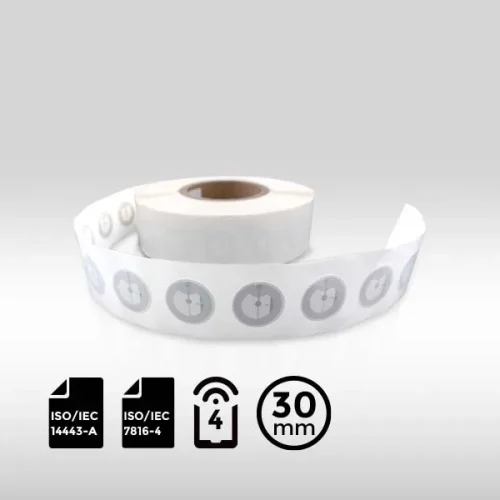
NXP NTAG® 424 DNA Coated Paper NFC label Ø30mm

The NXP NTAG® 424 DNA Eco-Friendly Adhesive NFC label features a sustainable construction with FSC-certified thin coated paper. It uses RPC5 adhesive for strong bonding and is backed by white Glasine C5-FSC liner, making it an environmentally friendly choice for NFC applications without compromising performance or durability.
Note: Labels are supplied in factory-default condition, with no data pre-encoded. For pre-encoding to enable immediate verification, please contact us for pricing.



