


Introduction
In today’s highly competitive retail environment, companies increasingly need innovative technologies to enhance customer experience and optimize product management. NFC (Near Field Communication) labels, as a state-of-the-art solution, not only provide instant information but also dramatically improve product traceability and brand interaction. This guide will provide an in-depth introduction to the basic concepts, features, benefits, and application scenarios of NFC label, as well as a comparison with other technologies of NFC labels, providing a reference for your organization to choose the right solution.
1. Overview of NFC Label
1.1 What is NFC Label

An NFC label is a small wireless device based on NFC technology. It consists of a small chip and an antenna that can communicate with an NFC-reading device over a short distance (usually 4-10 cm). NFC labels can store a small amount of data and quickly transmit information wirelessly and are widely used in retailing, payment, authentication, inventory management, and other fields.
1.2 How doe NFC Label work
Power supply
NFC labels are generally passive devices and do not require a power supply. The reading device powers the tag by electromagnetic induction.
Communication
A communication channel is established between the NFC reading device and the label using a high-frequency signal emitted by the antenna.
Data Transmission
The chip inside the label stores specific data, such as product information, URLs, or encrypted authentication information. The reading device receives and parses the data to complete the information interaction.
Performing Functions
The data is used for specific functions, such as opening a web page, processing a payment, authenticating an identity, etc.
1.3 Main functions of NFC Label
Information storage and reading
Store product information, instructions, coupon codes or event links. Readers can quickly access the information by scanning the labels.
Payment and Transactions
Used for payment systems (e.g. Apple Pay, Google Pay) and e-ticketing.
Authentication
Used in access cards, hotel key cards, transportation cards and other scenarios.
Location & Tracking
Used in logistics and supply chain management for real-time tracking of goods.
Interaction & Marketing
Interact with consumers through labels, such as scanning codes to get discounts or participate in events.
1.4 Different types of NFC Label
Classification by operating mode
| Type | Description | Application scenario |
| Active NFC Label | Self-powered, can actively send signals to the reading device | Advanced data transfer, complex device control |
| Passive NFC Label | No need for power supply, energy supply through the reading device, more economic price | Retail Merchandise Labeling, Payment Cards |
Classification by Data Writing Characteristics
| Type | Description | Application scenario |
| Disposable NFC Label | Data cannot be changed once written and is highly secure. | Anti-counterfeiting verification, ticket management |
| Rewritable NFC Label | Data can be modified multiple times for greater flexibility. | Dynamic information updates, such as inventory management and promotions |
Classification by material
| Type | Description | Application scenario |
| Plastic NFC Label | Lightweight and durable for long term use. | Retail and logistics industry |
| Paper NFC Label | Environmentally friendly and economical, biodegradable. | Temporary events, courier labels |
Classification by shape and form
| Type | Description | Application scenario |
| Sticker type NFC Label | Adheres to the surface of the item for ease of use. | Product information labeling, branding |
| Card-based NFC Label | Card format, suitable for payment and identity verification. | Access card, transportation card |
| Wristband NFC Label | Portable and durable, suitable for long-term wear. | Event admission, playground management |
2. Key benefits of NFC Label

2.1 Convenience and Fast Communication
One of the biggest advantages of NFC labels is its convenience and fast communication capabilities. NFC is a short-range wireless communication technology, the working distance is generally 4-10 cm, which allows users to scan the label only to bring the device close to the label to complete the exchange of information.
No need for complex operations: Users can read or write information with a single touch, eliminating the need for cumbersome operational steps.
Instant feedback: Communication between the NFC label and the reading device is almost instantaneous, ensuring fast data exchange. For example, after scanning a merchandise label, relevant product information, inventory or payment interface will be immediately displayed on the device.
This easy operation process greatly enhances the customer experience, especially in retail and payment scenarios.
2.2 High Security
NFC labels are highly secure and protect transmitted data from unauthorized access. It is commonly used in sensitive scenarios such as payment, authentication and anti-counterfeiting.
Encryption: Many NFC labels support built-in encryption to ensure the security of data transmission and prevent information from being stolen.
Tamper-resistant design: Some NFC labels have tamper-resistant features. Once the label is disassembled or subjected to external interference, the data will not be recoverable, ensuring anti-counterfeiting and anti-theft features.
These security advantages make NFC labels ideal for payment cards, access cards, and product anti-counterfeiting.
2.3 Cost-effective
Compared with other wireless communication technologies, NFC labels are relatively low cost, especially when applied on a large scale, the unit cost is more economical.
Low Manufacturing Cost: The production process of NFC labels is relatively simple, so they are less expensive to produce. The cost of a single label can be further reduced when produced in large quantities.
No Battery Required: Most NFC labels are passive, i.e., they do not require an internal battery; NFC labels work with energy provided by the reading device, which makes the cost of using the labels virtually zero and eliminates the need to maintain a battery.
Because of their low cost and long life, NFC labels are used in a wide range of products, from retail merchandise to logistics tracking, from transportation cards to access control systems.
2.4 Environmentally Friendly and Sustainable
NFC labels are usually manufactured using environmentally friendly materials, especially in the selection of paper and plastic labels, which can be recycled or biodegradable, thus reducing the burden on the environment.
Recyclable materials: Many NFC labels are made of recyclable plastic, metal and paper, which meets the requirements of sustainable development.
Low energy consumption: NFC labels are passive devices that do not require built-in batteries or other energy sources, which means they consume virtually zero energy and reduce e-waste generation.
As a result, NFC labels not only meet the environmental responsibilities of modern businesses but also satisfy consumer demand for sustainable products.
2.5 Highly flexible and customization
NFC labels can be customized according to the needs of different industries with a high degree of flexibility. In terms of shape, size, material and function, enterprises can design and choose the right label according to their specific needs.
Customized shapes and sizes: NFC labels can be designed not only in the traditional round or square shape but also in customized label shapes, such as oval, rounded rectangle, etc., according to the shape of the product.
Printable content: NFC labels can be printed with brand logos, product information, QR codes, etc. to enhance brand recognition.
Variable data: NFC labels support dynamic data updates, suitable for inventory management, promotional activities and other scenarios. The information on the label can be updated in real-time according to the demand without the need to change the label.
With these customization features, companies can ensure that NFC labels fit perfectly with their brand image and operational processes.
2.6 Enhanced User Experience
NFC labels provide consumers with a more interactive and personalized shopping experience, especially in retail and marketing.
Instant interaction: Consumers can get product details, and coupons or participate in brand activities with just one touch. For example, in a clothing store, consumers can use NFC labels to learn about a product’s ingredients, manufacturing process and brand story.
Personalized service: NFC labels support personalized marketing strategies, such as providing personalized discounts, reminders or recommended products for specific consumers to enhance consumer loyalty.
By providing convenient access to information and interactive experiences, NFC labels help enhance consumer recognition and satisfaction with brands.
2.7 Data Tracking and Analyzing Capability
NFC labels can provide enterprises with valuable real-time data to help them carry out efficient data tracking and analysis. Whether in inventory management, logistics and transportation or customer behaviour analysis, NFC labels can provide accurate data support.
Inventory Management: With NFC labels, retailers are able to track the inventory status of each product in real-time, reducing inventory backlogs and avoiding out-of-stock or expired items.
Supply Chain Tracking: NFC labels help companies monitor the flow of products throughout the supply chain in real-time, ensuring that the origin and destination of goods are clearly visible and reducing logistical errors.
Consumer Behavior Analysis: By interacting with consumers through NFC labels, retailers can collect data on consumers’ purchasing habits, preferences and interactions to optimize product recommendations and marketing strategies.
This data can help companies make better decisions and improve operational efficiency and customer satisfaction.
2.8 Compatibility with other technologies
NFC labels can seamlessly integrate with other technologies such as the Internet of Things (IoT), Bluetooth, Wi-Fi, etc. to enhance functionality and application scenario scalability.
IoT Integration: NFC labels can interconnect with smart devices, facilitating more efficient automated management by connecting with IoT devices via NFC labels.
Compatible with apps: NFC labels are compatible with smartphones, tablets, and other devices, support multiple operating systems (e.g., Android, iOS), and enable customized functionality through apps.
3. NFC Labels in retail applications

3.1 Commodity information and advertising display
NFC labels can provide consumers with instant and convenient product information and advertising displays. This approach greatly improves the shopping experience, enabling consumers to more quickly understand the details of the product and make purchasing decisions.
Instant information access: Customers can get detailed information about the product, such as price, specifications, usage, ingredients, etc., by simply touching the NFC label on the product with an NFC-enabled smartphone. For some high-value commodities or customized products, NFC labels can effectively complement traditional commodity labels.
Augmented Reality Advertising (AR): Retailers can combine NFC labels with AR technology, allowing consumers to scan the labels to view virtual product demonstrations, brand stories or event information. This interactive form of advertising not only attracts consumers but also enhances brand recall.
Promotions and Offers: Merchants can deliver discount information, coupons or special promotions directly to consumers through NFC labels. After consumers touch the label, the system will automatically push the discount information to increase the purchase conversion rate.
3.2 Inventory Management and Tracking
NFC labels help retailers realize real-time tracking and intelligent management of inventory. It can provide retailers with accurate inventory data to reduce inventory backlog, optimize merchandise flow, and improve supply chain efficiency.
Real-time inventory update: NFC labels installed on each item help retailers update inventory data with each scan. The system can record real-time merchandise sales and inventory levels to avoid excessive backlogs or out-of-stock issues.
Merchandise tracking: NFC labels can accurately track merchandise from the warehouse to the store and back to the customer. This tracking not only helps prevent theft of merchandise but also helps retailers keep track of the flow of merchandise and optimize replenishment plans.
Reduce human error: Automated scanning through NFC technology reduces errors in manual operations and improves the accuracy of inventory management.
3.3 Anti-counterfeiting and brand protection
NFC labels are widely used in the field of product anti-counterfeiting, especially in luxury goods, cosmetics, pharmaceuticals, and other commodities that need to be prevented from counterfeiting. NFC labels are effective in preventing counterfeiting and provide a secure way of verification.
Anti-counterfeiting verification: Consumers can verify the authenticity of goods in real-time by scanning the NFC label on the product. The unique code stored in the NFC label can be matched with the brand owner’s database to confirm whether the goods are genuine.
Increased consumer trust: The use of NFC labels provides consumers with a higher level of trust. Instead of relying solely on the logo on the package, consumers can be assured that their purchases are authentic through actual means of verification.
Enhanced brand value: Through the use of NFC labels, brands are able to communicate to consumers the production information, quality assurance and certificates of authenticity of their products, enhancing brand image and trust.
3.4 Customer Interaction and Personalized Marketing
NFC labels enable retailers to interact with consumers and provide personalized marketing experiences based on purchasing behaviour and interests. This approach helps to enhance customer loyalty and satisfaction, thereby promoting long-term customer relationships.
Personalized Recommendations: When a consumer scans an NFC label, the system can provide personalized product recommendations or customized services based on the customer’s purchase history, interests and preferences. For example, based on a customer’s previous purchases, merchants can push similar items or pairing suggestions.
Points and Loyalty Programs: Retailers can automatically accumulate points for customers through NFC labels, with the system recording and updating their points each time a customer scans the label. This approach can be combined with a merchant’s loyalty program to incentivize repeat purchases.
Interactive experience: In addition to traditional product information, NFC labels can push interactive content to customers, such as brand campaigns, questionnaires, games or sweepstakes. These interactions not only increase customer engagement but also improve brand exposure and customer loyalty.
Social Sharing Functionality: Retailers can use NFC labels to encourage customers to share product information or shopping experiences on social media. For example, after scanning the label, consumers can share the product directly to social platforms, further increasing brand exposure.
3.5 Self-checkout and Payment Functions
With the popularity of digital payment, the application of NFC labels in retail payment has become increasingly important. NFC labels can make the payment process more convenient, and faster, and improve the security of the transaction.
Cashless Payment: By combining NFC labels with payment applications (e.g. Apple Pay, Google Pay), customers can complete payments directly using their smartphones or smartwatches. Customers can simply bring their phone close to the NFC payment device to quickly complete the transaction without the need for cash or a bank card.
Self-checkout system: In retail stores, NFC labels can be combined with a self-checkout system, where customers can scan NFC labels on products and automatically enter product information into a self-checkout machine, which reduces queuing and manual checkout time and improves checkout efficiency.
Increased transaction security: Compared to traditional payment methods, NFC payments use encryption technology, making the transaction process more secure. Because it requires short-range contact and identity verification, NFC payment can effectively prevent the theft of payment information.
3.6 Smart Shelf and Automated Management
NFC labels can also be combined with smart shelf technology to enhance retailers’ automated management.
Smart Shelf: Retailers can install NFC readers and labels on shelves to automatically record relevant data when customers touch goods, updating inventory and sales records. Such smart shelves can display real-time inventory information, helping merchants to quickly restock and adjust prices.
Automatic replenishment alerts: Through the smart shelf’s monitoring system, retailers can monitor in real-time which items are below a predetermined level of inventory, and the system will automatically send replenishment alerts. This can avoid out-of-stock phenomenon and improve the efficiency of merchandising.
Data analysis and optimization: Smart shelves can also collect data on customers’ shopping behaviour, such as how often they browse or touch certain products, which allows retailers to optimize product placement, adjust pricing strategies, and improve marketing campaigns.
3.7 Customer Experience and Store Layout
NFC labels not only provide rich information and interactive experience but also enhance customer comfort and convenience by optimizing store layout.
Guiding customers: Stores can utilize NFC labels to provide in-store navigation to customers. For example, when customers touch the label, the system can tell them how to find a certain product or recommend related product areas.
Store Layout Optimization: By analyzing the frequency and location of customers scanning NFC labels, retailers are able to understand customers’ shopping habits, and then adjust the location of product displays and store layout to improve customers’ shopping experience and store sales performance.
4. Comparison between NFC Labels and other technologies
4.1 NFC vs. QR code
QR code is a kind of two-dimensional barcode, which is also widely used in product information display, promotional activities, payment and other fields. Here is the comparison between NFC and QR code.
| Characteristics | NFC | QR code |
| Working principle | Wireless communication where information is exchanged through electromagnetic fields. | Optical recognition, where the information in the QR code pattern is read by a scanning device. |
| Communication distance | Extremely short, usually within a few centimeters. | No distance limitation, but direct visual contact is required. |
| Data transmission rate | Lower, typically between 106kbps and 424kbps. | Lower data transmission speed, mainly used for small-scale data transmission. |
| Usage scenario | Used for payments, authentication, product tracking, mobile marketing, etc. | Used for product information display, web links, promotional activities, etc. |
| Costs | Higher, especially when integrated with smartphone payment systems. | Very low, the cost of QR code generation and printing is almost zero. |
| Security | Higher, usually secured by encryption or double authentication. | Lower security, easy to be forged and tampered. |
| Label size | Small, usually labels of a few millimeters to a few centimeters. | Labels are very small, usually a few centimeters in size with a QR code pattern. |
| User experience | Good user experience, click to scan for deeper interaction. | Scanning usually just provides a web page or a simple link to information. |
| Device requirements | Devices that require NFC functionality, such as smartphones, payment devices. | Any device with a camera and QR code scanning software can scan it. |
4.2 NFC vs. Bluetooth
| Characteristics | NFC | Bluetooth |
| Working principle | Utilizes electromagnetic fields to communicate over short distances and supports point-to-point exchanges. | Transmits data between devices via radio waves to support multi-device communication. |
| Communication distance | Extremely short, usually a few centimeters. | Longer than NFC, generally about 10 meters, supports longer distance communication. |
| Data transmission rate | Lower, usually between 106kbps and 424kbps. | Higher, Bluetooth 4.0 transmission rate of 1Mbps, Bluetooth 5.0 faster. |
| Usage scenario | Used for payments, authentication, product tracking, interactive advertising, etc. | Suitable for wireless headphones, audio, car system, smart home, etc. |
| Costs | Higher, especially in payment and security applications. | Lower, the cost of Bluetooth modules and devices is relatively cheap. |
| Device Compatibility | Requires NFC-enabled devices such as smartphones and payment terminals. | Supported by almost all smart devices and Bluetooth headphones, stereos and other devices. |
| Energy consumption | Extremely low, usually powering passive labels with low device power consumption. | Higher, especially in wide range communication, the device consumes more power. |
| Security | High, communication encryption ensures secure data transmission. | Relatively low, especially in unencrypted devices and applications. |
Conclusion
As an ideal choice for the retail industry, NFC labels can significantly improve customer experience and product management efficiency. Whether it is inventory tracking, anti-counterfeiting verification or brand interaction, it has demonstrated strong potential. By selecting the right NFC label and implementing it effectively, your business can not only optimize operations but also stand out from the competition.
If you need more NFC label information or customize NFC labels, please contact us through our official website.
Recommended Product
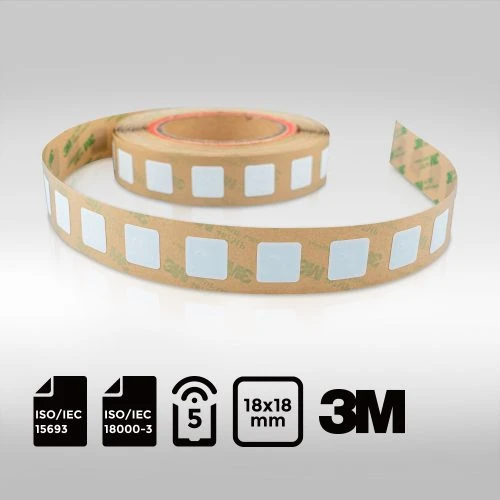
NFC Label 18x18mm NXP ICODE® SLIX | ISO15693 NFC Type-5

Elevate your tracking precision with our exceptionally compact NFC Label, sized at just 18x18mm and featuring the superior NXP ICODE® SLIX chip. Compliant with ISO15693 NFC Type-5 standards, this tiny yet mighty label is crafted with PET material and backed by reliable 3M adhesive. Experience the pinnacle of quality and efficiency in tracking solutions with this standout product.



