


Introduction
In today’s smart and connected world, Near Field Communication (NFC) technology has become an important bridge between the physical and digital worlds. However, communication stability has always been an insurmountable challenge when using NFC labels in metallic environments, and NXP Ultralight-C NFC phone label has successfully solved this challenge with their outstanding performance and innovative design, providing reliable NFC solutions for metal environments in a wide range of industries.
1. Challenges of NFC technology in metallic environments

NFC technology works based on the principle of electromagnetic induction at a frequency of 13.56 MHz, and metallic materials can have a shielding and interference effect on electromagnetic fields, leading to the following problems:
Signal attenuation: Metal surfaces reflect and absorb RF signals, significantly reducing the read range.
Resonance Frequency Shift: Metallic environments can change the resonance characteristics of the NFC label antenna, decreasing communication efficiency.
Data transmission errors: metal interference may lead to packet loss or error, affecting system reliability
Read instability: In metal environments, the read success rate of ordinary NFC labels is significantly reduced.
These challenges make it extremely difficult to apply NFC technology in scenarios such as metal access control systems, metal container asset tracking, and metal equipment maintenance management.
2. NXP Ultraight-C NFC Phone Label Technology Advantages Explained

The NXP Ultralight-C chip features several innovative technologies specifically optimised for metal environments:
2.1 Core technology features
Optimised antenna design: The special antenna structure can maintain high signal strength and stability in metal environments.
112-bit 3DES encryption: Provides advanced security to ensure that data is not illegally intercepted or tampered with during transmission.
Compliance with ISO/IEC 14443 A standard: Ensures broad compatibility with mainstream NFC reading devices in the market.
Expandable user memory: Provides more storage space than ordinary labels to meet diversified application requirements.
Metal-resistant material layer: A specialised ferrite layer effectively isolates metal interference and improves communication stability.
2.2 Performance in a metal environment
After professional testing, Ultralight-C’s performance in metal environments far exceeds that of ordinary NFC labels:
In the case of being directly attached to the metal surface, the reading distance can reach 3-5 centimetres (ordinary labels are almost unreadable).
Communication stability is improved by 200%, dramatically reducing read failure rates.
The data transmission error rate is reduced to less than 0.1%, ensuring reliable system operation.
Stable performance on all metal materials (aluminium, steel, iron, etc.).
3. Comparative analysis with mainstream NFC labels in the market
To visually demonstrate the benefits of Ultralight-C in metallic environments, we have thoroughly compared it to other mainstream NFC labels on the market:
| Features | NXP Ultralight-C | NTAG213 / 215 / 216 | MIFARE Classic | Normal NFC labels | Specialized metal-resistant NFC labels |
| Communication stability in metallic environments | Medium (requires special treatment) | Low (susceptible to interference) | Low (susceptible to interference) | Very low (virtually unusable) | High (designed for metallic environments) |
| Reading distance (metallic environments) | 3-5 cm (after treatment) | 1-3 cm | 2-4 cm | <1 cm | 5-8 cm |
| Security | 112-bit 3DES encryption | Password protection | Proprietary encryption (cracked) | Basic Protection | Depends on chip type |
| Storage capacity | Approx. 144 bytes | 144/504/888 bytes | 1K/4K bytes | 48-144 bytes | Depends on chip type |
| Price factor | Medium | Low to Medium | Medium | Medium | High |
| Phone Compatibility | Good | Excellent | Average | Good | Good |
| Application Flexibility | Medium | High | Medium | Medium | Medium |
From the comparison table, we can see that Ultralight-C achieves the best balance of communication stability, security and cost-effectiveness in metal environments, which is especially suitable for application scenarios that require stable operation in metal environments and are cost-sensitive.
4. Optimization solutions and application scenarios
To achieve the best performance in different metal environments, Ultralight-C can be optimised in a variety of ways:
| Optimization Solutions | Communication Stability Improvement | Cost increase | Implementation complexity | Applicable Scenarios |
| Standard Ultralight-C | Baseline | None | Low | Non-metallic environments |
| Add ferrite barrier | +50% | Low | Low | Mild metal interference environment |
| Specialized metal-resistant substrate | +120% | Medium | Medium | Direct adhesion to metal surfaces |
| Optimized antenna design | +80% | Medium | High | Various metal environments |
| Ultralight-C + Integrated Optimization | +200% | High | High | Harsh metal environments |
Typical Application Scenarios
The excellent performance of the Ultralight-C NFC phone label in metallic environments makes it ideal for the following scenarios:
Hotel metal access control systems: Ensuring guest stability in metal access control environments
Metal asset management: Efficient asset tracking and management on metal equipment and containers
Metal packaging product anti-counterfeiting: provide reliable anti-counterfeiting verification for high-end metal packaging products
Industrial Equipment Maintenance: Storing maintenance information on metal equipment for easy on-site inquiry
Metal surface payment application: Realise stable NFC payment on metal equipment, such as a vending machine
Conclusion
NXP Ultralight-C NFC cell phone label successfully solves the stability challenges faced by NFC technology in metal environments through innovative technology and optimised design. Its excellent performance, reliable security and reasonable cost structure make it an ideal choice for NFC applications in metal environments.
Whether for hotel access control systems, asset management, product anti-counterfeiting or industrial maintenance, Ultralight-C provides a stable and reliable solution. By adopting the appropriate optimisation solutions and best practices, companies can take full advantage of the convenience of NFC technology while overcoming the challenges posed by metallic environments to digitally transform their business processes.
As a professional manufacturer of RFID labels and NFC solutions, RFIDLabel is committed to providing customers with high-quality, customised Ultralight-C NFC label products to meet the application needs of various industries in metal environments. Our technical team has a wealth of experience in the industry and can provide you with a full range of support from product selection to system integration, to help you build stable and reliable NFC applications in metal environments.
Choose NXP Ultralight-C NFC cell phone labels, so that your metal environment applications are no longer subject to communication stability of the trouble, to open a new experience of intelligent connectivity!
Recommended Product
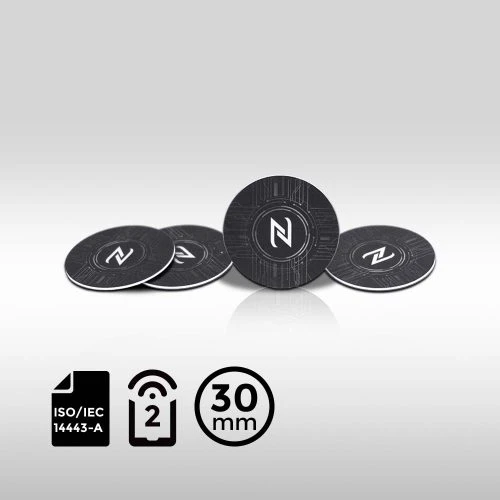
On-Metal Mobile NFC Label MIFARE Ultralight® C Ø30mm

The Ø30mm NXP MIFARE Ultralight® C On-Metal Mobile NFC Label is a compact and high-performance NFC label specifically designed for on-metal applications. Powered by NXP’s MIFARE Ultralight® C chip, this NFC label supports 3DES authentication for enhanced data security, making it ideal for applications requiring both compact size and secure communication. Also, it supports ISO/IEC 14443-A , NFC Type-2 international communication standards. With a diameter of 30mm, the label is small enough to be embedded discreetly, yet large enough to provide reliable performance even when applied directly to metal surfaces — a scenario where many standard NFC labels fail. It comes equipped with a specially engineered ferrite layer, which neutralizes interference from metal and ensures consistent readability.
This NFC label is optimized for mobile interaction, compatible with all NFC-enabled smartphones and devices. It is widely used in asset tracking, anti-counterfeiting, industrial equipment tagging, product authentication, and smart marketing initiatives.



