


Paper RFID tag solutions are becoming the default choice for item-level visibility in retail and fast-moving supply chains—especially as brands push for lower packaging waste, faster counts, and better control over inventory accuracy. But “paper RFID tag” can mean very different things depending on your product, your packaging, your read environment, and whether you also want brand protection.
This 2026 buying guide breaks the decision down into practical choices: what to buy, why it matters, and how to spec it so you avoid underperforming tags, rework, or unnecessary cost.
Why Paper RFID Tags Are Winning in 2026
Paper-based RFID labels and hangtags fit into existing printing and labeling workflows, making them easy to scale across apparel, footwear, consumer goods, cosmetics, and many logistics applications. Compared with thicker or specialty constructions, paper tags are often preferred when you need:
- High-volume, cost-efficient tagging for item-level tracking
- Sustainable packaging alignment using FSC-certified or recycled paper facestock
- Simple integration into current label converting and print processes
- Clean aesthetics for retail-facing packaging and hangtags
The key is to choose the right inlay + antenna + adhesive + converting format for your environment.

What Paper RFID Tags Improve in Retail Logistics
A properly specified UHF paper RFID tag can support:
- Faster inventory counts (bulk reads without line-of-sight scanning)
- Better shelf and backroom visibility (reducing “phantom stock”)
- Smoother omnichannel fulfillment (BOPIS, ship-from-store, store-to-store transfer)
- More reliable receiving and shipping (carton verification, exception handling)
The operational impact depends on execution—tag placement, reader coverage, encode quality, and data discipline—so selecting the right tag spec is a major lever.
A Quick Reality Check: UHF vs NFC for Brand Protection
Many “brand protection” promises fail because the frequency is misunderstood.
UHF RFID (860–960 MHz) is best for supply chain tracking: warehouses, DCs, stores, gates, handheld counts, bulk reads.
NFC (13.56 MHz) is best for consumer interactions: a smartphone can tap and verify, open product pages, or trigger warranty registration.
If you want both supply-chain control and consumer-facing authentication, consider:
UHF for logistics + a printed QR for consumer verification, or dual-technology labeling (UHF + NFC) for premium programs, when the ROI supports it.
This guide focuses on paper UHF RFID tags, and shows how to extend them into brand protection workflows without overpromising.
Recommended Paper RFID Tag Specs for 2026
Use this table as a starting point. The “best” spec depends on your products and reading environment.
| Specification | 2026 Recommendation | Why It Matters |
| Frequency | UHF (860–960 MHz) | Long read range and fast bulk scanning |
| Standard / Protocol | EPC Gen2 / Gen2v2 (ISO/IEC 18000-63) | Broad interoperability across readers and regions |
| Chip Family (common choices) | Impinj M700 series, NXP UCODE 9 series | High sensitivity options for real-world retail density |
| EPC Memory | 96-bit to 128-bit EPC | Unique item identity at scale |
| User Memory (optional) | Only if needed | Adds cost; useful for special workflows |
| Facestock | FSC-certified or recycled paper | Sustainability and brand packaging alignment |
| Adhesive | Acrylic, permanent (or application-specific) | Prevents edge lift, fall-off, and rework |
| Converting Format | Roll labels, fanfold, hangtag inlays | Must match your print/apply and encoding flow |
The 2026 Buyer’s Decision Tree
Step 1: What are you tagging?
A) Apparel / hangtags
Prioritize: stable performance in dense stacks, consistent encoding
Typical format: inlay integrated into hangtag or paper label
B) Consumer goods packaging
Prioritize: adhesive compatibility, placement consistency, carton behavior
Typical format: paper RFID label on carton or product pack
C) Cartons / cases / logistics labels
Prioritize: larger antennas, longer read range, orientation tolerance
Typical format: 4×6″ RFID shipping labels (paper)
Step 2: Where will it be read?
Store counts / cycle counts → handheld reads in dense environments
Dock doors / portals → fixed readers, fast motion, orientation variation
Conveyors / sortation → speed, read zone tuning, label placement rules
Step 3: What packaging materials will interfere?
Liquids and metalized packaging can reduce performance
Dense product stacks can detune antennas
If you have challenging materials, you may need a different inlay, larger antenna, or placement adjustment.

What “Good” Looks Like: Performance Targets You Can Spec
For item-level retail (apparel, footwear)
Target: reliable reads in stacked conditions at typical handheld distance
Focus: chip sensitivity, antenna design, placement consistency
For cartons and cases
Target: stable reads at dock doors and during receiving/shipping workflows
Focus: larger antennas, orientation tolerance, correct label placement rules
For pallets / logistics handling
Target: gate/portal reads with high pass rates
Focus: tag location standardization and reader zone design (tag spec alone won’t fix bad portal tuning)
Deep Spec Guide: What to Optimize
1) Chip Selection: Sensitivity First, “Features” Second
High-sensitivity chips usually deliver the biggest real-world win in retail density. Security features matter for specific use cases, but don’t pay for them unless your workflow uses them.
Choose a proven chip family and validate performance with your products.
2) Antenna and Inlay Design: This Determines Most of Your Read Results
Two tags with the same chip can behave very differently because of antenna geometry. If your SKUs vary widely, you may need:
- one “general purpose” inlay for most items, and
- a second inlay tuned for harder products/packaging
3) Paper Facestock: Sustainability Is Real, but So Is Durability
Paper can be highly effective, but supply chains are rough. Specify:
- abrasion resistance expectations
- humidity exposure range
- scuff/edge handling requirements
If tags fail physically, the RFID performance doesn’t matter.
4) Adhesive: A Silent Failure Point
Most tagging issues are not “RFID issues”—they’re fall-off issues.
Match adhesive to:
- cardboard vs coated boxes
- textured packaging
- hangtag integration (no adhesive)
- temperature and storage conditions
5) Encoding & QA: Don’t Skip This
A strong spec includes:
- encoding format (EPC structure, GS1 compliance if required)
- serialization rules
- QA sampling plan
- dead-tag thresholds and replacement policy

Using Paper RFID Tags for Brand Protection
Paper UHF RFID tags strengthen brand protection primarily through traceability and control, not phone-based consumer scanning.
Practical brand protection workflows with UHF
- Anti-diversion / channel monitoring: detect unexpected movements and receiving anomalies
- Returns verification: check whether an item identity matches the original sale/ship record
- Supply chain transparency: reduce gray-market leakage by strengthening chain-of-custody data
If you need consumer authentication
Add one of these:
- Printed QR linked to a verification page and serial record
- NFC (or dual-technology) for premium items where phone-tap verification is required
Supplier Checklist: What to Ask Before You Buy
- Inlay portfolio + application matching:not “one inlay fits all,” but a recommendation based on your materials and read points
- Manufacturing QA and functional testing:clear QA standards, documented yield targets, and traceability
- Converting and customization capability:print, variable data, serialization, roll format that matches your applicators
- Sample program and validation support:sample packs, guidance on placement to reduce deployment risk
- Scalable supply with flexible MOQs:consistent lead times, stable materials, and capacity for growth

Next Step: Get a Spec-Matched Recommendation
If you want a fast, accurate recommendation, you can provide your supplier with three pieces of information:
- Application: item-level, carton/case, or logistics label
- Packaging material: paperboard, plastic, metalized, liquid-filled, etc.
- Read scenario: handheld counts, portals, conveyors, or mixed
Based on that, a supplier should be able to propose a shortlist of inlays, sizes, and options plan.
Conclusion
In 2026, paper RFID tags are a practical path to higher retail visibility, faster counts, and stronger inventory control—without forcing a full process rebuild. The best results come from matching the tag spec to your product materials, read environment, and operational workflow. For brand protection, UHF paper RFID tags deliver real value through traceability and returns control, and can be extended with QR or NFC when consumer authentication is required.
The rfidlabel.com provides customizable, eco-friendly RFID labels and tags for retail and logistics. If you’re planning a deployment, request a sample pack and a spec recommendation aligned to your products and read points.
FAQs
Are paper RFID tags recyclable?
Paper facestock can support recycling goals, but recyclability depends on the full construction (adhesive, liner, and inlay components) and local recycling rules. Many brands use paper facestock to reduce plastic content and improve packaging sustainability alignment.
Can paper RFID tags be customized with branding and variable data?
Yes. Common options include logo printing, QR printing, variable serial numbers, and pre-encoding/serialization on rolls to match your ERP/WMS requirements.
Do paper RFID tags work on metal or liquid packaging?
Performance can drop significantly on metal or liquid-filled products. In those cases, you may need alternative inlays, different placement, or specialty tag constructions. Testing with real products is the safest path.
Should I choose UHF or NFC for authentication?
Use UHF for supply chain tracking and bulk scanning. Use NFC when you need smartphone tap-to-verify experiences. Many programs use UHF for operations and QR/NFC for consumer-facing verification.
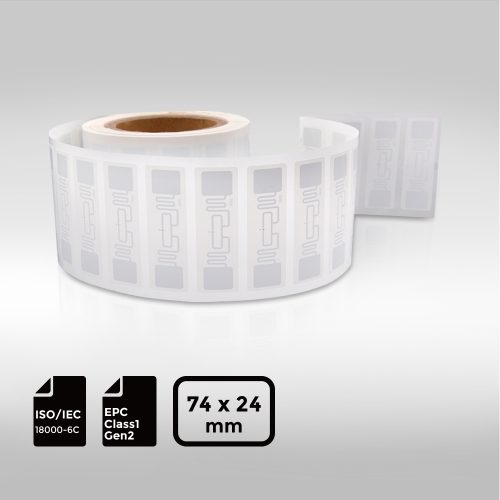
UHF RFID Label Alien Higgs® 4 74x24mm | ISO18000-6C

Unlock unparalleled tracking capabilities with our 74x24mm UHF RFID Label, embedded with the innovative Alien Higgs® 4 chip. Known for its exceptional data rate and read sensitivity, this chip sets our label apart in the RFID landscape. The Higgs® 4 enables advanced functionalities like dynamic authentication and robust memory protection, ensuring secure and efficient data management. Coupled with ISO18000-6C compliance, the chip optimizes RF performance and ensures high data throughput for seamless, real-time asset tracking.
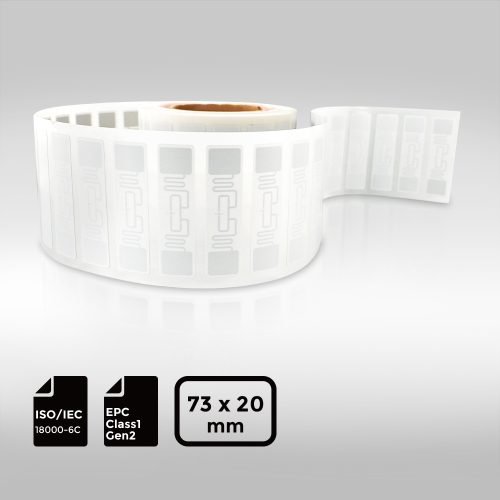
UHF RFID Label Alien Higgs® EC 73x20mm | ISO18000-6C
Introducing the UHF RFID Label Alien Higgs® EC 73x20mm: the perfect fusion of efficiency and customization. Compliant with ISO 18000-6C, this label is designed for optimal tracking and data security. Its coated paper material ensures high-quality thermal transfer printing, making it ideal for custom branding and detailed labeling.

UHF RFID Label Alien Higgs® 3 74x24mm | ISO18000-6C
Enhance your tracking systems with our premium 74x24mm UHF RFID Label featuring the industry-leading Alien Higgs® 3 chip. This advanced chip provides high read sensitivity and a fast data transfer rate, ensuring seamless tracking performance even in demanding environments. The Higgs® 3 chip is designed for optimized EPC data integrity, and when combined with ISO18000-6C compliance, it sets the gold standard for RFID technology. Ideal for data-centric applications in logistics, retail, and asset management, this label is the choice for those who demand the best in RFID capabilities.



