Nowadays, continuous innovation and advancement in technology have pushed every industry towards the path of digital transformation. The manufacturing industry, as one of them, has also experienced innovations across the board. Among them, RFID and AI technologies serve as the main enablers to guide the manufacturing industry towards digitization and automation. Manufacturing companies have unprecedented opportunities and prospects. This blog will give a detailed explanation of how RFID and AI can integrate into manufacturing and drive innovation in the industry.
Introduction of RFID and AI
RFID is an identification technology that uses radio waves to realize the interaction of data and information. By attaching labels with microchips to items, RFID readers can complete the reading of tag information in a non-contact manner.
Artificial intelligence is a technology that imitates human intelligence and can learn, test, make decisions and solve problems. In addition, AI can analyze large amounts of data to discover patterns and development trends and make predictions based on this.
Intelligent supply chain management
For the manufacturing industry, how to ensure the continuous and efficient operation of the supply chain is crucial. By combining RFID and AI technology, companies can realize supervision and link optimization of the entire supply chain process.
Among them, inventory management is a key link in the supply chain. By attaching RFID labels to products and parts on the production line, manufacturing companies can keep abreast of existing inventory information and product dynamics. The AI system analyzes these data to predict future demand and reminds manufacturers to adjust production plans to avoid inventory redundancy or out-of-stock.
Precision manufacturing and automation
In digital and automated production lines, every product and component can be identified and tracked using RFID labels. AI technology monitors production progress and product quality by analyzing data provided by RFID systems. When AI detects an abnormal condition in a certain production link, the system will immediately notify managers to check. Or make automated corrections to avoid production interruptions.
On the other hand, AI can also optimize production processes through machine learning. For example, AI systems can analyze differences in quality between products produced under different production parameters. This can largely help manufacturers find the best production parameters and effectively improve the quality of future products.
Quality control and defect prediction
Manufacturers can supervise the entire product process by installing RFID readers on their production lines. For example, raw materials used, production date, production batch, etc. Based on this data, AI systems can detect and predict product quality. When AI detects an abnormality in a product or link, the system will automatically mark the product and adjust production parameters promptly to prevent defective products from appearing again.
More importantly, by analyzing past production data, AI can predict problems that will occur under certain production factors, to take preventive measures in advance.
Optimizing resource management
Various aspects such as human resources and materials will directly affect the operating costs of the company. By combining RFID and AI technology, the resources of manufacturing companies have been intelligently utilized.
Through RFID technology, companies can supervise the raw materials and production equipment of products to ensure that production resources can be fully and efficiently utilized. Secondly, the AI system further optimizes the allocation and use of resources based on RFID data. For example, AI can predict the peak period of production and allocate human resources and materials in advance to ensure the sustainability of production. On the other hand, AI can also analyze the operating status of production equipment, predict the time the equipment needs maintenance in advance, and avoid unnecessary downtime and production interruptions.
Innovation and competitive advantage
The combination of RFID and AI not only brings technological progress to the manufacturing industry but also creates new competitive advantages for enterprises. In the global market, manufacturing companies are facing increasingly fierce competitive pressure. By introducing RFID and AI technology, companies can achieve intelligent and lean production processes, thereby improving product quality, reducing costs, and shortening product time-to-market.
More importantly, the combination of RFID and AI opens up new possibilities for innovation in manufacturing. For example, companies can customize products through data-driven methods to meet the special needs of different customers. In addition, AI can also help companies identify market trends, develop new products and services, and maintain market competitiveness.
Conclusion
The combination of RFID and AI has pushed the manufacturing industry towards digitization and automation. More importantly, manufacturing enterprises for RFID and AI technology references, not only just follow the trend of digital transformation, but also later achieve sustainable development of the pavement. In the future, with the continuous improvement and progress of RFID and AI technology, the application of RFID and AI combination will be more in-depth. Manufacturing companies should actively utilize the potential of these technologies to gain a head start in the competitive marketplace.
After reading this blog, do you have some idea about the RFID and AI? If you still need more information, you can visit our official website (www.rfidlabel.com) to browse more product information related to RFID technology. We provide different RFID products on our website, you can purchase the products according to your needs.
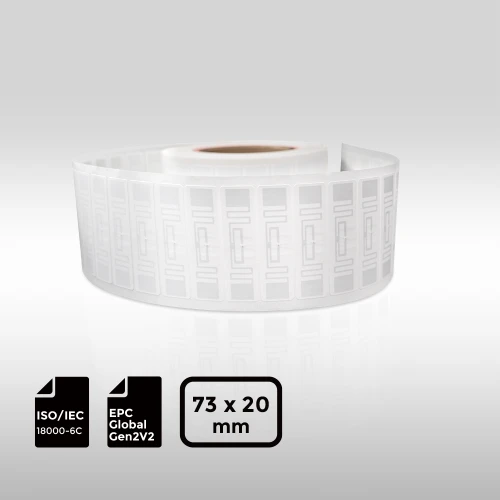
UHF RFID Label Impinj® M730 73×20mm | ISO18000-6C

The M730 RFID Label is a high-performance, versatile label designed for various industrial and commercial applications. Leveraging the advanced Impinj® M730 chip, this label enables solutions for high-speed inventory counting, loss prevention, frictionless self-checkout, and seamless product returns. With a range of EPC and user memory configurations, including cryptographic authentication capabilities, the M730 RFID Label provides unparalleled versatility and security for diverse applications.