


RFID asset tracking news currently highlights a transformative update from GS1 that will redefine supply chain visibility. Historically, RFID tags were digital license plates requiring a private database to interpret. However, with the launch of the GS1 Tag Data Standard (TDS) 2.3, every pallet, carton, and product can now have its own unique web address.
The Dawn of Web-Native RFID: What is TDS 2.3?
The core of the TDS 2.3 update is the introduction of web-resolvable Electronic Product Code (EPC) encoding. This means an RFID tag can now house a domain name alongside its traditional identifier. When scanned, the tag can “phone home” to a specific URL to retrieve or share real-time data.
As Jonathan Gregory, Senior Director of Global Standards at GS1 US, noted, this capability addresses the biggest challenge in global logistics: knowing where to find and share data across fragmented supply chains. Stakeholders can now access a “Digital Product Passport” (DPP) directly through the tag itself.

Comparison: Traditional RFID vs. TDS 2.3 Web-Enabled RFID
| Feature | Traditional RFID | Web-Enabled RFID (TDS 2.3) |
| Data Structure | Binary EPC / Local ID | Web-Resolvable URI / URL |
| Connectivity | Proprietary database | Web-native; “Phones home” |
| Accessibility | Limited to system users | Globally accessible |
| Visibility | Siloed data | Seamless tracking |
Combatting Organized Retail Crime with Digital Breadcrumbs
One of the most practical applications mentioned in recent RFID asset tracking news is the fight against organized retail crime (ORC) and cargo theft. Because TDS 2.3 allows for hierarchical traceability—knowing which items are in which carton and on which pallet—it creates a digital trail that is much harder to break.
If a shipment is intercepted, law enforcement can scan the RFID tags and immediately identify the origin and destination via the embedded web address. This “lowers the friction” for pressing charges and reclaiming stolen property. For a procurement manager, this means reduced insurance premiums and a more secure transit process.

Why Your Logistics Units Need to “Phone Home”
While the EU’s Digital Product Passport focuses on individual items, the immediate value for B2B wholesalers lies in logistics units. Imagine a pallet of RFIDLabel custom tags arriving at a distribution center. With TDS 2.3, that pallet can automatically update its weight, certifications, and storage conditions to a central web service the moment it’s scanned.
Case Study: Retail Efficiency and the 2027 Sunrise Mandate
Practical Benefits for Procurement and Factory Owners
For procurement managers focusing on quality and logistics, the RFID asset tracking news regarding TDS 2.3 offers three advantages:
- Reduced Communication Inefficiency: No more chasing sales reps for shipping updates; the tag provides the link to the data directly.
- Global Traceability: Ensure your RFID labels meet international certifications (like FSMA or DPP) without extra paperwork.
- Cost-Effective Scalability: Smaller businesses can now use low-cost web-based readers instead of expensive middleware.
At RFIDLabel, we specialize in high-quality, customizable RFID solutions ready for these new standards. We ensure our products are compatible with the latest GS1 protocols.

Conclusion
The shift to TDS 2.3 is a landmark moment in RFID asset tracking news. By giving RFID tags their own web addresses, GS1 has bridged the gap between the physical and digital worlds, offering unprecedented transparency for global supply chains. Staying informed is essential for any detail-oriented buyer.
If you are looking to source high-quality, GS1-compliant RFID labels or custom solutions from a reliable Chinese manufacturer with 5 advanced production lines, we are here to help. You can choose to buy related products or get more information about our flexible MOQ and wholesale options at rfidlabel.com.
FAQs
1. Does TDS 2.3 require new RFID hardware?
Most modern RAIN RFID readers can be updated via firmware to support the new URI/URL encoding schemes.
2. How does TDS 2.3 help with the EU Digital Product Passport (DPP)?
TDS 2.3 provides the technical framework for an RFID tag to link directly to a product’s digital passport on the web, fulfilling the core requirements of the DPP regulation.
Recommended Product

ARC Certified Impinj® M730 Coated Paper RFID Label 47x31mm

This ARC-certified RFID label can be used in clothing retail, supply chain management, and brand protection. They not only fully conform to the ISO/IEC 18000-6C and EPCglobal Gen2v2 standards, but their inlays have also completely passed the ARC certification tests, ensuring stable performance and reliable tracking. Ideal for retail chains such as Walmart and Dillard’s, it helps streamline inventory management, enhance supply chain visibility, and maintain brand integrity.
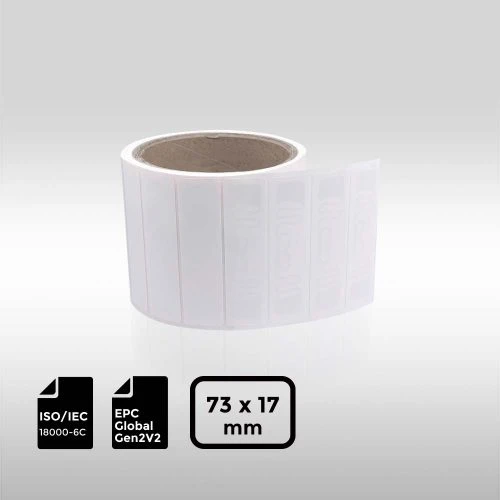
ARC Certified Impinj® M830 RFID Label | 73×17mm
This 73×17 mm ARC-certified Impinj® M830 RFID label is ideal for tagging apparel, footwear, accessories, jewelry, electronics, and toys. Fully compliant with ISO/IEC 18000-6C and EPCglobal Gen2v2 standards, its inlay has passed ARC certification tests. Widely used in retail chains like Walmart and Dillard’s, the label ensures reliable performance, smooth inventory management, and easy in-store deployment.
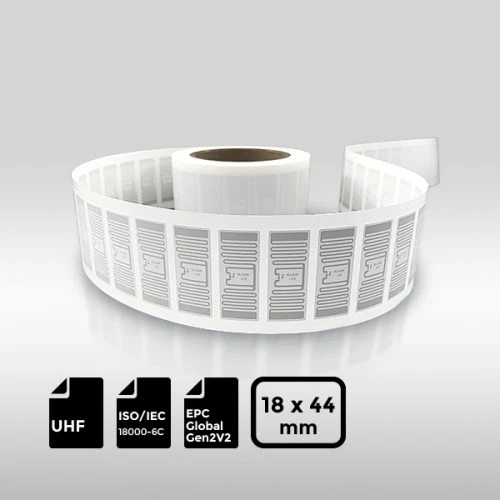
ARC Certified Impinj® M730 Coated Paper RFID Label 44x18mm
This ARC-certified RFID tag for Walmart is designed for clothing retail, supply chain management, and brand protection. Fully compliant with ISO/IEC 18000-6C and EPCglobal Gen2v2 standards, it delivers stable performance and accurate tracking. Passing the ARC certification tests, the label ensures quality and reliability in large-scale retail operations. Ideal for use in retail chains such as Walmart and Dillard’s, it helps streamline inventory management, improve supply chain visibility, and maintain brand integrity.



