Nowadays, people pay more and more attention to the research and protection of the ecological environment. Among them, people began to use animal specimens to study animal behavior and how to better protect rare animals. On this basis, we need to introduce new technical solutions for the accuracy and protection of animal specimen management. In the past, animal specimen management encountered a large number of problems such as damage, loss and mistake classification. Through its high accuracy and high-security characteristics, RFID has gradually become the most ideal solution for animal specimen management.
Overview of RFID technology
RFID is a technology that uses radio waves to automatically identify and track items. It usually consists of an RFID label, a reader and a back-end processing system. Among them, the label can be adhered to the surface of the item or embedded into the item. Each label has a unique identification code to prevent unauthorized tampering and counterfeiting. When the reader reads the signal sent by the label, it will automatically identify the data information of the label and transmit it to the back-end processing system for analysis and storage.
When users use RFID technology in the management of animal specimens, detailed information about animal specimens can be accurately recorded. For example, animal type, collection location, collection time and processing method. This specimen information can be updated at any time, thus improving the efficiency and accuracy of specimen management.
Application of RFID technology in wild collection
Generally speaking, animal researchers need to process a large number of samples when collecting specimens in the wild. In previous processing, researchers needed to write their own to record relevant information about the samples. These include the location, time and environmental conditions of the collection. This not only requires a lot of time, but also requires a lot of energy to record, and is even prone to human errors. RFID can enter data information into the label when collecting a specimen and attach the label to the specimen. This effectively streamlined the entire recording process.
Through the considerable data storage capacity of RFID labels, researchers can store a large amount of sample collection information. In addition, researchers can also use portable RFID readers to quickly read labels, allowing instant updates and writing of data during the collection process. On the other hand, RFID labels have reliable durability. For complex field environments, RFID labels can always maintain stable performance. Such as humidity, cold or high temperatures.
What are the applications of RFID technology in laboratory management?
In the laboratory, specimen management is a complex task. Researchers need to ensure that the identity, origin and historical records of each specimen are preserved accurately and that specific specimens can be quickly found when needed. RFID technology makes this process more efficient and reliable through its automated and precise characteristics.
- Specimen classification and storage
Using RFID labels, laboratories can uniquely identify each specimen, which not only avoids confusion but also allows for the classification and management of specimens when stored. For example, different specimens can be classified and stored based on their type, collection time, or geographical location. When researchers need to find a specific specimen, they can quickly locate the specimen by simply scanning the label with an RFID reader and writer.
- Data management and traceability
RFID labels can not only store basic information about specimens but also record historical data about specimens, such as research projects and experimental results they have participated in. This provides researchers with a comprehensive data traceability system that can view detailed information and use records of specimens at any time. In addition, RFID technology can also be integrated with the laboratory’s LIMS system to realize automatic updates and synchronization of data and further improve management efficiency.
- Preservation and protection
Animal specimens are often fragile and valuable resources that require special care during long-term storage. RFID technology also plays an important role in specimen maintenance and protection. Through the tracking of RFID labels, the laboratory can monitor the environmental conditions of specimens, such as temperature, humidity, etc., to ensure that their storage environment meets requirements. If a specimen is moved or lost, the RFID system can quickly issue an alarm to help researchers take timely measures.
Future prospects of RFID in specimen research
With the continuous advancement of RFID technology, its application prospects in specimen management are very broad. First, RFID technology can be combined with other advanced technologies, such as the IoT and big data analysis, to achieve more intelligent specimen management. For example, with IoT sensors, laboratories can monitor the specimen storage environment in real-time and automatically adjust conditions to ensure specimen integrity.
Furthermore, RFID technology can promote specimen sharing and collaborative research. Through RFID systems, research institutions can more easily share specimen information and data with other organizations, promoting interdisciplinary and cross-regional cooperation. In addition, RFID technology can also be used for the digital management of specimens, supporting virtual display and remote access, and expanding the research and educational value of specimens.
Conclusion
Whether it is wild collection or laboratory management. RFID has gradually changed the way animal specimens are managed. It not only provides researchers and animal research institutions with a more reliable and precise technical solution but also streamlines the process of specimen recording and management. The continuous improvement of RFID technology will expand more application areas for animal specimen management. In the future, we can believe that RFID technology can make more contributions to ecological science research and provide additional assistance to protecting life on earth.
After reading this blog, do you have some idea about the RFID in animal specimen management? If you still need more information, you can visit our official website (www.rfidlabel.com) to browse more product information related to specimen management. We provide RFID labels with different chips on our website, you can choose according to your needs.
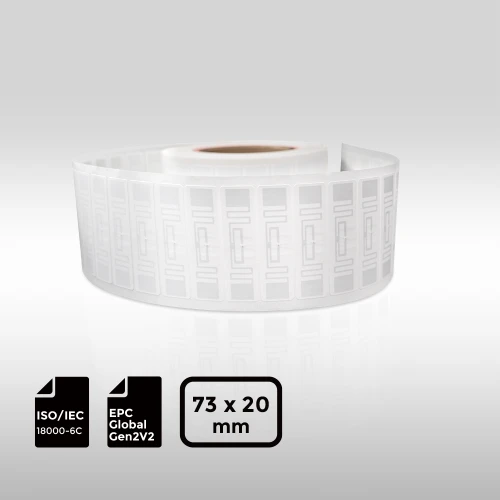
UHF RFID Label Impinj® M730 73×20mm | ISO18000-6C

The M730 RFID Label is a high-performance, versatile label designed for various industrial and commercial applications. Leveraging the advanced Impinj® M730 chip, this label enables solutions for high-speed inventory counting, loss prevention, frictionless self-checkout, and seamless product returns. With a range of EPC and user memory configurations, including cryptographic authentication capabilities, the M730 RFID Label provides unparalleled versatility and security for diverse applications.