


As society enters the process of intelligence and digitization, the field of education follows in the footsteps of society and moves towards the path of intelligence and digitization. Schools are not only a place for students to receive education, but also a place for their safety, and RFID, as an emerging technology that improves safety and efficiency, is becoming an ideal tool for the education sector. This blog will analyze in detail the applications, advantages and challenges of RFID in education.
Introduction of RFID technology
RFID is a technology that uses radio signals to interact with data. Compared to barcode and QR code technology, it does not require any direct contact to read the data. In addition, it can also read a large number of labels at the same time. Effectively improve the processing efficiency of data information.
Usually, a complete RFID system is constructed by RFID labels, readers and background processing systems. Among them, the RFID label is embedded with a microchip and antenna. It is used to store a large amount of data information and adheres to the items that need to be identified. The reader is used to transmit and receive radio signals, which enables direct data interaction with the label.
What are the applications of RFID in campus security?
- Campus access control management
Accurate school access control management is the key to ensuring campus security. By equipping students and staff with RFID smart cards or RFID student ID cards, RFID systems can automatically record the exact time students and staff enter or leave the campus. At the same time, the RFID system generates a report of people entering and exiting, which helps campus administrators keep track of people’s movements. For example, in the event of a natural disaster or security threat, the school can use the RFID system to identify the whereabouts of all the people on campus and arrange effective emergency measures.
- Visitor management
RFID technology is suitable for managing and tracking the movement of students, parents, campus vendors and other external visitors. On the other hand, campus administrators can also provide temporary RFID cards to visitors when they enter the campus. These cards will be restricted by the administrators to access only certain areas. In addition, visitors will not be able to enter or exit other areas of the campus without authorization, thus ensuring maximum security within the campus.
- Emergency evacuation management
In the event of a fire or other emergency on campus, schools can use RFID systems to quickly confirm that all students and staff have been safely evacuated. The RFID system will automatically record the time of departure as people leave the building. The RFID system will sound an alarm if people are staying in the building. Managers will be the first to know that an evacuation has not taken place as expected.
What are the applications of RFID in enhancing campus efficiency?
- Library management
The use of RFID technology can effectively enhance the efficiency of library management. In the past, barcodes needed to be scanned manually to record each book, whereas RFID technology can record a large number of books at the same time. This not only simplifies the process of recording books but also reduces the time needed for students to borrow and return books. On the other hand, by attaching RFID labels to each book, the location of library books can be better tracked.
- Asset management
Because of the large number of resources and equipment on the campus, the school needs a lot of manpower and cost to manage these resources and equipment. Examples of assets include sports equipment, laboratory equipment, and computers. Equipped with RFID labels in these assets, school managers can realize the inventory and location of the assets. Managers can also be alerted by the system promptly when assets are lost or damaged. This greatly improves the efficiency of asset management and reduces the loss of resources.
- Attendance management
One of the most important aspects of education management is student attendance. In the past, teachers had to manually record student attendance. This way will not only consume a lot of time but even prone to record errors. Then, RFID technology can be used to automate the recording of student attendance. When students enter the campus or classroom, the RFID system will automatically record their attendance status and upload that data to the school’s management system. Teachers can spend more time focusing on teaching students instead of wasting a lot of time on students’ attendance records.
- Canteen management
In addition to the above, RFID is also applicable to the management of school canteens. Schools can equip each student with a campus RFID card, which can be used by students to pay for meals in the school canteen. This largely avoids the tedious process of meal transactions and the riskiness of cash transactions. In addition, the school can also analyze the eating habits of students based on the payment data of the card in the canteen and provide a basis for subsequent optimization of the catering service.
What are the advantages of RFID technology?
- High efficiency
The most obvious advantage of RFID technology is that it does not require physical contact or visual alignment. In addition, RFID technology allows multiple labels to be read at the same time, thus improving the efficiency and accuracy of data interaction.
- Safety
RFID systems allow users to use encryption technology to increase the security of data and information protection. Not only can it effectively prevent unauthorized access. It also prevents unruly elements from tampering or stealing data information. On the other hand, RFID technology further optimizes the security of the system by integrating bio-metrics.
- Timeliness
RFID systems can track the location and status of people or assets promptly, thus helping managers make decisions in the shortest possible time. For example, in the event of natural disasters and other emergencies, administrators can check the RFID system to confirm the whereabouts of people on the campus and arrange emergency relief measures in an orderly manner.
- Easy to integrate
Because RFID technology has excellent compatibility characteristics, the existing school management system can be seamlessly integrated with the RFID system. Data sharing and collaboration between the two systems is achieved. This ensures the consistency and integrity of the school’s data management.
What challenges does RFID technology face?
- Privacy issues
Despite the convenience that RFID technology brings to campus management, it also raises privacy concerns among students and staff. Because personal whereabouts data are fully recorded and managed by the system, the supervises may feel uncomfortable. To be able to better balance personal privacy and campus security, school administrators need to have a clear and detailed privacy policy. They need to ensure that personal data is used correctly and with the consent of the person concerned.
- Cost problem
Although RFID technology can significantly improve management efficiency and reduce operating costs in the long run, the initial investment in RFID technology can be significant. However, the initial investment in RFID technology will be a significant expense. For example, the cost of purchasing, installing and maintaining RFID equipment. Therefore, for some schools with limited budgets, the implementation of RFID technology will face considerable financial pressure.
- Technical compatibility issues
The selection of different brands and models of RFID equipment will have technical compatibility issues and the entire RFID system integration difficulties. When deploying RFID technology, schools need to fully evaluate various vendors’ devices to ensure that they can be connected to existing systems.
Conclusion
With the introduction of RFID technology in the education sector, the security and management efficiency of campuses have been significantly improved. At the same time, schools should also fully consider factors such as privacy protection and technology compatibility. Only with a full understanding of RFID technology, schools can realize the maximum potential of RFID technology to provide a safer, more efficient and smarter learning environment for students and staff. In the future, RFID technology can become a key enabler for schools to move towards modernization and intelligence.
After reading this blog, if you are interested about RFID technology in education, you can visit our official website (www.rfidlabel.com) to browse more information about it. If you want to get solutions for RFID technology, please contact our sales experts, who will provide you with the suitable solutions and the professional suggestions according to your needs.
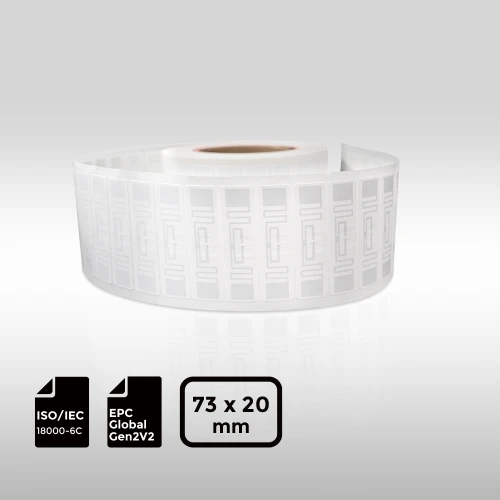
UHF RFID Label Impinj® M730 73×20mm | ISO18000-6C

The M730 RFID Label is a high-performance, versatile label designed for various industrial and commercial applications. Leveraging the advanced Impinj® M730 chip, this label enables solutions for high-speed inventory counting, loss prevention, frictionless self-checkout, and seamless product returns. With a range of EPC and user memory configurations, including cryptographic authentication capabilities, the M730 RFID Label provides unparalleled versatility and security for diverse applications.



