


Today, we are in an era of rapid development of the Internet of Things. As a new technology in the Internet of Things era, RFID has become an ideal tool in all walks of life. Among them, the RFID reader is a key component of the entire system, and it will directly affect the performance of the RFID system. For example, read range, data transfer rate and system stability. On this basis, if users want to ensure the best performance of the RFID system, they must fully understand the reader antenna and optimize it. This blog will provide a comprehensive analysis of how RFID reader antennas work and the main factors that affect their performance.
Working principle of RFID reader antennas
The RFID reader antenna constructs data information interaction with the label by transmitting and receiving radio waves. The design and selection of antennas have a direct impact on the signal transmission range, directionality and overall efficiency of the RFID system.
Among them, linear polarization and circular polarization are common types of RFID reader antennas. They all have their unique characteristics. First of all, the radio wave vibration direction of linearly polarized antennas is single, which is more suitable for applications where the direction of labels is fixed or predicted. Secondly, circularly polarized antennas have wider coverage and are ideal for use in applications where the label direction is difficult to predict.
What are the key factors that affect the performance of RFID reader antennas?
- Frequency range
In different applications, RFID systems adapt to different operating frequency ranges. The three most common operating frequencies are low-frequency, high-frequency and ultra high-frequency. Each operating frequency has different requirements for antenna design. For ultra high-frequency bands, reader antenna designs tend to focus on better gain and directionality. This allows the reader to achieve a longer reading range. In addition, reader antennas in the high-frequency band focus on short-range accuracy and anti-interference functions. Therefore, when selecting the reader antenna, users need to consider the working frequency band of the RFID system to ensure the matching between frequencies.
- Antenna gain
On the other hand, the reader’s antenna gain determines its ability to amplify signals in a specific direction. High-gain antennas can provide stronger signals over long distances but are often accompanied by narrower coverage. In contrast, low-gain antennas provide wider coverage but have lower signal strength over long distances. Depending on the needs of the application scenario, selecting an antenna with appropriate gain can help improve the performance of the RFID system. For example, in large warehouses or vast outdoor environments, high-gain antennas help achieve long-range readings, while in retail stores or office environments, low-gain antennas can provide more uniform coverage.
- Antenna directionality
The directivity of an antenna determines its signal distribution in space. Highly directional antennas can concentrate signals in a specific direction, which is suitable for applications that require precise positioning, such as monitoring a specific area of a production line. In contrast, low-directional antennas can cover a wider area and are suitable for a wide range of tag reading needs. In practical applications, the directivity of the antenna needs to match the installation position and label distribution to ensure effective signal coverage.
- Antenna location and environmental factors
The installation location and surrounding environment of the antenna can also significantly affect its performance. Metal objects, liquids, and other sources of electromagnetic interference can cause signal attenuation or multi-path effects, which can reduce the system’s reading performance. When installing the antenna, try to avoid these potential interference factors and choose the appropriate installation height and angle. In addition, in multiple antenna systems, the distance and relative position between antennas also need to be accurately adjusted to avoid mutual interference of signals.
- Impedance matching
To maximize the power transfer efficiency of the antenna, the impedance of the antenna needs to match the output impedance of the reader. Generally, the output impedance of the reader in an RFID system is 50 ohms, and the antenna design should also try to achieve this value. If the impedance is not matched, it will cause signal reflection and power loss, which will reduce reading performance. Adjustment of impedance matching can be achieved by using a matching circuit or adjusting the antenna structure.
Recommendations for optimal performance of RFID reader antennas
- Regular testing and calibration
The performance of an RFID system may gradually degrade due to changes in time and the environment, so regular testing and calibration of the antenna is a critical step in maintaining optimal system performance. Using professional test equipment, parameters such as antenna gain, directionality, and impedance matching can be measured and adjusted in time to cope with any changes.
- Optimize antenna layout
For multiple antenna systems, a reasonable antenna layout can significantly improve system performance. The distance, angle and relative position between the antennas and the tags need to be carefully designed to avoid signal overlap or blind spots. Through simulation software or actual testing, optimizing antenna layout can achieve more uniform coverage and higher reading efficiency.
Conclusion
All in all, RFID reader antennas are the main factor affecting the performance of RFID systems. Users can effectively improve the overall efficiency and data reliability of the RFID system by selecting the corresponding operating frequency, antenna gain, antenna directionality, antenna position and environmental factors. In the future, we believe that with the continuous improvement of RFID technology, the performance requirements of reader antennas will gradually increase. Only by maintaining attention to antenna performance and continuous optimization can users occupy a leading position and competitiveness in a competition-inspired market.
If you want to browse more information about RFID reader antennas, you can visit our official website (www.rfidlabel.com). Also, you can use the contact information on the website to contact our sales experts, who will provide you with the suitable RFID solutions and the professional product purchase advice according to your needs.
Recommended Product
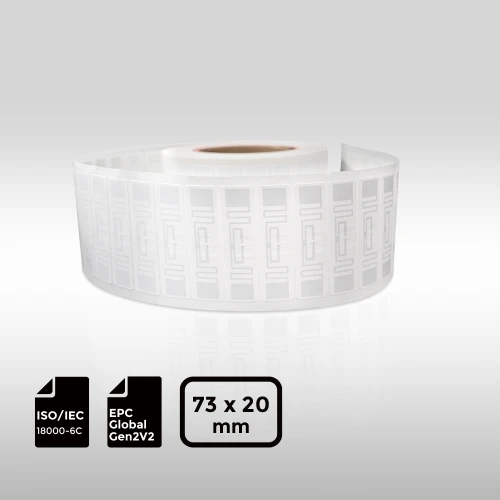
UHF RFID Label Impinj® M730 73×20mm | ISO18000-6C

The M730 RFID Label is a high-performance, versatile label designed for various industrial and commercial applications. Leveraging the advanced Impinj® M730 chip, this label enables solutions for high-speed inventory counting, loss prevention, frictionless self-checkout, and seamless product returns. With a range of EPC and user memory configurations, including cryptographic authentication capabilities, the M730 RFID Label provides unparalleled versatility and security for diverse applications.



