


RFID tags for garments should be selected by how well they perform in real apparel retail workflows, not by chip name or label price alone. A tag that works on a single T-shirt on a desk may behave differently on a packed rail, a folded denim stack, a checkout counter, or a carton moving through receiving.
For apparel retailers, RFID is not only a labeling tool. It becomes part of inventory counting, stockroom visibility, replenishment, checkout, returns, and omnichannel fulfillment. That means the right tag needs to work across the full retail process.
This guide explains five practical metrics to evaluate before ordering RFID tags for garments:
- Read rate
- Bulk reading
- EPC encoding
- Checkout compatibility
- Tag durability
The goal is simple: choose a garment RFID label that supports accurate stock data, faster store operations, and a smoother path from factory to selling floor.
Why Apparel Retailers Need a Selection Framework

Garment retail is SKU-heavy. One style may come in several sizes, colors, collections, price points, and regional assortments. If staff rely only on barcode scanning, each item must be found, handled, aligned, and scanned one by one.
RFID tags for garments allow item-level identification without direct line-of-sight. A handheld RFID reader can scan multiple garments on a rack. A fixed reader can help verify goods during receiving. A checkout reader can identify several items together when the system is designed correctly.
Still, not every apparel RFID tag serves the same purpose.
A disposable UHF RFID hang tag for fashion retail, a care label for inner garment identification, an RFID laundry tag for reusable textiles, and a heat press NFC garment badge for brand engagement are built for different jobs. Before choosing a tag, retailers should first define the workflow they want to improve.
| Retail Need | Best-Fit Tag Type | Why It Fits |
| Fashion store inventory | UHF RFID hang tag | Strong for item-level bulk reading |
| Folded apparel or inner labeling | RFID care label | More integrated with the product |
| Uniforms, linens, rental garments | RFID laundry tag | Designed for industrial washing, textile circulation, and repeated garment management |
| Premium product authentication | Heat press NFC garment badge | Smartphone interaction and secure digital verification |
| Carton or packaging control | UHF RFID sticker label | Practical for logistics and receiving |
For fashion store inventory, UHF RFID hang tags are usually the first option to test because they support bulk reading and item-level stock visibility.
Metric 1: Read Rate
Read rate means the percentage of tagged garments successfully detected during a scan. For RFID tags for garments, this is the first metric to test because the business value of RFID depends on reliable item detection.
A good read rate helps retailers keep inventory data close to reality. This affects size availability, shelf replenishment, online order fulfillment, and store-to-store transfers.
Retailers should not test tags only in open air. The test should use real garments and real scanning conditions.
What to Test
Recommended test scenes include:
- Hanging garments on a dense rail
- Folded garments on a shelf
- Garments packed in a carton
- Mixed fabrics such as cotton, denim, leather, wool, and synthetic materials
- Items placed near zippers, buttons, hangers, mirrors, shelves, or checkout fixtures
What the Test Should Record
| Test Item | What to Record |
| Reader type | Handheld reader, fixed reader, tunnel reader, checkout reader |
| Read distance | Short range, shelf range, stockroom range |
| Tag position | Hang tag, care label, side seam, waistband |
| Garment state | Hanging, folded, stacked, boxed |
| Scan result | Read count, missed reads, repeated reads, scan time |
Metric 2: Bulk Reading

Bulk reading is the ability to identify many garments at once. This is one of the main reasons apparel retailers use RFID instead of relying only on barcodes.
Barcode scanning is item-by-item. RFID scanning can identify multiple items in one pass, depending on the tag, reader, antenna setup, item density, and scanning environment.
RFID tags for garments can support bulk reading in several retail workflows:
- Receiving goods into the store
- Counting items on racks
- Checking stockroom availability
- Verifying pick lists for online orders
- Preparing click-and-collect orders
- Processing returns and transfers
- Auditing high-turnover product categories
How to Test Bulk Reading
A useful test should include 30, 50, or 100 tagged garments together, not just one item at a time. The garments should be tested while hanging, folded, stacked, and packed inside cartons.
| Test Setup | Why It Matters |
| 50 hanging garments | Simulates store cycle counting |
| 100 folded garments | Tests dense fabric and tag orientation |
| Mixed sizes and colors | Checks SKU-level identification |
| Carton scan before unpacking | Supports receiving and shipment verification |
| Basket or checkout tray | Tests transaction-level item recognition |
Metric 3: EPC Encoding
EPC encoding turns RFID tags for garments into unique digital item identities. This is what allows a retailer to distinguish one physical garment from another, even when both items are the same style, color, and size.
Without a clear encoding plan, the tag may still be readable, but the data may not connect properly with the retailer’s system.
For example, the system needs to know that a specific encoded tag belongs to:
- A particular SKU
- A specific size
- A specific color
- A specific product line
- A unique item identity
- Possibly a barcode or serial number
This connection is important for inventory accuracy, checkout, returns, replenishment, and omnichannel order fulfillment.
EPC Encoding Checklist
Before ordering RFID tags for garments in bulk, retailers should confirm the following points:
| Encoding Factor | Why It Matters |
| EPC structure | Keeps item identity consistent across systems |
| SKU mapping | Connects the tag to the correct product record |
| Serial uniqueness | Prevents duplicate garment identities |
| Barcode matching | Helps stores use RFID and barcode workflows together |
| Print verification | Confirms printed data matches encoded data |
| Sample file approval | Reduces errors before mass encoding |
Questions to Ask Before Production
A good encoding process should answer these questions:
- Will each garment have a unique item-level identity?
- Will the EPC data match the printed barcode?
- Will the encoded data connect correctly with the POS, ERP, WMS, or inventory system?
- Can the supplier provide pre-encoded tags?
- Can variable data, such as size, color, SKU, and barcode, be printed on the same label?
- Can samples be verified before full production?
Metric 4: Checkout Compatibility

Checkout compatibility means the RFID tag works with the way the retailer sells items. A tag used only for stock counting may not need the same setup as a tag used for quick checkout, self-checkout, mobile checkout, or return counters.
Retailers should test RFID tags for garments near real checkout equipment, not only in the stockroom.
Important Checkout Questions
Retailers should check:
- Can the system identify all items in a basket or tray?
- Can the POS match EPC data to the correct SKU and price?
- Can the reader avoid detecting nearby items that are not part of the sale?
- Can the tag support returns and exchanges?
- Does the tag remain readable after fitting room handling?
- Should the tag be removed, deactivated, or kept with the product after purchase?
Checkout Workflow Comparison
| Checkout Model | Tag Requirement |
| Cashier checkout | Fast and clear item recognition |
| Self-checkout | Basket-level reading with limited unwanted reads |
| Mobile checkout | Stable reads in different store zones |
| Return counter | Reliable item identity after sale |
| Omnichannel pickup | Accurate matching between order and physical item |
Metric 5: Tag Durability

Tag durability should match the garment lifecycle. A fashion hang tag used only until sale does not need the same construction as an RFID laundry tag used on uniforms, linens, towels, or rental textiles.
Disposable Retail Hang Tags
For disposable retail hang tags, the tag should be printable, brand-friendly, easy to attach, and reliable during normal handling. These tags are commonly used for fashion apparel, store inventory, receiving, and checkout.
Sewn-In or Care-Label RFID
For sewn-in or care-label RFID, the tag becomes more integrated with the garment. This option is often relevant for uniforms, workwear, rental apparel, and products that need longer-term identification.
RFID Laundry Tags
For reusable garments, uniforms, linens, towels, and rental textiles, RFID laundry tags are more suitable than ordinary retail hang tags or general washable labels. These tags are designed for industrial laundry and fabric management, where garments may go through repeated washing, drying, sanitizing, ironing, sorting, and circulation.
RFID laundry tags can be sewn, heat-pressed, or embedded into textiles, depending on the product structure and the textile application. They are commonly used in hotels, hospitals, laundry facilities, corporate uniform management, and other textile circulation workflows.
Heat Press NFC Garment Badges
For NFC garment badges, the goal is different. NFC is usually used for authentication, digital product information, care guidance, product registration, or customer engagement. It is not a replacement for UHF bulk inventory scanning, but it can complement a UHF RFID system for selected products.
| Tag Format | Best Use | Key Advantage |
| UHF RFID hang tag | Apparel store inventory | Bulk reading and easy attachment |
| RFID care label | Inner garment identification | Discreet item-level tracking |
| RFID laundry tag | Uniforms, linens, towels, and reusable textiles | Industrial washing resistance and long-term textile tracking |
| Heat press NFC garment badge | Authentication and customer engagement | Smartphone-readable interaction |
| UHF sticker label | Packaging and cartons | Simple logistics tagging |
Real-World Example: Inditex and Zara
The company explained that RFID allowed garments to be individually identified from the moment they were fitted with security tags at logistics platforms until they were sold. This allowed store teams to locate items quickly and precisely. RFID also supported wider retail projects, including integrated online and offline shopping, quick checkout registers, and improved customer service workflows.
This case shows that RFID works best when the label, logistics process, store operation, checkout process, and customer experience are planned together.

How RFIDLabel Products Fit Garment Retail Projects
RFIDLabel products can support different garment and apparel retail applications. The best option depends on the workflow the retailer wants to improve.
1. UHF RFID Hang Tags for Apparel Inventory
For store counts, stockroom visibility, receiving, and item-level apparel tracking, a dedicated UHF RFID hang tag is usually a better starting point than a general RFID label category.
One suitable option is the Impinj® Monza® R6-P RFID Hang Tag. It is designed for apparel applications and can be integrated into clothing hangtags for tracking and inventory management. The tag uses UHF 860–960 MHz, supports ISO/IEC 18000-6C and EPCglobal Gen2v2, and comes in a 110×37 mm hang tag format.
Advantages
- Designed specifically for apparel hangtag use
- Suitable for item-level garment inventory
- Supports bulk reading in store and stockroom workflows
- Uses Impinj® Monza® R6-P chip
- Supports ISO/IEC 18000-6C and EPCglobal Gen2v2
- Can work with printed garment information such as SKU, size, barcode, and brand content
- More relevant for garment retail than a general UHF RFID label category
→ Click to learn more: Impinj® Monza® R6-P UHF RFID Hang Tag
2. RFID Laundry Tags for Reusable Garments and Textile Circulation

For uniforms, hotel linens, hospital textiles, towels, rental garments, and industrial laundry workflows, RFID laundry tags are a better fit than ordinary retail hang tags or general washable labels.
These tags are designed for textile circulation environments where each item may need to remain identifiable through repeated washing, drying, sanitizing, ironing, sorting, storage, and redistribution. They are especially useful when the goal is not only apparel inventory, but long-term textile lifecycle management.
Advantages
- Designed for industrial laundry and fabric management
- Suitable for uniforms, bed linens, towels, rental garments, and reusable textiles
- Supports long-term textile identification across washing and circulation cycles
- Can be sewn, heat-pressed, or embedded into fabrics depending on the application
- Helps track cleaning cycles, textile lifespan, inventory status, and item movement
- Suitable for hotels, hospitals, laundry facilities, and corporate uniform management
- More relevant for reusable garment workflows than a general washable textile label category
→ Click to learn more: RFID Laundry Tags
Related videos: Comparative Performance Test of Washable Smart Textile RFID Tags

Washable Smart RFID Tags: Testing Read Range, Anti-Collision and Post-Wash Sensitivity

Comprehensive Performance Test of the Washable Textile RFID Tag

3. Heat Press NFC Garment Badges for Brand Protection and Customer Interaction
For premium garments, limited-edition apparel, sportswear, uniforms, fan merchandise, and branded clothing, NFC can add value beyond inventory management. Instead of using NFC only as a generic label, apparel brands can use a heat press NFC garment badge to connect the physical garment with digital authentication, product information, membership content, care guidance, or brand storytelling.
A suitable product is the Heat Press Interactive NFC Garment Badge with NTAG® 424 DNA. It uses HF 13.56 MHz, supports ISO/IEC 14443-A and NFC Forum Type 4 Tag, and contains an NXP NTAG® 424 DNA chip. The product page also lists AES-128 encryption, 416 bytes user memory, a 7-byte UID, up to 10 cm operating distance, and 50+ washes or dries.
Advantages
- Designed for garment use, not just general NFC labeling
- Heat press application makes it suitable for apparel and textile products
- Uses NXP NTAG® 424 DNA for secure NFC authentication
- Supports AES-128 encryption
- Enables smartphone-based product interaction
- Can support anti-counterfeiting, digital content, brand promotion, and post-sale engagement
- Useful for premium garments, limited drops, sportswear, fan merchandise, and branded apparel
→ Click to learn more: NTAG® 424 DNA Heat Press Interactive NFC Garment Badge
Related videos: NFC Garment Badge Heat Press Tutorial

NFC Garment Badge Anti-counterfeiting And Social Functions

4. Dual-Frequency RFID Labels for Inventory and Interaction
Some garment projects may need both UHF and NFC functions. UHF can support inventory counting and logistics visibility, while NFC can support customer-facing interaction or product authentication.
For these applications, a dual-frequency RFID label can be considered. It can help brands connect supply chain visibility with consumer engagement, especially when the garment needs both operational tracking and post-sale digital value.
Related videos: How To Use EM4425 RFID Labels For Inventory Management and Product Interaction

Product Testing and Video Evidence
Product specifications are useful, but apparel RFID projects should also be evaluated through practical testing. Garments may be scanned while hanging, folded, stacked, boxed, washed, or handled at checkout. That is why test videos can help buyers understand how different RFID and NFC garment tags behave in practical use.
RFIDLabel and related product channels provide several video demonstrations that can support the selection process, including inventory comparison, RFID laundry tag testing, NFC garment badge heat press installation, and NFC anti-counterfeiting interaction.
Suggested Videos to Review
| Video Content | What It Helps Evaluate | Related Videos |
| RFID vs. manual inventory | How RFID bulk reading compares with manual inventory counting | Watch video |
| RFID laundry tag performance | Read range, anti-collision, and post-wash performance | Watch video |
| RFID laundry tag comparison | Performance comparison for washable garment and textile RFID tags | Watch video |
| RFID laundry tag performance test | Group reading and long-range reading evaluation | Watch video |
| EM4425 dual-frequency RFID label use | UHF inventory management plus NFC product interaction | Watch video |
| NFC garment badge heat press tutorial | How the NFC badge is applied to a garment | Watch video |
| NFC garment badge anti-counterfeiting and social functions | How NFC supports authentication and customer interaction | Watch video |
Buying Checklist: Questions to Ask Before Ordering
Before ordering RFID tags for garments in bulk, retailers should answer these questions:
- Which workflow should the tag support: inventory, checkout, returns, laundry, authentication, or customer engagement?
- Will the tag be attached as a hang tag, care label, sticker, heat press badge, sewn-in laundry tag, or embedded textile tag?
- Which reader will be used: handheld reader, fixed reader, tunnel reader, checkout reader, laundry tunnel reader, or NFC smartphone?
- What EPC structure and printed data are required?
- Do you need barcode and EPC matching?
- Will the garment be folded, stacked, boxed, industrially washed, sanitized, ironed, returned, reused, or circulated after sale?
- Do you need UHF for bulk inventory, NFC for customer interaction, an RFID laundry tag for textile circulation, or a dual-frequency solution?
- Can the supplier provide samples and test videos before production?
- Does the selected product already have a relevant test video or application demonstration?
- Can the product be customized with size, logo, barcode, EPC encoding, or secure NFC content?
This checklist helps turn RFID tag selection from a general product search into a practical buying decision.

Conclusion
RFID tags for garments should be chosen through practical testing, not only by comparing datasheets. Read rate, bulk reading, EPC encoding, checkout compatibility, and durability all affect how well the system performs once tags move from sample testing to real retail operations.
For apparel retailers, the right label can support faster counts, cleaner stock data, smoother checkout, stronger product authentication, and better omnichannel execution. For textile circulation teams, the right RFID laundry tag can also support long-term tracking across washing, sorting, reuse, and redistribution.
To explore suitable RFID tags for garments, visit rfidlabel.com and review application-ready options such as the Impinj® Monza® R6-P RFID Hang Tag for apparel inventory, RFID laundry tags for reusable garments and textile circulation, and the NTAG® 424 DNA Heat Press NFC Garment Badge for brand protection and customer interaction. You can also request samples or a quote to test the right tag format before mass production.
FAQ
1. What is the best RFID tag type for garment retail?
For most apparel retail inventory projects, UHF RFID hang tags are the best starting point because they support bulk reading and item-level stock visibility. For reusable garments, uniforms, linens, towels, or industrial laundry workflows, RFID laundry tags are usually more suitable because they are designed for repeated textile circulation and washing.
2. Are RFID tags for garments the same as NFC clothing labels?
No. UHF RFID tags are usually used for inventory, receiving, checkout, and supply chain tracking. NFC clothing labels are mainly used for smartphone interaction, authentication, product storytelling, and customer engagement. Some projects use both technologies for different purposes.
Recommended Product
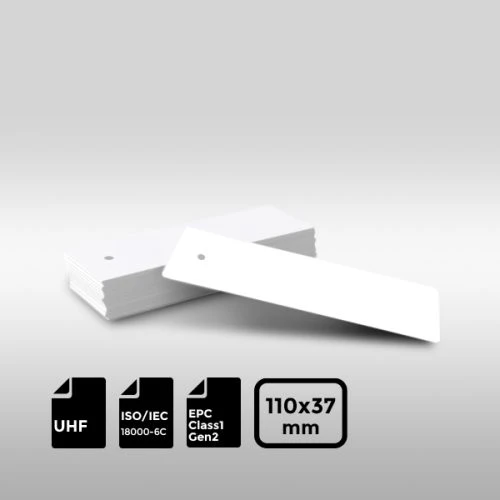
UHF RFID Hang Tag Impinj® Monza® R6-P 110×37mm | ISO18000-6C

The Impinj® Monza® R6-P RFID Hang Tag is specifically designed for the apparel industry. This hangtag seamlessly integrates into clothing hangtags, ensuring accurate tracking and inventory management. It effectively safeguards merchandise against theft and counterfeiting, while maintaining stability and performance advantages. The Impinj® Monza® R6-P RFID Hang Tag enhances operational efficiency for clothing brands and protects brand integrity.



