


As technology continues to advance, more and more businesses and organizations are relying on efficient and reliable technology to safeguard their security. Among the many emerging technologies, RFID technology stands out for its unique advantages and is being used in a wide range of applications. This blog will take a closer look at the importance of RFID technology in security measures and its application scenarios.
What does RFID technology mean
RFID technology is a technology for data transmission and identification through radio waves. It consists of three main components: tags, readers, and back-end systems. Among them, the tag has a built-in microchip and antenna that can store data. The reader is responsible for reading and writing the tag information. The back-end system is used to process and store the data.
What are the benefits of RFID technology
Firstly, RFID can identify objects without touching them, which greatly facilitates data reading and management. Secondly, RFID readers can read multiple tag information at the same time, effectively improving work efficiency. In addition, RFID tags usually have strong anti-interference ability and environmental adaptability, suitable for a variety of complex environments. And RFID tags can store more data than traditional barcodes, providing more information support.
How to apply RFID Technology in Security measures
We will illustrate the use of RFID technology in security measures in the following four areas.
- Logistics & supply chain security
In logistics and supply chain management, the application of RFID technology significantly improves the traceability and security of items. By attaching RFID tags to each piece of cargo, the flow of goods can be checked to ensure the safety of items in transit.
- Access control
RFID technology is widely used in access control systems in office buildings, factories, and schools where access control is required. The traditional key and password access control system is prone to problems such as losing and forgetting passwords, while the RFID access control system is more secure and convenient. The RFID system records every time a person enters or leaves, which is convenient for administrators to enquire and manage.
- Product anti-counterfeiting
RFID technology is also widely used in the anti-counterfeiting field. By using RFID tags implanted with UID, the circulation of counterfeit products can be effectively prevented. Consumers can read the tag information to confirm the authenticity of the product and protect their rights and interests.
- Safety of medical treatment
The application of RFID technology in healthcare is mainly reflected in patient identification and drug management. Wristbands with built-in RFID chips worn by patients when they are admitted to hospitals record basic patient information and treatment plans. Doctors and nurses can quickly access patient information through the reader to ensure the accuracy and safety of treatment. In addition, every box of medication in the hospital is affixed with an RFID tag, which records information such as the date of manufacture and expiry date. With the record of the RFID system, the hospital can monitor the drug inventory in real-time to avoid expiry or shortage of drugs and improve the safety of drug management.
Advantages of RFID Technology in Security measures
The following are four examples of the advantages of RFID technology in security measures.
- Real-time and accuracy
RFID technology can realize the in and out monitoring and management of goods and personnel, ensuring timely updates and accuracy of data. For example, in logistics and supply chain management, RFID tags can record the quantity and situation of goods in and out of the warehouse, helping managers find and solve problems in time.
- Convenience and efficiency
Compared with traditional barcode technology, RFID technology does not require human intervention, and the reader can automatically read the tag information, which improves work efficiency. In addition, RFID technology can read multiple tags at the same time, further enhancing the convenience and efficiency of data collection.
- Data capacity and variety
RFID tags can store a large amount of data, including the basic information of the items, flow records, and so on. All these data can provide rich information support for managers and help them make more accurate decisions.
- Security and Anti-counterfeiting
RFID tags are unique and difficult to copy, which can effectively prevent the circulation of counterfeit products. In addition, RFID technology can realize the supervision of goods and guarantee the safety of goods in the process of transportation, storage, and use.
Conclusion
With the development of IoT technology, the application of RFID technology in security measures is very promising. In the future, RFID technology will play a more important role in the security and management efficiency of enterprises under the combination of technologies such as artificial intelligence and big data. In addition, through a large amount of data mining and utilization, RFID technology provides more accurate decision-making support for enterprise managers and also brings more value and security to enterprises and society.
After reading this blog, if you are interested in RFID technology related information, you can visit our official website (www.rfidlabel.com) to browse. In addition, if you have related needs, please feel free to contact our sales experts, who will provide you with the most suitable solutions and the most professional purchasing suggestions according to your needs.
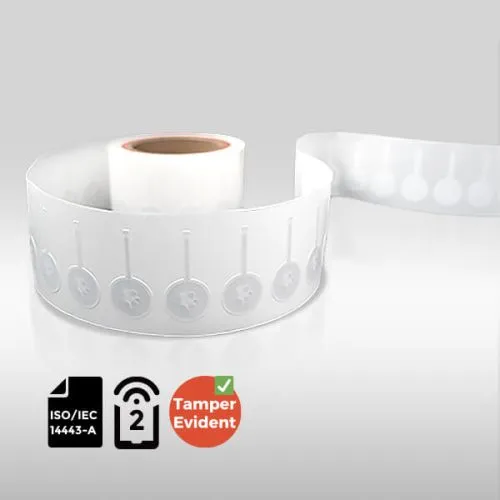
ISO14443A 13.56MHz NFC Label/Inlay NXP NTAG® 213 TagTamper

NTAG® 213 TagTamper offers several features to protect brands and enable advanced anti-counterfeiting as well as tamper-proofing. Furthermore, it lets brand owners have a direct engagement with consumers.



