


As technology continues to advance, the application of RFID technology is becoming more and more widespread. From logistics management to asset tracking, RFID tracker stickers are being used with increasing frequency. However, with the popularity of the technology comes growing concerns about security and privacy protection. This blog will explore how RFID tracker stickers are achieved to ensure security and privacy protection.
Introduction of RFID technology
RFID technology uses radio waves for data transmission and consists of electronic tags and readers. RFID tracker stickers are tags that contain tiny antennas and chips that are attached to items for identification and tracking of items. Most of the RFID tags used in the market today are passive tags. Passive tags rely on the electromagnetic field activation of the reader, which has a relatively short signal transmission distance.
How RFID tracker stickers ensure security?
In the following we will list the ways in which RFID tracker stickers are secured security.
- Data encryption
To prevent data from being intercepted during transmission, RFID systems usually use encryption. Common encryption algorithms are symmetric encryption (AES) and asymmetric encryption (RSA). Through encryption, only the device holding the correct key can decrypt and read the data in the sticker, ensuring information security.
- Access control
RFID systems can be set up with an access control mechanism so that only authorized readers can communicate with the sticker. This mechanism can be implemented by way of whitelisting or blacklisting to ensure that only trusted devices can access the sticker data. For example, the management system of a warehouse can be set up so that only designated readers can read the sticker information of the goods, thus preventing unauthorized access.
- Anti-collision technology
In RFID systems, multiple stickers may respond to the same reader request at the same time, resulting in data collision. Anti-collision technology improves the reliability of the system by coordinating the timing of sticker responses to avoid data collision. Common anti-collision techniques are TDMA and FDMA.
- Tag blocking function
In some application scenarios with high-security requirements, RFID stickers with tamper-resistant features may be required. When such stickers are damaged and torn, the chip is automatically shielded from being read again, ensuring that sensitive information is not compromised.
How RFID tracker stickers provide privacy protection?
We will list four ways in which RFID tracker stickers provide privacy protection.
- Data anonymization
To allow for the protection of user privacy, the data in RFID stickers can be anonymized. For example, instead of storing information in the sticker that directly identifies an individual, a UID is used, which can only be associated with information about a specific individual or item through a back-end database, so that even if the sticker data is intercepted, the individual cannot be directly identified.
- Data minimization principle
When designing an RFID system, the principle of data minimization is followed. That is, only the necessary data are collected and stored, reducing the processing and transmission of sensitive information. For example, in a library lending system, RFID stickers store only the book number without storing the borrower’s personal information, so that even if the tag data is intercepted, the borrower’s privacy will not be compromised.
- Tag disabled and blocked
Users can protect privacy by disabling or blocking stickers. Disabling a sticker means turning off the wireless communication capabilities of the tag so that it cannot be read. Shielding stickers, on the other hand, use shielding materials to block the sticker’s wireless signal. In the retail industry, customers have the option of disabling or blocking it after purchasing an item to prevent it from continuing to send information.
- Reader distance control
The working distance of the RFID reader can be controlled by adjusting the power and antenna design. In terms of privacy protection, the operating distance of the reader can be set as short as possible, so that the tag data can only be read at close range, reducing the risk of the tag being read at a distance. For example, in access control systems, the effective reading distance of the reader is usually only a few centimeters, ensuring that the tag data can only be read when the holder is close to the reader.
Conclusion
In conclusion, RFID tracker stickers face security and privacy protection challenges while enhancing the efficiency and convenience of asset management. Effective measures such as encryption, access control, and data anonymization are used to improve the security and privacy protection of RFID systems. In the future, with the introduction of advanced technologies such as block-chain and artificial intelligence, RFID systems will achieve higher security and intelligence, providing users with more secure and reliable services.
FAQ
Which tracker stickers with higher data security are available?
Among our branded RFID tag stickers, the Impinj Monza R6-P series, NXP MIFARE Ultralight series and NXP NTAG 213 TT series offer higher data security and privacy protection. This is because they were originally designed for tamper- resistant use.
If you still need more information, you can visit our official website rfidlabel.com to browse the relevant information about RFID tag stickers.
Recommended Product
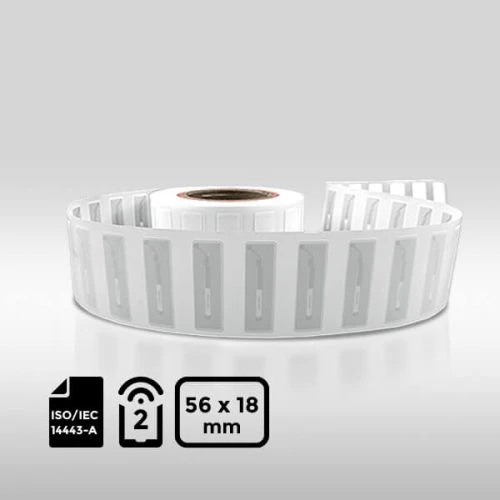
RFID Label 56x18mm NXP MIFARE Ultralight® EV1 50pf | ISO14443A

RFID Label 56x18mm featuring NXP MIFARE Ultralight® EV1 with a precise 50pF capacitance for optimal read range and performance. Adhering to the ISO14443A standard, this label incorporates the Ultralight® EV1’s advanced security mechanisms, including password protection and originality signature.



