


With the popularity of RFID technology, the use of RFID tag stickers in supply chain management, apparel retailing, healthcare, and logistics is becoming more and more common. However, the issue of data security in RFID tags has also arisen. How to secure the data in RFID tag stickers has become an important issue that needs to be addressed urgently. This blog will discuss how to address the data security challenges of RFID tag stickers and provide practical protection measures.
What is the challenges for RFID tag stickers
- Data stealing
The data in RFID tags can be transmitted via radio waves, which makes the tags vulnerable to unauthorized reading. If the tags store sensitive information, such as personal identities, financial data, or trade secrets, it could lead to serious consequences if it is stolen by the wrong people.
- Data tampering
In addition to data theft, the data in RFID tags can be tampered with. Unscrupulous individuals can defraud the system by tampering with the data in the tags for illegal purposes. Such tampering can lead to inventory management disruption, product recalls, and even jeopardize consumer safety.
- Data corruption
The data in RFID tags can be damaged due to environmental factors such as high temperatures, strong magnetic fields, or human damage. Once the data is lost, it may have an impact on the normal operation of the business.
- Man-in-the-middle attack
Man-in-the-middle attacks are a common threat in RFID systems. An unscrupulous person can intercept communications between the tag and reader and obtain or tamper with the transmitted data for illegal purposes.
How RFID Tag Stickers Protect Data Security
- Data encryption
Encryption is one of the basic means to protect data security. By encrypting data during the communication process between RFID tags and readers, data can be effectively prevented from being stolen or tampered with. Common encryption algorithms are AES and DES. enterprises choose the appropriate encryption algorithm according to specific application scenarios.
- Access control
Implementing strict access control in RFID systems can effectively prevent unauthorized reading and tampering. Common means of access control include password protection and authentication. Password protection refers to setting passwords for RFID tags so that only authorized users can read and write data. Authentication refers to the requirement of user authentication before reading or writing data to ensure that only authorized personnel can access the tag data.
- Data integrity verification
To prevent data tampering, companies can add data integrity verification mechanisms to RFID tags. Common methods are hash functions and digital signatures. A data digest is generated using a hash function and stored in the tag to verify that the data has not been tampered with. In addition, when the data is written to the tag, a digital signature is generated using a private key and stored in the tag to ensure the integrity and authenticity of the data.
- Frequency selection
Different RFID systems use different frequency ranges. By choosing the right frequency, the risk of data theft or interference can be reduced. For example, UHF RFID systems have a longer transmission distance and are prone to data theft. Whereas HF RFID systems have shorter transmission distances and are relatively more secure.
- Security protocols
In RFID systems, the use of security protocols can enhance the security of data transmission. Common security protocols include SSL/TLS and EPC Gen2 protocols. Using SSL/TLS protocol for encrypted communication between the RFID reader and the back-end system can ensure the security of data transmission. The EPC Gen2 protocol, on the other hand, is a widely used RFID standard that includes security features such as tag privacy protection and encrypted communication.
- Physical security
In addition to technical measures, physical security is an important aspect of protecting RFID tags data. The most common methods are the use of tamper-resistant tags and secure storage. With tamper-resistant tags, the data in the tag will be automatically destroyed or locked once the tag is removed or damaged. In addition, store RFID tags in a secure environment to avoid damage to the tags from factors such as high temperatures and strong magnetic fields.
- Periodic audits
Regular security audits of the RFID system can identify and fix security vulnerabilities promptly. Firstly, check the access logs of the RFID system to ensure that there is no unauthorized access. Secondly, check the configuration of the RFID system to confirm that all security measures have been implemented correctly. Finally, use professional vulnerability scanning tools to perform a comprehensive scan of the RFID system to identify potential security vulnerabilities and fix them promptly.
Conclusion
Although RFID technology has brought great convenience to various industries, it also brings the challenge of data security. Through data encryption, access control, data integrity checks, security protocols, and other measures, you can effectively protect the data security in the RFID tag sticker. Enterprises in the deployment of RFID systems should give full consideration to these security measures, and according to the actual application scenarios for a reasonable configuration, the maximum protection of data security.
FAQ
Which tag stickers with higher data security are available?
Among our branded RFID tag stickers, the Impinj Monza R6-P, NXP MIFARE Ultralight and NXP NTAG 213 TT series are the higher data security. This is because they were originally designed for tamper- resistant use. If you still need more information, you can visit our official website (www.rfidlabel.com) to browse the relevant information about RFID tag stickers.
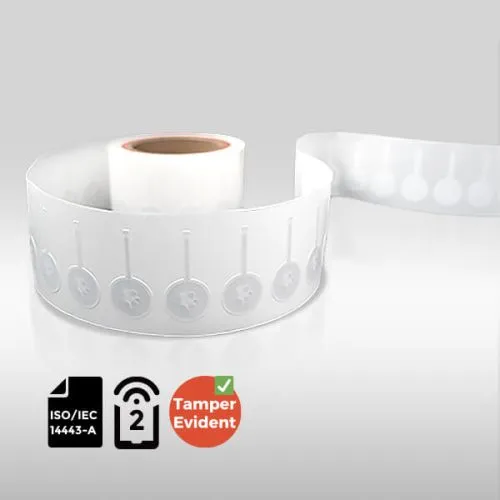
ISO14443A 13.56MHz NFC Label/Inlay NXP NTAG® 213 TagTamper

NTAG® 213 TagTamper offers several features to protect brands and enable advanced anti-counterfeiting as well as tamper-proofing. Furthermore, it lets brand owners have a direct engagement with consumers.



