

For businesses engaged in RFID label import US from China, understanding the intricate landscape of customs declaration, tariffs, and compliance is paramount. This guide provides a practical overview, ensuring a smooth and compliant import process for your RFID products.
1. Harmonized Tariff Schedule of the United States (HTSUS) Classification: The Foundation of Compliance
Accurate HTSUS classification is the cornerstone of determining applicable duties and ensuring regulatory compliance for RFID label import US. RFID tags, due to their varied structures and functionalities, can fall under different classifications. We recognize three primary pathways, though actual classification depends on specific product characteristics:
1.1. Smart Cards / Semiconductor Media
Many RFID cards and passive tags containing chips are classified as “smart cards” or “semiconductor media for recording other phenomena.” For instance, a Spanish RFID tag might be classified under 8523.52.00 (Smart cards), often with a Free basic duty rate. Similarly, read-only/read-write ID transponders like the Atmel TK5551 could fall under 8523.59.00 (Other semiconductor media), also typically free of basic duty.
1.2. Other Electrical Apparatus with Individual Functions
In some cases, particularly for earlier or specific transponder forms, RFID devices may be considered “electrical apparatus with individual functions, not elsewhere specified or included.” Examples include RFID transponders or “Digital Signature Wedge Transponders” that have been classified under 8543.81/8543.70 categories.
1.3. Pure Paper Labels (Without Chips)
If the RFID label is a simple paper or self-adhesive label without an embedded chip, it typically falls under Chapter 4821 (Paper or paperboard labels of all kinds, whether or not printed). These often incur low or free basic duty rates.
Critical Recommendation: For high-volume shipments or complex structures (e.g., paper surface + antenna inlay + IC chip + adhesive), we strongly advise applying for a Binding Ruling from U.S. Customs and Border Protection (CBP) (19 CFR Part 177). A binding ruling significantly reduces the risk of classification disputes, as CBP is bound by its decision upon approval.
1.4 Practical Classifications from Prior Rulings (Rule-of-Thumb)
Based on prior CBP rulings and trade practice, RFID products that meet the definition of “RFID labels/cards” are typically declared under HTSUS 8523.52.00.10 (smart cards—unrecorded). This 10-digit statistical suffix has been used for RFID wristbands/tags incorporating an IC and antenna when imported as standalone media. That said, actual classification still depends on construction and function (e.g., paper-only labels without chips often fall under 4821; certain transponders may fall under 8543). Always confirm against the current HTS and consider requesting a CBP Binding Ruling for certainty.

2. Basic Tariffs & China Section 301 Additional Duties
While many RFID-related HTSUS codes (like those under 8523, 8543, or 4821) often have low or free basic duty rates, the imposition of China Section 301 additional duties is a critical consideration for RFID label import US. We must consult the USTR Section 301 tariff lists and the USITC “China Tariffs” dynamic tables for the most current information.
2.1. Section 301 Exclusions
Several product exclusions under Section 301 have been extended, some until November 29, 2025. Whether your specific goods are covered depends on precise matching with the exclusion description and the 10-digit statistical subheading. If an exclusion applies, we declare the corresponding Chapter 99 exclusion item, thereby avoiding the 9903.88.xx additional duty.
2.2. Practical Declaration Points
During customs declaration, we first declare the actual HTSUS code (e.g., 8523.52.00). If Section 301 duties apply, the corresponding Chapter 99 item (9903.88.xx) is added. If an exclusion is utilized, we use the specific exclusion-related Chapter 99 item. We recommend cross-referencing with the USITC’s online “China Tariffs” table for verification.

3. FCC Compliance: Radio Frequency Devices
FCC compliance is crucial for radio frequency (RF) devices imported into the U.S., particularly for RFID readers and active tags.
3.1. RFID Readers / Active Tags
These are considered intentional radiators and must complete equipment authorization under FCC Part 15 before entering the U.S. This typically involves obtaining an FCC ID.
3.2. Passive RFID Tags / Inlays
Passive RFID tags and inlays are generally not certified as intentional radiators. However, they still fall under the purview of RF device regulations. We must ensure they are used in conjunction with certified readers and do not cause harmful interference. While not typically requiring an FCC ID, it is prudent to have technical documentation demonstrating their compatibility with Part 15 certified equipment.

4. Country of Origin (COO) Marking: “Made in China” Specifics
All imported foreign products and their outermost containers must be clearly and permanently marked in English with their country of origin (e.g., “Made in China”) as per 19 CFR Part 134.
4.1. Special Marking for Labels
For products like RFID labels that will be affixed to other goods, regulations require a qualifying statement to prevent consumers from mistakenly believing the final product is from China. Therefore, we should use phrases like “Label made in China” or “Tag made in China” instead of just “Made in China.”
5. Forced Labor Compliance: UFLPA
The Uyghur Forced Labor Prevention Act (UFLPA) establishes a rebuttable presumption that goods produced in Xinjiang or by entities on the “UFLPA Entity List” are made with forced labor and are prohibited from entry into the U.S. Enforcement has intensified, requiring robust due diligence for RFID label import US.
5.1. Supply Chain Traceability
Importers must prepare full supply chain traceability documentation, covering raw materials (e.g., copper/aluminum foil, wafers/chips), assembly, and final packaging, to prove that their goods are not involved with the restricted regions or entities. If necessary, we must submit rebuttal evidence according to CBP’s “Importer Guidance for UFLPA Enforcement.”

6. Declaration & Document Checklist (Maritime Shipping Example)
A well-prepared documentation set is essential for efficient customs clearance.
- ISF 10+2: Submitted by the Importer of Record (IOR) or agent to CBP 24 hours before vessel loading (outside the U.S.). This includes 10 importer elements and 2 carrier elements. Late or missing submissions can incur penalties.
- Formal Entry: Upon arrival, an Entry declaration is made, followed by an Entry Summary (CBP Form 7501) submission and duty payment within 10 business days.
- Commercial Invoice/Packing List/Bill of Lading: The invoice must reflect the true transaction value, currency, trade terms, itemized lines with unit prices, and country of origin. Any “Assists” provided by the buyer (e.g., molds, antenna designs, software) must be included in the dutiable value as per 19 CFR 152.
- Customs Bond: Importers require a customs bond. A Single Entry Bond (SEB) is suitable for occasional imports, while a Continuous Bond is recommended for frequent importers, typically calculated at 10% of the past 12 months’ duties, with a minimum of $50,000.

7. Practical Checklist for Smooth Operations
To streamline your RFID label import US process, we recommend the following operational checklist:
- Product Definition: Clearly define the RFID tag’s form factor and function (card, ticket, paper sticker, presence of chip/antenna/battery).
- HTSUS Pre-selection: Pre-select the HTSUS code, cross-reference with existing CBP rulings, and submit a Binding Ruling if necessary.
- Section 301 Verification: Use the USITC China Tariffs table to check for 9903.88.xx additional duties and available exclusions.
- COO Marking: Confirm the country of origin marking solution with the factory (e.g., “Label made in China”) and external packaging.
- FCC Documentation: If importing readers/active devices, verify and retain FCC Part 15 certification materials.
- ISF 10+2 Preparation: Prepare ISF 10+2 elements for submission 24 hours before loading.
- Invoice & Assists: Prepare invoices/packing lists, disclosing any assists to ensure dutiable value compliance.
- Customs Bond Selection: Choose between SEB or Continuous Bond (Continuous Bond is advised for frequent importers).
- UFLPA Risk Assessment: Review UFLPA risks and collect supply chain traceability evidence.
Conclusion
Navigating the complexities of RFID label import US from China requires meticulous attention to detail across various regulatory domains. By understanding and adhering to HTSUS classification, tariff regulations, FCC compliance, country of origin marking, UFLPA requirements, and proper documentation, importers can ensure efficient and compliant operations. We hope this guide empowers you with the knowledge to make informed decisions and optimize your import strategy. For further information or to explore our range of RFID products, please visit rfidlabel.com.
FAQs
What are the potential consequences of incorrect HTSUS classification for RFID labels?
Incorrect HTSUS classification can lead to several issues, including underpayment or overpayment of duties, delays in customs clearance, potential fines and penalties from CBP, and even seizure of goods. It is crucial to ensure accurate classification to avoid these costly complications.
How can importers best mitigate UFLPA risks when sourcing RFID labels from China?
To mitigate UFLPA risks, importers should implement robust due diligence processes. This includes obtaining detailed supply chain maps from suppliers, requesting affidavits or certifications from manufacturers confirming no forced labor is used, conducting independent audits of supplier facilities, and ensuring all raw material origins are verifiable and outside of restricted regions or entities.
Recommended Product

ARC Certified Impinj® M730 Coated Paper RFID Label 47x31mm

This ARC-certified RFID label can be used in clothing retail, supply chain management, and brand protection. They not only fully conform to the ISO/IEC 18000-6C and EPCglobal Gen2v2 standards, but their inlays have also completely passed the ARC certification tests, ensuring stable performance and reliable tracking. Ideal for retail chains such as Walmart and Dillard’s, it helps streamline inventory management, enhance supply chain visibility, and maintain brand integrity.
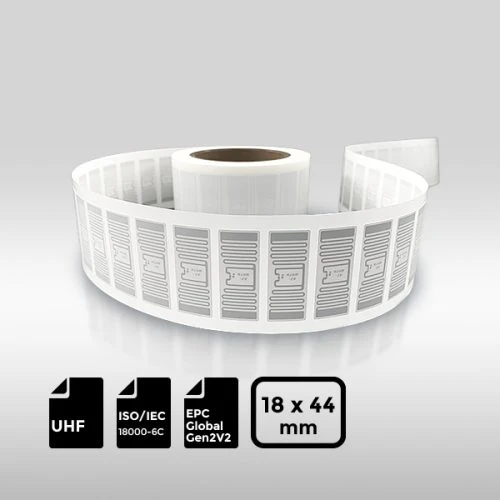
ARC Certified Impinj® M730 Coated Paper RFID Label 44x18mm
This ARC-certified RFID tag for Walmart is designed for clothing retail, supply chain management, and brand protection. Fully compliant with ISO/IEC 18000-6C and EPCglobal Gen2v2 standards, it delivers stable performance and accurate tracking. Passing the ARC certification tests, the label ensures quality and reliability in large-scale retail operations. Ideal for use in retail chains such as Walmart and Dillard’s, it helps streamline inventory management, improve supply chain visibility, and maintain brand integrity.
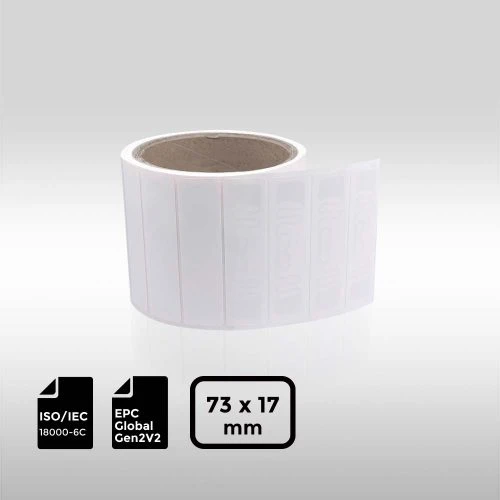
ARC Certified Impinj® M830 RFID Label | 73×17mm
This 73×17 mm ARC-certified Impinj® M830 RFID label is ideal for tagging apparel, footwear, accessories, jewelry, electronics, and toys. Fully compliant with ISO/IEC 18000-6C and EPCglobal Gen2v2 standards, its inlay has passed ARC certification tests. Widely used in retail chains like Walmart and Dillard’s, the label ensures reliable performance, smooth inventory management, and easy in-store deployment.