
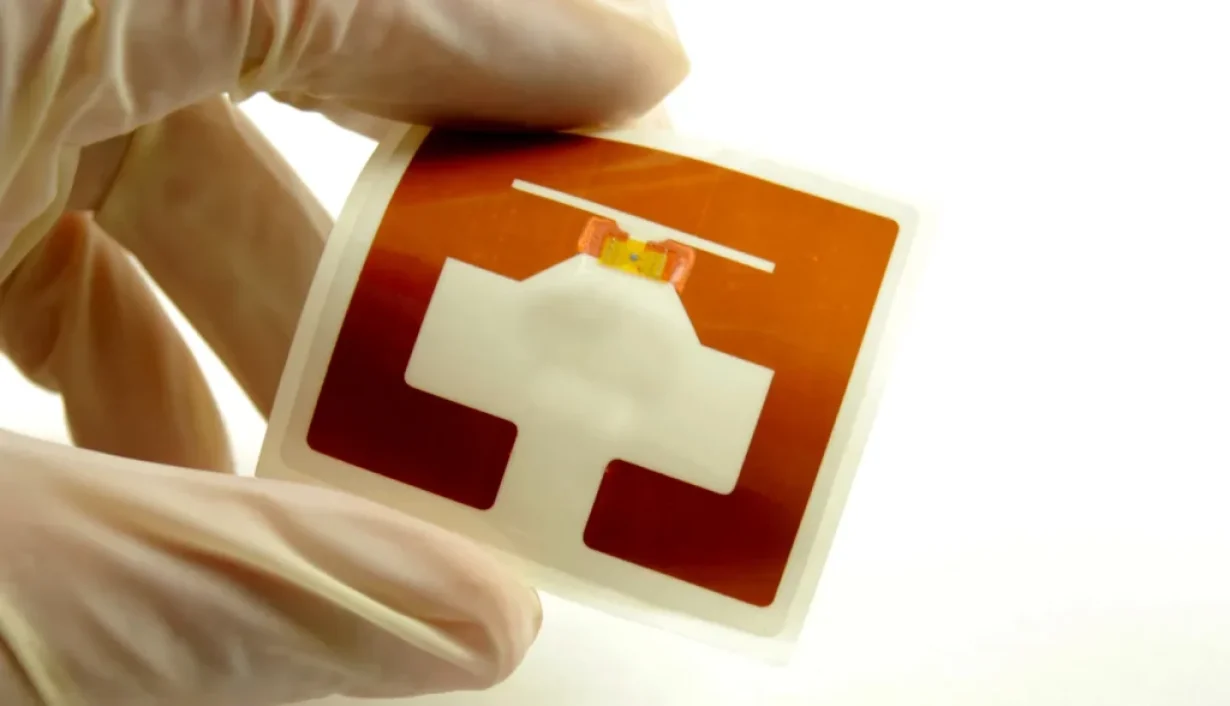

UHF RFID chip antenna matching is easy to ignore because the chip is small and the antenna looks like a simple metal pattern. But inside a finished RFID label, these two parts are not independent.
If an antenna was designed for one chip, replacing that chip with another model is not always a simple substitution. The new chip may still be bonded to the antenna. The tag may still respond when you scan it at close range. But that does not mean the label will perform the same in production.
This is where many RFID projects become confusing. A tag works in a short test, but later the read distance is shorter than expected. Or the printer starts showing more encoding failures. Or the label reads in the lab, then becomes unstable after it is applied to the actual product.
In many cases, the problem is not the chip alone or the antenna alone. It is the match between them.
The Chip and Antenna Are a Pair
A passive UHF RFID tag has no battery. It depends on energy from the reader.
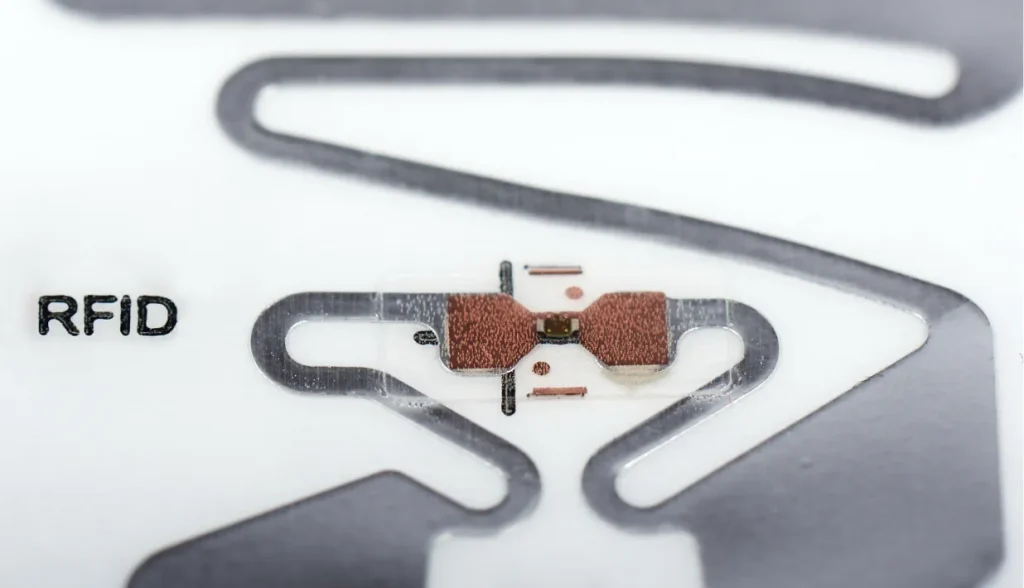
The antenna receives the reader’s signal and passes energy to the chip. The chip uses that energy to wake up and respond. For this to happen efficiently, the antenna has to be tuned for the electrical behavior of that specific chip.
This is the basic idea behind UHF RFID chip antenna matching. It is not only about whether the chip pads can be physically connected to the antenna. Physical connection is the easy part. The harder question is whether energy can move efficiently from the antenna into the chip.
Every chip has its own input impedance. Antennas also have impedance. If the antenna is not designed around the chip’s impedance, part of the energy is lost. The chip receives less usable power, so the tag needs a stronger signal to operate.
In practice, that usually means shorter read range, weaker margins, or unstable performance when conditions are not ideal.
Why a Chip Change Can Cause Problems
Chip changes happen for normal reasons. You may need a different memory size. A project may require a specific chip family. Supply availability may change. Cost may also be a factor.
The risk is assuming that the old antenna will behave the same after the chip changes.
It may not.
A chip with better sensitivity can help, but it cannot magically fix a poorly matched antenna. A chip with more memory may need more reliable energy during writing. A different chip package may also affect the bonding area and antenna feed structure.
This is why UHF RFID chip antenna matching should be reviewed before changing chip brands or chip series. The tag may pass a quick read test and still fail where it matters: during encoding, carton reading, pallet reading, or after being attached to the product.
Chip replacement should be treated as a technical change, not only a purchasing change.
Read Range Is Not the Only Test
Many people judge RFID labels by read distance first. That is understandable, but it can be misleading.
A tag may read well in open air when you scan one piece by hand. But RFID labels are rarely used that way.
They may need to be printed and encoded in batches. They may be attached to cartons, bottles, plastic cases, textiles, or assets. They may be stacked closely together. They may be read from different angles or through packaging.
There is another point that is often missed: reading and writing are not the same.
A weak chip-antenna match may still allow the tag to be read, but writing EPC data or user memory can become less stable. If you see more failed tags during encoding, the issue may not be the printer alone. The RF design of the inlay may also need to be checked.
For projects that require serialized EPC data, password locking, user memory, or batch encoding, write success rate should be tested together with read range.
The Product Surface Can Change the Result
Even if the chip and antenna are well matched in free space, the final product can still change the result.
A paper carton, a plastic container, a glass bottle, a liquid product, a textile surface, and a metal asset do not affect RFID in the same way. Some materials shift the antenna tuning. Some absorb RF energy. Some reflect it. Some cause the label to bend, which also changes antenna behavior.
This is why UHF RFID chip antenna matching should not be checked only at the inlay level.
A design that works well before lamination may behave differently after face material, adhesive, printing, or a spacer is added. A small label may leave less room for antenna tuning. A label placed near liquid or metal may need a different structure altogether.
For this reason, the final test should be done on the actual product, not only on a sample sheet.
When Should Matching Be Rechecked?
You do not need to redesign a label every time the artwork changes. But some changes should trigger a new performance check.
Recheck UHF RFID chip antenna matching when:
- The chip brand or chip series changes.
- The label size is reduced.
- The inlay position changes.
- The label moves from one surface to another.
- The label will be used near liquid, glass, metal, or electronics.
- Foam, spacer, lamination, or a thicker material is added.
- Encoding failures increase after a chip or material change.
- A label that worked in testing becomes unstable in production.
Small visual changes may not affect RF performance. Structural changes often do.
A More Useful Test Method
A handheld scan is a good first check, but it is not enough to approve a chip change.
A better test should answer practical questions:
- Can the tag be read at the required distance, not just at the maximum possible distance?
- Can it be written reliably in the actual printer or encoder?
- Does it still work across the target UHF frequency band?
- Does performance drop sharply when the tag angle changes?
- Does it still work after being applied to the real product?
These questions are more useful than asking whether the tag can be read once on a desk.
For high-volume RFID labels, consistency matters more than one excellent sample.
What This Means for Custom RFID Labels
For a custom RFID label, chip selection should not be separated from antenna design.
Start with the application. Where will the label be attached? What material is nearby? How much space is available for the antenna? Does the label need to be encoded? Will it be read one by one, in cartons, or on pallets? Which regional frequency band does it need to support?
After those details are clear, the chip and antenna can be selected as a working pair.
If the chip needs to be changed later, UHF RFID chip antenna matching should be tested again. It may still work. It may only need minor tuning. Or it may need a different antenna. The only safe way to know is to test the new chip-antenna combination under the same conditions in which the label will be used.
Conclusion
UHF RFID chips and antennas are not plug-and-play parts.
A chip can be physically connected to an antenna and still be a poor RF match. That poor match may show up as shorter read range, unstable encoding, narrow frequency response, or inconsistent performance after the label is applied to the product.
Before switching chips in a UHF RFID label, check UHF RFID chip antenna matching and test the finished label in the real application environment.
For more RFID label insights, application guides, and custom RFID label solutions, visit rfidlabel.com.
Recommended Product

4″x2″ 860-960MHz UHF RFID Label Impinj® Monza® 4D

Introducing our 4″x2″ UHF RFID Label, a fusion of size and technological excellence featuring the highly capable Impinj® Monza® 4D chip. Operating in the 860-960MHz frequency range, this label offers unparalleled read and write performance. Designed for versatility, its PP Synthetic Paper surface is fully compatible with thermal transfer label printers. Whether you’re in logistics, healthcare, or retail, you’ll find this label is built for precision, speed, and durability.



