


As the business environment becomes highly digitized and interconnected, RFID technology becomes one of the key tools to improve business efficiency and accuracy. Among them, printable RFID tags, because of their flexibility and versatility, are widely used in various industries. So, how to choose the printable RFID tags that fit the user’s business needs can be a complicated task. This blog will analyze how to choose the right printable RFID tags for specific business needs to help users make an informed choice.
Working principles of printable RFID tags
Before choosing a printable RFID tag, we should understand its basic principles. First of all, RFID tags are composed of chips, antennas, and encapsulation materials. The chip is mainly responsible for storing information, the antenna is responsible for receiving and transmitting signals, and the encapsulation material protects the chip and antenna from the external environment. Printable RFID tags allow for a wide range of applications by allowing visual information, such as barcodes, text, and graphics, to be printed on the tag.
Which factors to consider when purchasing printable RFID tags
- Identify specific application scenarios
Different business scenarios have different requirements for RFID tags. For example, in logistics and supply chain management, RFID tags need to be durable, tear-resistant, and on-liquid. In apparel retail environments, it is more important for tags to be aesthetically pleasing and easy to apply. Determining the specific application scenario is the first step in choosing the right tag.
- Data storage requirements
RFID tags use different chips and the storage capacity will be different. Then, tags can be divided into two types: low-capacity and high-capacity tags. Low-capacity tags are suitable for simple identification tasks such as product identification and inventory management. High-capacity tags, on the other hand, are suitable for applications that require large amounts of data, such as medical records and complex asset management systems.
- Reading range
Different RFID tags have different reading distances. UHF tags usually have a long read range and are suitable for warehouse management and logistics counting. HF tags have a relatively short read range and are more suitable for apparel retail and access control systems.
- Environmental conditions
The environment in which the tag is to be used is also an important consideration in selection. If the use of the tag requires exposure to high temperatures, humidity, chemicals, or other complex environments, the selection of a tag with special protective properties is necessary.
How to choose the right printable RFID tags
- Tag materials
Printable RFID tags are available in a wide variety of materials, including coated paper, plastic, and metal. Paper tags are relatively low-cost and suitable for short-term use. Plastic and metal tags, on the other hand, offer better durability and on-liquid for complex environments and long-term use.
- Types of chip
Different types of chips have different functions and performance. Common types of chips are read-only, read-write, and encryption chips. The choice of the right type of chip will then depend on the need for data security and flexibility.
- Antenna design
The design of the antenna directly affects the tag’s read range and performance. Complex antenna design usually provides better performance, but at the same time will also increase the cost. Therefore, users need to choose the right antenna design according to their actual needs to balance performance and cost.
- Printing technology
Printable RFID tags support a variety of printing technologies, including thermal transfer, laser, and Inkjet. Each print technology has its advantages and disadvantages, and the choice of the appropriate print technology depends on the scenario and printing requirements of the tag. For example, thermal transfer printing can be used to print large quantities with long-lasting results. on the other hand, laser printing is suitable for high-precision and personalized printing.
Application of printable RFID tags
- Apparel retailing
Apparel retailing wanted to improve inventory management efficiency and customer experience. After a needs analysis, they chose to use HF printable RFID tags. These tags have a short read range but are sufficient to cover the shelves. In addition, they chose a durable plastic material to ensure that the tags would not be easily damaged under prolonged use. They chose a customized printing service to print their product information and barcodes for easy identification by staff and customers.
- Warehousing Industry
Warehousing industry wanted to enable inquiry and management of goods. After analysis, they chose UHF printable RFID tags. These tags have a long read range and can cover most areas of the warehouse. They chose an on-liquid and tear-resistant tag material to ensure that the tags are protected from vandalism during storage and entry and exit from the warehouse.
Conclusion
Choosing the right printable RFID tag for a user’s business needs is a process that takes into account several factors. From understanding the fundamentals to identifying business needs to evaluating the technical features, it is critical. Through careful analyses and trade-offs, users can find the most suitable solution to enhance business efficiency and operations management. Hopefully, this blog will provide a valuable reference for users in the process of selecting printable RFID tags.
After reading this blog, do you have enough understanding of Printable RFID Tags and have a Printable RFID Tags? If you still need more information, please feel free to contact our sales experts, who will provide you with the most suitable solutions and the most professional purchasing advice according to your needs. In addition, you can also visit our official website (www.rfidlabel.com) to browse the relevant information about Printable RFID Tags.
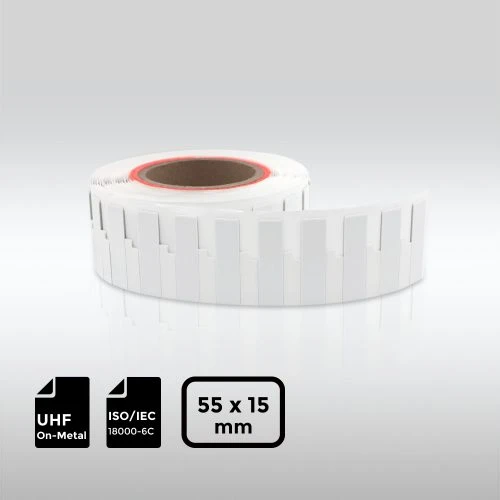
UHF On-Metal RFID Label Impinj® Monza® R6-P 55x15mm | ISO18000-6C

The Flexible & Printable UHF On-Metal Label is a durable, customizable, high-performance RFID label that can be easily printed and encoded. The label is ideal for metallic container tracking, equipment & device tracking, warehouse shelf tracking, automotive components tracking, IT asset tracking, etc. It can be stuck to metallic assets easily, especially on irregular and uneven surfaces.



