


The rfid manufacturing process is a complex journey that transforms raw silicon and conductive materials into the intelligent labels powering modern global supply chains. While much of the industry’s focus remains on chip sensitivity and antenna design, the final stages of production—specifically lamination and surface finishing—are where the real-world reliability of a tag is forged. At RFIDLabel, we have seen firsthand how these “outer layers” can either enhance a label’s performance or, if poorly chosen, lead to systemic failures in the field.
In this guide, we will explore the critical role that lamination and surface finishes play in the rfid manufacturing process, providing you with the technical insights needed to choose the right specifications for your specific application.
The Role of Lamination in RFID Label Durability
Lamination is the process of bonding protective layers over the RFID inlay. In the rfid manufacturing process, this step is vital because the inlay itself is incredibly fragile. A single scratch on the antenna or a microscopic crack in the chip-to-antenna bond can render the entire label useless.

Hot vs. Cold Lamination: Which One Suits Your Application?
When we talk about lamination at our factory, we generally categorize the methods into hot and cold processes. Each has its own set of advantages depending on the intended use of the RFID label.
- Hot Lamination: This involves using heat-activated adhesives. The heat creates a much stronger, more permanent bond between the layers. This is the preferred method for labels exposed to extreme temperatures or harsh industrial environments.
- Cold Lamination: This uses pressure-sensitive adhesives (PSA). It is faster and more cost-effective for high-volume retail applications where the labels are not expected to face extreme physical stress.
| Feature | Hot Lamination | Cold Lamination |
| Bond Strength | Exceptional / Permanent | Moderate / Flexible |
| Durability | High (Weather & Chemical Resistant) | Standard (Indoor/Retail) |
| Cost | Higher (Energy & Material) | Lower (High-speed production) |
| Best For | Logistics, Outdoor Assets, Industrial | Apparel, Retail, Event Tickets |
How Lamination Protects the Sensitive Inlay
Beyond physical protection, lamination acts as a barrier against moisture and chemicals. If a label is destined for a humid warehouse or will be exposed to cleaning agents, a high-quality PET laminate is essential. Without it, moisture can seep into the inlay, causing antenna oxidation and a significant drop in read range.
Surface Finishes: More Than Just Aesthetics
Once the label is laminated, the final surface finish is applied. This is the part of the label that the world sees and interacts with. In the rfid manufacturing process, the surface finish serves two primary purposes: branding and functional protection.
Gloss Finish: Maximizing Visual Impact
A glossy finish is characterized by its high-shine, reflective surface. It makes colors appear more vibrant and saturated, which is excellent for brand-heavy applications like luxury retail or high-end electronics. However, from a technical perspective, gloss finishes can sometimes cause glare, which might interfere with traditional barcode scanners if you are using a hybrid RFID/Barcode label.

Matte Finish: The Choice for Scannability and Elegance
Matte finishes offer a smooth, non-reflective surface. We often recommend matte finishes for clients who require high scannability for QR codes or barcodes printed on the RFID label. The lack of reflection ensures that optical scanners can read the printed data accurately from various angles. Furthermore, matte finishes provide a premium, “soft-touch” feel that many fashion brands prefer for their hangtags.
UV Coating: Shielding Against Environmental Stress
UV coating is a liquid finish that is cured using ultraviolet light. It provides an incredibly hard, scratch-resistant surface. In the rfid manufacturing process, adding a UV coat is a “pro move” for labels that will be handled frequently or exposed to sunlight. It prevents the printed information from fading and adds an extra layer of physical armor to the RFID components beneath.
Technical Impact: How Materials Affect Read Range
One of the most overlooked aspects of the rfid manufacturing process is the dielectric constant of the materials used in lamination and finishing. Every material that covers the RFID antenna has a “dielectric” property that can slightly shift the frequency at which the antenna resonates.
At RFIDLabel, we conduct rigorous testing to ensure that our laminates do not “detune” the tag. If a laminate is too thick or made of a material with a high dielectric constant, it can shift the tag’s optimal frequency away from the standard 860-960 MHz range used in UHF RFID. This results in a shorter read range and potential “blind spots” in your inventory system.
The choice of laminate is not just about protection; it’s about RF transparency. We select materials that provide maximum durability with minimum interference to the electromagnetic waves.

Real-World Application: The Uniqlo Case Study
Uniqlo uses RFID labels for everything from factory-to-store tracking to automated self-checkout. In their self-checkout kiosks, customers place an entire basket of clothes into a bin, and the system reads all the tags simultaneously. For this to work, the labels must be durable enough to survive being tossed into bins and handled by thousands of customers without the inlay being damaged.
By choosing specific surface finishes that resist friction and lamination that maintains antenna integrity, Uniqlo has achieved:
- 90% savings in labor costs related to inventory and checkout.
- Near-100% accuracy in reading tagged inventory.
- 25-30% increase in inventory accuracy across their global supply chain.
Choosing the Right Finish for Your Business
When you are sourcing RFID labels, consider the following factors to determine the best lamination and finish for your needs:
- Environment: Will the labels be outdoors, in a cold chain, or a standard retail store?
- Printing Needs: Do you need to overprint variable data like serial numbers or QR codes?
- Branding: Does your brand require a high-gloss, vibrant look or a subtle, matte elegance?
- Lifespan: How long does the label need to remain functional?

Conclusion
The success of an RFID implementation often hinges on the smallest details. While the chip provides the intelligence, the lamination and surface finish provide the “body” that allows that intelligence to survive the rigors of the real world. By understanding how these elements affect performance, you can ensure that your rfid manufacturing process results in a product that is not only functional but also durable and visually appealing.
At RFIDLabel, we specialize in creating custom RFID solutions that balance technical performance with commercial value. For more information on our products or to request a custom quote, please visit us at rfidlabel.com.
FAQs
1. Can a glossy finish reduce the read range of an RFID label?
Generally, the “gloss” itself does not affect the read range. However, the material used to create that gloss—such as a thick UV coating or a specific type of plastic laminate—can have a dielectric effect that slightly shifts the antenna’s frequency. At RFIDLabel, we calibrate our antenna designs to account for these coatings, ensuring consistent performance.
2. Is hot lamination always better than cold lamination?
Not necessarily. While hot lamination provides a stronger bond and better environmental resistance, it is also more expensive and can be overkill for indoor retail applications. Cold lamination is perfectly adequate for apparel tags and standard warehouse labels, offering a more cost-effective solution for high-volume orders.
Recommended Product

UHF On-Metal RFID Label Impinj® Monza® R6-P 70x50mm | ISO18000-6C

The Flexible & Printable UHF On-Metal Label is a durable, customizable, high-performance RFID label that can be easily printed and encoded. The label is ideal for metallic container tracking, equipment & device tracking, warehouse shelf tracking, automotive components tracking, IT asset tracking, etc. It can be stuck to metallic assets easily, especially on irregular and uneven surfaces.
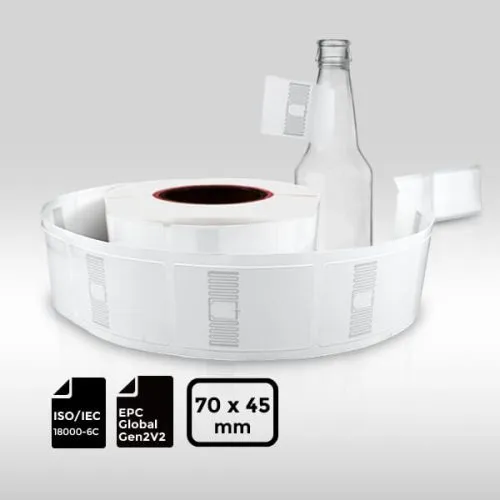
Flag UHF RFID Label ISO18000-6C NXP UCODE® 8 70x45mm
This is a 70x45mm UHF Flag RFID label that can be embedded with NXP UCODE® 8. The “flag” portion of the label extends from the label and helps to ensure that the RFID antenna does not attach directly to the surface of the object to which it is attached. This prevents interference and maximizes the reading distance of the label, making it ideal for use in supply chain, inventory management, asset tracking, security, and access control applications.

Tamper-Evident On-Metal UHF RFID Label Alien® Higgs® 9 | 75×25mm
The 75×25mm Alien® Higgs® 9 Flexible & Printable UHF On-Metal RFID Label is specifically engineered to deliver high-performance tagging in challenging environments where traditional RFID labels fail.Equipped with the advanced Higgs® 9 IC, it offers fast inventory counting, exceptional read sensitivity, and long read ranges even when applied directly to metal surfaces. The flexible structure ensures reliable performance on curved or irregular assets, making it ideal for IT equipment, machinery, tools, and metallic containers.
Designed for seamless integration into asset management and industrial workflows, this label supports EPC Class 1 Gen 2 and ISO/IEC 18000-6C standards and features a printable surface, allowing users to customize graphics, barcodes, or variable data via standard RFID printers. Additionally, its tamper-proof design, made from fragile material, ensures security—once installed, it will be damaged if removed, providing a clear indication of tampering.



