In the world of international scientific research, the integrity of specimen tracking is paramount. The ability to accurately monitor biological samples as they move between labs, across borders, and through various stages of analysis is fundamental to the success of collaborative projects. Radio-Frequency Identification (RFID) technology has emerged as a transformative force in this field, offering a robust solution for seamless and error-free specimen tracking. This technology not only enhances efficiency but also builds a new level of trust and transparency among research partners worldwide.
The Foundation of Global Research: Reliable Sample Management
Cross-border research collaborations bring together the brightest minds to tackle some of the world’s most pressing challenges, from developing new vaccines to understanding climate change. However, these partnerships introduce significant logistical complexities. A biological sample might be collected in one country, processed in another, and analyzed in a third. Throughout this journey, maintaining a verifiable chain of custody is critical. Any gap or error in the tracking process can compromise the sample’s integrity, leading to questionable results and potentially invalidating years of work. Effective specimen tracking systems are the bedrock upon which successful international research is built.

Why Traditional Methods Fall Short
For years, researchers relied on manual methods like handwritten labels and barcodes for sample management. While functional for small-scale, localized studies, these methods are fraught with potential issues in a global context:
- Human Error: Manual data entry is prone to transcription errors, and labels can become smudged, illegible, or detached.
- Inefficiency: Barcode scanning requires a direct line of sight and individual scans, a time-consuming process when dealing with hundreds or thousands of samples.
- Limited Data Capacity: Barcodes store a limited amount of information, often just a simple identification number, requiring a constant connection to a central database for details.
- Durability Issues: Labels can be damaged by harsh storage conditions, such as cryogenic freezing, which is common for biological specimens.
The RFID Revolution in Specimen Tracking
RFID technology overcomes these limitations by providing a dynamic, durable, and automated solution for specimen tracking. An RFID system consists of a small tag affixed to the sample container, a reader that communicates with the tag via radio waves, and a software system to manage the data.
Key Advantages of RFID for Global Collaboration
| Feature | Benefit in Cross-Border Research |
| Automated Data Capture | Readers can scan multiple tags simultaneously without a direct line of sight, drastically reducing processing time at shipping and receiving points. |
| Enhanced Data Storage | RFID tags can store significantly more data than barcodes, including sample type, collection date, patient ID, and processing history, directly on the tag. |
| Increased Accuracy | Automation eliminates manual data entry errors, ensuring a 99.9% accuracy rate in sample identification. |
| Environmental Resistance | RFID tags are designed to withstand extreme temperatures, from cryogenic storage to autoclaving, ensuring data remains intact throughout the sample’s lifecycle. |
A Real-World Example: North York General Hospital
North York General Hospital in Canada implemented RFID technology to reduce medication errors. Using the Intelliguard® Kit and Tray Management System, the hospital automated medication tray restocking. RFID tags, containing essential drug data, are scanned in seconds, identifying missing, expired, or soon-to-expire items for prompt replacement. This system reduced errors, saved labor hours, and allowed for precise daily restocking, improving workflow between the pharmacy and departments like anesthesia. While this example focuses on medication, the principles of accurate, automated tracking are directly applicable to specimen tracking in a research context, demonstrating RFID’s power in critical healthcare logistics.

Conclusion: Fostering a Future of Seamless Global Science
As scientific research becomes increasingly interconnected, the need for reliable and efficient logistical solutions is more critical than ever. RFID technology provides a powerful tool to enable seamless cross-border research collaboration by ensuring the integrity of every biological sample. It minimizes errors, saves valuable time, and provides a transparent, verifiable chain of custody from collection to analysis.
At RFIDLabel, we understand the critical demands of modern research. We offer a range of high-quality, customizable RFID tags and labels designed to withstand the rigorous conditions of any laboratory environment. If you are looking to enhance your specimen tracking capabilities and foster more effective research collaborations, explore our product solutions or contact us for more information at rfidlabel.com. Let us help you build a foundation of trust and efficiency for your next groundbreaking discovery.
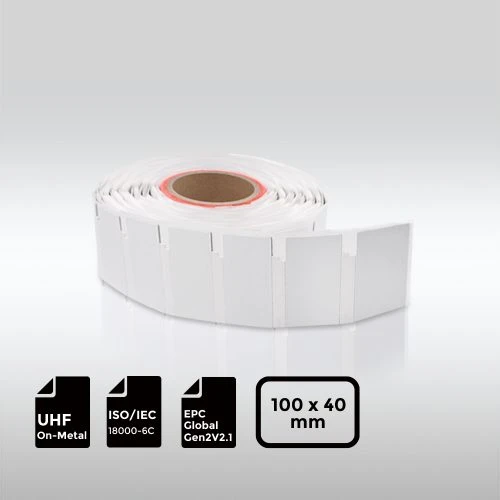
On-Metal & On-Liquid NXP® UCODE® 9xm UHF RFID Label | 100×40 mm

The 100×40 mm NXP® UCODE® 9xm On-Metal & On-Liquid RFID label is engineered for reliable performance on metal surfaces and liquid-filled containers. Featuring a high-performance UHF chip with large user memory,it enables long read ranges,fast inventory of dense tag populations, and supports demanding RFID applications. Constructed from PET,aluminum foil,and foam,the label is durable,tear-resistant, and flexible,with self-adhesive backing for easy application on flat or curved surfaces. It is ideal for asset tracking, electronics, cosmetics, beverages, and industrial components, ensuring seamless integration into RFID-enabled systems.
Powered by the NXP® UCODE® 9xe chip and compliant with ISO/IEC 18000-6C and EPC Global Gen2v2.1 standards, the label delivers high sensitivity, fast inventory speed, and excellent read range. This ensures compatibility with global RFID systems while supporting efficient, scalable tracking across logistics, manufacturing, and warehouse operations.
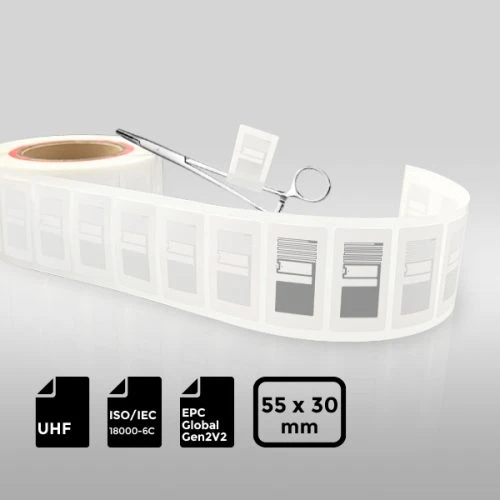
NXP UCODE® 9 Coated Paper UHF RFID Flag Label for Medical Device Management
NXP UCODE® 9 UHF RFID flag label for medical device management is a high-performance label with a high-quality coated paper surface, self-adhesive, NXP UCODE® 9 chip, aluminum antenna, double-sided glue and 80g release paper structure. The label has excellent reading distance and reliability, and is suitable for inventory and asset management, specifically targeted at the medical industry to ensure fast and accurate data acquisition and management.
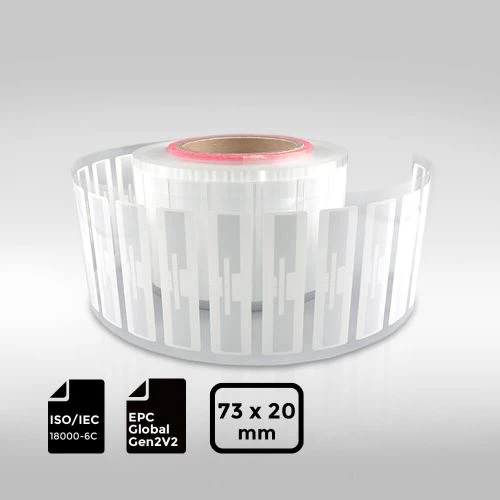
NXP UCODE® 8 PET RFID UHF On-Liquid Label | 73×20mm
The NXP UCODE® 8 PET RFID On-Liquid Label is specifically designed to perform better on glass bottles and is specially engineered for high-performance RFID tagging on liquid-filled containers or moist environments. Powered by the advanced UCODE® 8 chip, it offers exceptional read sensitivity, faster inventory counts, and enhanced data reliability, making it ideal for challenging applications involving liquids.
Constructed with durable PET material, this label provides strong adhesion and resistance to water, chemicals, and abrasion. It performs reliably on curved or irregular surfaces and is perfectly suited for tracking bottled products, cosmetics, chemicals, and pharmaceuticals — improving inventory visibility and operational efficiency.