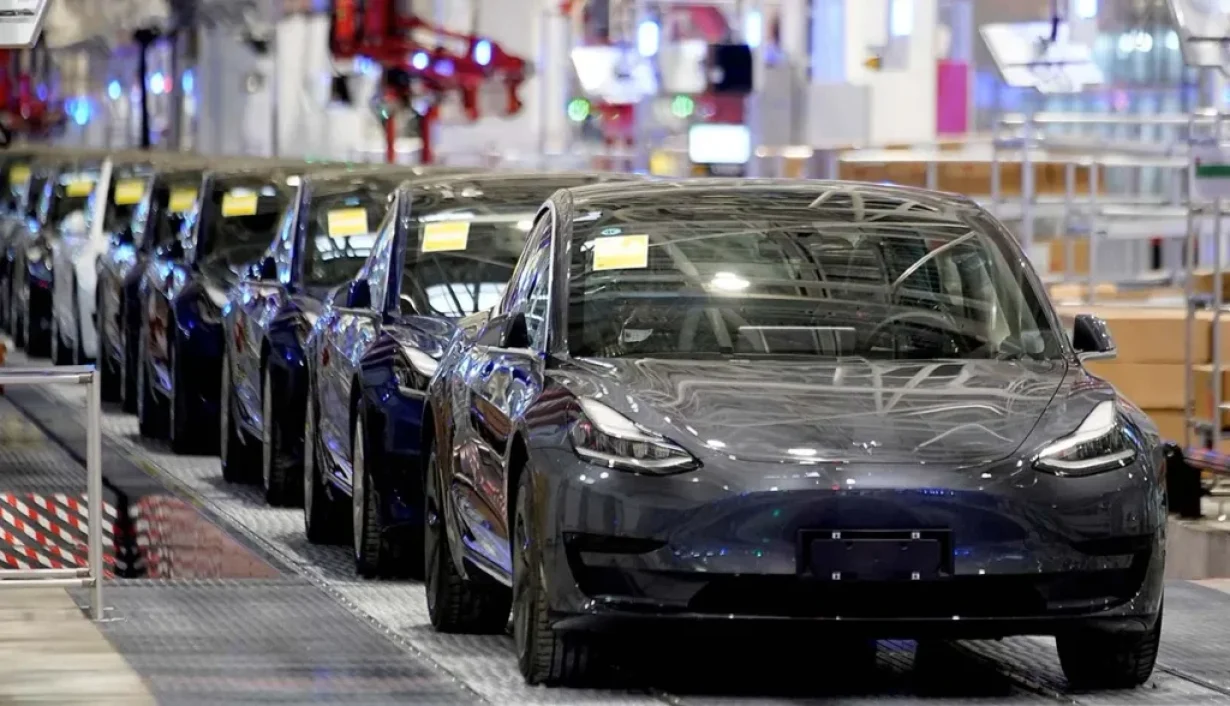

In the era of smart manufacturing, Tesla is considered one of the most innovative automakers in the world. To maintain its leading position in the fiercely competitive market, Tesla is constantly optimising its production processes. Among them, applying RFID technology (Radio Frequency Identification) in its supply chain management is a widely overlooked but crucial secret weapon. In this article, we will analyse how Tesla uses RFID to streamline its car manufacture supply chain and reveal the revolutionary changes behind this technology. It will also show the advantages of RFID over traditional technologies through a table of comparison.
What Is RFID Technology?
RFID is a technology for non-contact identification and data exchange through radio frequency signals. It usually consists of three parts:
- RFID label: pasted or embedded in the object, carrying a unique ID and related information
- RFID reader: identifies and reads the label through radio frequency waves
- Data system: used to process and analyse the read data
Why Is RFID Becoming Increasingly Important in the Car Manufacture Supply Chain?
In modern car manufacture, a complete automotive project involves tens of thousands of parts, and RFID can do just that:
- Track the location of each part in real time
- Automatically record assembly times and nodes
- Prevent parts from being lost or misused
- Improve supply chain transparency and accuracy
While traditional barcode systems can also recognise information, RFID has the following key advantages over conventional barcode systems:
| Compare Dimensions | Barcode | RFID |
| Reading method | Must be aligned with the scanner | Can be read at a distance, non-contact reading |
| Number of labels can be read | Read 1 at a time | Can read dozens of labels at the same time |
| Durability | Easy to be scratched or dirty can not be recognized | More abrasion-resistant, encapsulable, dustproof and waterproof |
| Data capacity | Very low (ID only) | More dynamic data can be written |
| Degree of automation | Low | Very high, suitable for industrial automation scenarios |
How Is Tesla Deploying RFID in Its Car Manufacture Supply Chain?
When Tesla builds its smart car manufacture ecosystem, it not only uses RFID as a “labelling technology”, but also embeds it into the whole production process, logistics system and data platform, thus forming a complete set of closed-loop RFID smart car manufacture supply chain management system. This deployment is mainly reflected in the following six core links:
- Raw Materials and Parts Warehousing
The key parts provided by suppliers (e.g., electric core, electric control module, doors, lights) have been embedded with RFID labels when they leave the factory. The label information includes: part number, production lot, factory time, and supplier information.
The warehousing process is as follows: parts arrive at the warehouse, → RFID access control system, automatic identification, → the system compares the planned order, → and automatic accounting into the warehouse.
Benefits: automated acceptance process, greatly reducing manual errors and registration costs.
- Dynamic Inventory Management
Tesla’s warehouse no longer uses the traditional static shelf code management, but adopts the dynamic inventory model of RFID + positioning.
Practical application:
RFID pallets or totes are automatically bound to items
RFID readers are distributed in the warehouse area, continuously scanning the location of the items
Benefits: real-time understanding of where the material is currently, to avoid finding goods, wrong collar, inventory is not allowed and other issues.
- Automated Assembly Line Operation
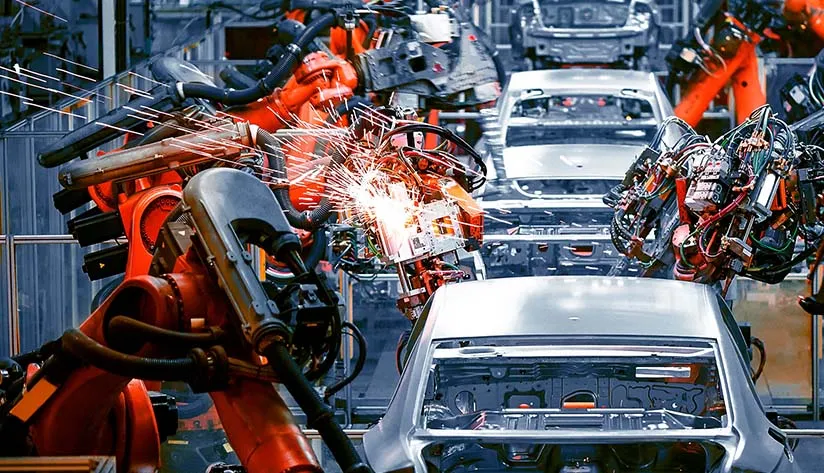
On the assembly line, Tesla makes extensive use of robotic arms and robots. Each key component to be assembled will be pre-bound with RFID labels.
Typical scenario: the battery module passes through the scanning point → the system recognises the ID of the module → the control system dispatches the corresponding robot to execute the installation
Benefits: Realise flexible manufacturing, different configurations of models can be automatically adapted to the required parts.
- Process Quality Tracking
RFID is also used to record the operational information of each station. For example, after the completion of each spot welding, electrical testing and tightening process, the machine will write the process data into the RFID system.
The data includes: completion time, station number, quality control results, and operating equipment code.
Benefit: Generate a complete “manufacturing history” for each vehicle for subsequent analysis, recall management or AI optimisation.
- Finished Product Delivery and Transportation
After the vehicle is completed, the system will automatically summarise all the RFID binding information to generate a digital file of the vehicle. At the time of transportation out of the factory:
RFID scanning vehicle → generate loading list → automatic matching transportation plan → logistics platform synchronisation data
Advantages: Realise shipping automation, vehicle misdirection rate is zero.
- After-Sales and Service Tracking
Each vehicle’s RFID file will exist in the system for a long time. After-sales maintenance personnel by scanning the vehicle a part of the label, you can know: installation time; factory batch; whether in the warranty period.
Benefits: Realise the true meaning of the full life cycle management.

Why Did Tesla Choose RFID Over Other Options?
Although there are a variety of other identification and tracking technologies available in manufacturing, such as barcodes, QR codes, Bluetooth, NFC, GPS, etc., Tesla ultimately chose RFID for clear and systemic reasons.
| Technology Options | Advantages | Disadvantages | Suitability for Tesla |
| Barcode / QR code | Low cost, widely used | Must be scanned manually, easily soiled and inefficient | Too inefficient |
| GPS positioning | Can be tracked remotely | High cost, can’t locate accurately indoors | Not suitable for factory scenarios |
| Bluetooth / LoRa / NFC | Strong communication function, suitable for interactive applications | High power consumption, high price, suitable for close range communication | Not the main use |
| RFID (UHF) | Long range identification, high speed, low power consumption, can penetrate barriers | Controllable cost, high volume deployability, high temperature and chemical resistant environment | Best choice |
Here are the six reasons why Tesla favors RFID technology:
- The Extremely High Degree of Matching in Industrial Scenarios
RFID is suitable for surface or internal implantation of metal, plastic, and electronic devices, is high-temperature and corrosion-resistant, and is suitable for the high-intensity production environment of electric vehicles.
- Non-Contact Long-Distance Reading
The factory environment is noisy and complex, RFID supports 3~10 meters long-distance scanning, robots and unmanned vehicles (AGV) can perform batch identification of goods.
- Information Can Be Read and Written to Meet Dynamic Needs
Compared with only reading barcodes, RFID can write dynamic data, such as process status, inspection results, and location changes.
- Supports Batch Scanning
RFID can recognise multiple labels at a time, which greatly improves the efficiency of assembly lines and warehouse handling.
- Strong System Integration
It can be easily connected to Tesla’s existing systems, such as MES, ERP, WMS, etc., realising a complete data closed loop.
- Environmentally Friendly Materials
Tesla has always emphasised sustainable development. RFID labels can be made of biodegradable plastic, paper-based encapsulation and other environmentally friendly solutions, in line with its environmentally friendly brand image.
How RFID Can Help Tesla Achieve “Lean Manufacturing”?
“Lean Manufacturing is a production method that aims to maximise value and minimise waste, and the introduction of RFID has made this concept a reality at the Tesla factory.
The following are specific applications of how RFID supports the core principles of Lean Manufacturing:
| Lean Manufacturing Elements | RFID Realization | Effectiveness |
| Reduce inventory waste | Real-time tracking of location and quantity of raw materials and semi-finished products | Reduces inventory holdings and avoids stock-outs and backlogs |
| Reduce waiting time | Automatically triggers follow-on jobs to improve process continuity | Eliminate wait times and improve beat stability |
| Error Prevention (Poka-Yoke) | Part labeling + reader verification → automatically determine if it is the correct part | Avoid assembly errors and reduce rework |
| Fast Feedback on Abnormalities | Once a part is abnormal, the system sends out an alert and records the time point | Rapid response to avoid spreading the problem |
| Data-driven continuous improvement | Labels record complete production data, making it easy to analyze capacity bottlenecks and quality trends | Drive improvement plans and algorithm optimization |
| Automatic replenishment mechanism | When the number of parts in the warehouse falls below the warning line → the system automatically sends a replenishment notification | Ensures continuous stock replenishment without manual intervention |
Conclusion
The reason why Tesla can rise rapidly in the global automobile market, in addition to battery technology, software algorithms, and a whole set of intelligent manufacturing systems behind it, is indispensable. The extensive deployment of RFID labels allows it to realise the true meaning of: real-time tracking, accurate assembly, intelligent decision-making, and supply chain transparency. In the future, with the popularisation of smart factories and the further reduction of the cost of RFID technology, it is expected that more automotive brands will follow the example of Tesla and fully adopt the RFID system.
If you are an automotive manufacturer, logistics integrator or parts supplier planning to deploy RFID labels and systems, contact us rfidlabel.com for a customised solution evaluation.