When you decide to order NFC tags for your business, the sheer variety on the market can be overwhelming. It’s easy to assume all Near Field Communication (NFC) tags are created equal, but that is a costly misconception. For procurement managers and project leaders, understanding the nuances of tag selection is critical to ensuring seamless integration, long-term reliability, and a strong return on investment. We understand that sourcing high-quality RFID and NFC products from overseas suppliers can present challenges, from quality control to communication efficiency. That is why we focus on providing detailed, transparent information to help you make the best decision.
The Core Difference: Chipset and Memory
The heart of any NFC tag is its integrated circuit (IC) or chipset. This component dictates the tag’s functionality, memory capacity, and compatibility. When you order NFC tags, the choice of chipset is arguably the most important technical specification.
NFC Forum Types: Compatibility is Key
NFC tags are categorized into four main types by the NFC Forum, each corresponding to a specific chip family.
| NFC Forum Type | Common Chipsets | Memory Range (Bytes) | Typical Use Case |
| Type 1 | Broadcom Topaz | 96 to 2048 | Simple URL links, basic data storage |
| Type 2 | NXP NTAG, Mifare Ultralight | 48 to 2048 | Consumer electronics, smart posters, retail |
| Type 3 | Sony FeliCa | Up to 1MB | Public transport, complex applications |
| Type 4 | NXP DESFire, SmartMX | Up to 32KB | High-security applications, access control |
For most commercial applications, especially in retail and logistics, NXP NTAG chips (Type 2) are the industry standard due to their excellent balance of cost, performance, and wide device compatibility. We recommend confirming the specific NTAG model (e.g., NTAG213, NTAG215, NTAG216) to ensure the memory size meets your project’s data requirements.

Material Matters: Durability and Environment
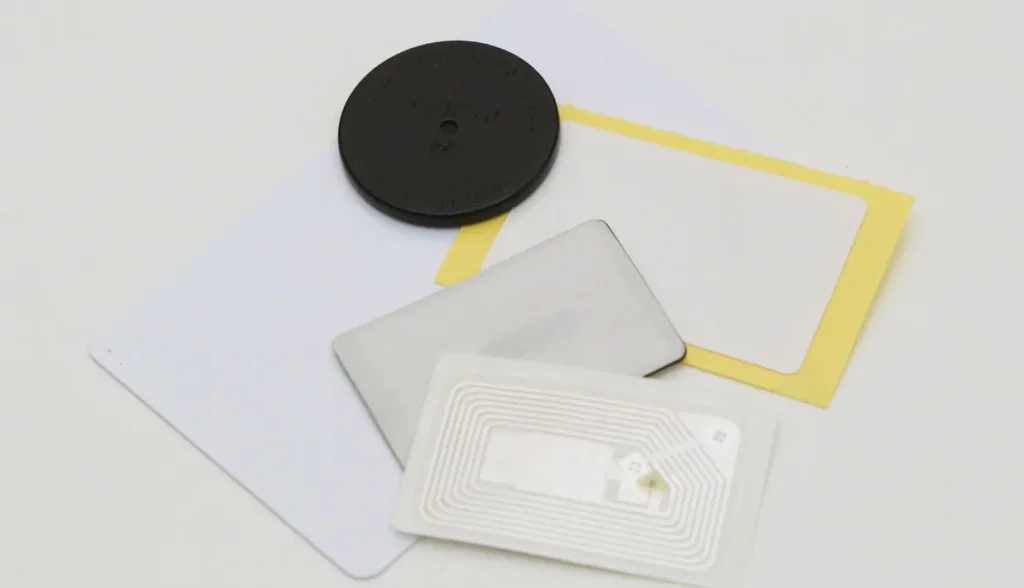
The material encasing the NFC chip and antenna determines the tag’s durability and suitability for its intended environment. A tag used for inventory tracking in a warehouse has vastly different requirements than one embedded in a hotel key card.
Selecting the Right Form Factor
When you order NFC tags, consider the physical stress they will endure.
- Paper/Adhesive Labels: Cost-effective for one-time use or dry, indoor environments, such as retail product tagging.
- On-Metal Tags: Essential for assets with metallic surfaces. Standard NFC tags will not function correctly when placed directly on metal; these tags include a ferrite layer to shield the antenna.
Antenna Design: The Range and Reliability Factor
The antenna is the component that enables communication between the tag and the reader device. A poorly designed or damaged antenna leads to unreliable reads and operational inefficiency—a major pain point in fast-paced procurement environments. The size and shape of the antenna directly impact the reading distance and the tag’s form factor. For example, a larger antenna generally provides a longer read range, which is crucial for quick inventory scans.
Quality Control and Certifications: Our Commitment to Excellence
We understand quality control and certifications are non-negotiable. Sourcing from a reliable factory is the best way to mitigate the risks of cross-border procurement, such as receiving a batch with a high failure rate.
We maintain rigorous quality checks across our five production lines, ensuring every batch of NFC tags meets international standards. Our focus on high-quality materials and precise manufacturing minimizes the risk of early failure, which translates directly into cost savings and operational stability for our B2B clients.
Customization: Making the Tag Your Own
For large-scale B2B orders, customization is key to brand consistency and project-specific needs. We offer extensive customization options, including:
- Logo Printing: High-resolution offset or digital printing for clear branding.
- Encoding: Pre-encoding the tags with specific URLs or unique identifiers before shipment, saving you significant time and labor.
- Shape and Size: Custom die-cutting to match unique product designs or packaging.

Conclusion
Choosing the right NFC tag is a strategic decision that impacts your operational efficiency and customer experience. By focusing on the chipset, material durability, and the reliability of your supplier’s quality control, you can ensure that your investment pays off. We at RFIDLabel are committed to being your trusted partner, offering high-quality, customizable, and competitively priced NFC solutions directly from our factory. Now that you have a clearer understanding of what to look for, we invite you to explore our full range of products and order NFC tags that are perfectly suited for your next project at rfidlabel.com.
FAQs
What is the difference between an NFC tag and a standard RFID tag?
NFC (Near Field Communication) is a subset of RFID (Radio Frequency Identification). NFC tags operate at 13.56 MHz (High Frequency – HF) and are designed for very short-range communication (typically a few centimeters), often used with consumer devices like smartphones. Standard RFID tags can operate at various frequencies (Low Frequency – LF, HF, Ultra High Frequency – UHF) and are used for longer-range applications like supply chain tracking.
How does the memory size of an NFC tag affect my project?
The memory size determines how much data can be stored on the tag. For simple tasks like linking to a website (URL), a small memory tag (e.g., NTAG213 with 144 bytes) is sufficient. For storing more complex data, such as product serial numbers, maintenance logs, or larger NDEF messages, you would need a larger memory tag (e.g., NTAG216 with 888 bytes). Always choose a tag with slightly more memory than your current needs to allow for future expansion.
Recommended Product
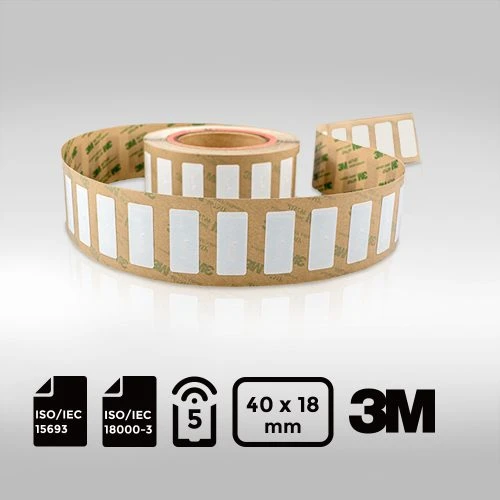
NFC Label 40x18mm NXP ICODE® SLIX2 | ISO15693

The NXP ICODE® SLIX2 RFID Label is a 40×18 mm high-frequency label operating at 13.56 MHz. It offers 2528 bits of user memory, enhanced anti-collision features, and reliable performance up to a 1.5 meter read range, making it ideal for library management, document tracking, and asset management. The label uses 3M adhesive for secure and firm attachment.
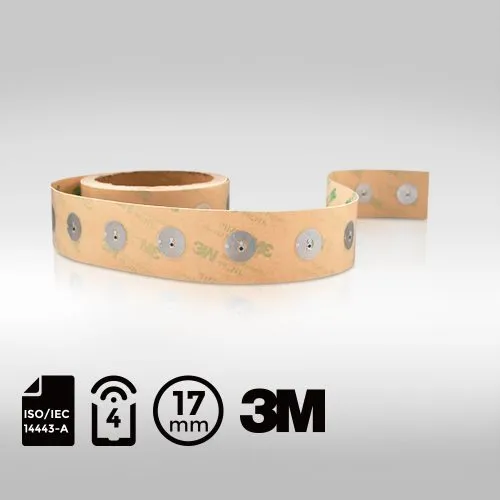
NFC label NXP NTAG® 424 DNA ISO14443A | NFC type 4 | ⌀17mm
Elevate your NFC and IoT applications to new heights with our ⌀17mm NXP NTAG® 424 DNA Label. This label sets a new standard for secure NFC and IoT applications. Engineered for ISO14443A and NFC Type 4 compatibility, it offers AES-128 cryptographic encryption and SUN authentication for unmatched security and real-time user experiences. Ideal for advanced product protection and secure transactions in NFC Crypto Wallets and NFT Marketplaces.
Note: Labels are supplied in factory-default condition, with no data pre-encoded. For pre-encoding to enable immediate verification, please contact us for pricing.

NXP ICODE® SLIX NFC Label 1.5″x0.75″ (38×19 mm) | ISO15693
Elevate your tracking experience with our ISO15693 NFC Label, compactly sized at 0.75″x1.5″ (19×38 mm) and featuring the high-performance NXP ICODE® SLIX chip. Enjoy an extended reading range that ensures precision in data capture. Ideal for asset management, access control, and beyond.