Pharmaceutical RFID is no longer a futuristic concept; it is the essential backbone of a secure, efficient, and patient-safe medicine supply chain. We understand that in the world of critical medications, a single point of failure in tracking can have devastating consequences. That is why we champion a multi-layered approach to medicine traceability, moving beyond simple inventory management to create an ecosystem of tags that secure assets from the manufacturing line to the patient’s bedside.
Why a Single Tag Solution Fails in Pharma
The complexity of the pharmaceutical supply chain demands more than a basic “one tag fits all” solution. Medicines move through distinct environments—from high-speed manufacturing, through temperature-controlled cold chains, into hospital inventory systems, and finally to patient administration. Each stage presents unique challenges for data capture and environmental resilience. A single, generic RFID tag simply cannot meet the varied requirements for read range, data capacity, and material compatibility across this entire journey.
We see the most robust solutions employing a strategic mix of RFID types, each optimized for its specific role. This approach ensures that every critical asset, whether a bulk shipment or a single-dose vial, is accounted for with precision.

The Pharmaceutical RFID Tag Ecosystem: Securing Every Link
To achieve true end-to-end visibility, we advocate for an integrated system where different RFID tag formats work in concert. This pharmaceutical RFID ecosystem is designed to address the unique needs of various product forms and logistical stages.
| Product/Asset Type | Recommended RFID Tag Type | Primary Function | Key Advantage |
| Bulk Shipments/Pallets | UHF RFID Labels (Long-Range) | Logistics and Warehouse Management | High-speed, long-range reading for rapid inventory checks. |
| Temperature-Sensitive Vials | RFID Sensor Tags (Temperature Logging) | Cold Chain Monitoring and Compliance | Real-time temperature logging to ensure medicine efficacy. |
| Individual Vials/Syringes | HF/UHF On-Metal Tags (Small Form Factor) | Dosage-Level Traceability and Authentication | High data capacity and reliable performance on liquid-filled containers. |
| Reusable Totes/Containers | Durable Hard Tags (High-Impact Resistance) | Asset Management and Reverse Logistics | Longevity and resilience for repeated use in distribution centers. |
This strategic deployment ensures that the right tag is used for the right application, maximizing both efficiency and data integrity.

Case Study: Achieving Dosage-Level Traceability with Pharmaceutical RFID
The industry has already seen groundbreaking success with this multi-layered strategy. A prime example is the work done by Fresenius Kabi, a global healthcare company specializing in life-saving medicines. They pioneered the use of GS1 EPC-enabled RFID tagging at the dosage level, embedding high-performance tags directly into the labels of individual vials and syringes.
This initiative moved the point of tagging upstream to the manufacturing process, allowing hospitals to benefit immediately from enhanced inventory management and patient safety protocols. By adopting this standard, they ensured interoperability with hospital systems, drastically reducing manual counting errors and improving the speed of medicine administration. This is a powerful demonstration of how detailed, dosage-level pharmaceutical RFID can transform operations.

The Future of Medicine Security: Beyond the Single Scan
We are committed to pushing the boundaries of what pharmaceutical RFID can achieve. By focusing on rich, comprehensive data capture at every stage, we help our clients build an unbreakable chain of custody. This detailed traceability not only meets stringent regulatory requirements but also provides a powerful defense against counterfeiting and diversion, ultimately protecting patient health. We believe that by providing high-quality, customizable, and reliable RFID solutions, we empower the pharmaceutical industry to operate with unprecedented levels of safety and efficiency.
Conclusion
The journey toward a fully transparent and secure pharmaceutical supply chain is complex, but the path is clear: it requires a sophisticated, multi-layered pharmaceutical RFID strategy. We have the expertise and manufacturing capability to provide the precise, high-quality RFID tags and labels needed for every point in your process, from bulk logistics to dosage-level tracking. If you are ready to elevate your medicine traceability and security to the highest industry standards, we invite you to explore our comprehensive product range and custom solutions. Visit rfidlabel.com today to learn more and start a conversation with our wholesale experts.

FAQs
1. How does the “on-metal” capability of some RFID tags apply to liquid-filled pharmaceutical vials?
While pharmaceutical vials are not metal, the liquid contents (which are often saline or water-based) can significantly interfere with the RFID signal, mimicking the effect of metal. Using flag-style RFID labels is a practical strategy to overcome signal interference from metal and liquid-filled products.
2. What is the difference between an RFID sensor tag and a standard RFID label in the cold chain?
A standard RFID label (like a UHF tag) primarily stores a unique identifier (EPC) for tracking location and inventory. An RFID sensor tag, however, integrates a temperature sensor and logging capability. It not only provides the unique ID but also actively records and stores temperature data throughout the journey. When scanned, it transmits both the product ID and the complete temperature history, providing crucial compliance data for cold chain products.
Recommended Product
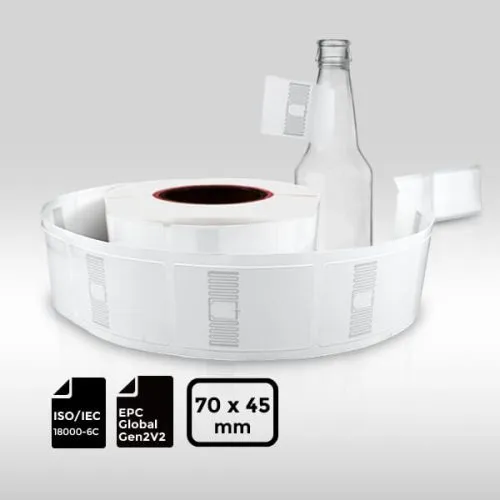
Flag UHF RFID Label ISO18000-6C NXP UCODE® 8 70x45mm

This is a 70x45mm UHF Flag RFID label that can be embedded with NXP UCODE® 8. The “flag” portion of the label extends from the label and helps to ensure that the RFID antenna does not attach directly to the surface of the object to which it is attached. This prevents interference and maximizes the reading distance of the label, making it ideal for use in supply chain, inventory management, asset tracking, security, and access control applications.