


With the rapid development of technology, RFID technology has become a mainstream tool in various industries. For example, logistics, warehousing, retail and medical industries. Among them, RFID labels, as one of the main representatives of RFID technology, have the function of identifying authentication and tracking items. To promote the popularity of RFID technology and user-friendliness, printable RFID label stands out in the market and have become the focus of attention. So, what is a printable RFID label? And then how does it work? This blog will analyze this topic in detail.
What is a printable RFID label?
Printable RFID labels are RFID labels that are printed with professional printing equipment. These labels contain an RFID chip and antenna and have a printable surface. Users can print information such as text, barcodes and QR codes on the label.
The main components of a printable RFID label are the same as a normal RFID label. It contains an RFID chip, an antenna and a substrate. However, the surface design of a printable RFID label is not the same as that of an ordinary label. It not only stores and transmits electronic information, but also provides visual information. Therefore, in practical applications, printable RFID labels have better flexibility and functionality.
What are the structures of a printable RFID label?
To have a clearer understanding of how a printable RFID label works, we first need to understand its composition. A standard printable RFID label is made up of the following components:
- RFID chip: The core component of a printable label is its RFID chip. The chip is mainly responsible for storing data and interacting with the reader. Among them, the RFID chip has a unique identification code and allows reading and writing storage space.
- Antenna: The antenna, as the component used by the label to receive and send signals, is responsible for the link between the chip and the RFID reader. Its design and choice of material affect the label’s read range and read performance.
- Substrate: There is also a carrier in the label, which we call the substrate. The substrate is usually made of synthetic materials such as PVC, PET and Coated Paper. Especially for printable RFID labels, the substrate should have excellent print ability.
- Printed layer: The print layer, as the exclusive component of a printable label, is a layer of surface material printed by thermal transfer or inkjet printing technology. The purpose is to ensure that the label can display images or text information.
How does it work?
The working principle of printable RFID labels is similar to the ordinary RFID labels, and the working steps are as follows:
Label initialization
During the production or use of a label, the chip needs to undergo an initialization process. Among them, this initialization process includes writing EPC and other initial data for the chip. These data should be completed with professional RFID writing equipment.
Label printing
RFID labels are printed by thermal transfer or inkjet printers. Users can use the printing software to edit the information on the printed side of the label. For example, text, barcode and QR code. However, it is worth noting that the user needs to confirm the printer settings before printing the label. Otherwise, the printed image or text and other information are not clear enough.
Label reading
Data information interacts with the label through the use of RFID readers that emit radio waves. The antenna in the label receives the signal from the reader and activates the chip inside. The chip transmits data back to the reader according to a predefined logic. The data can be UID, stored item information and so on.
Data processing
The RFID reader receives the information transmitted by the label, and immediately afterwards it is conveyed to the background processing system for recording and processing. In this process, the background processing system can carry out operations such as identity authentication and inventory management based on the information read.
What are the advantages of printable RFID label?
Printable RFID labels have the following advantages over regular RFID labels:
Personalized customization
Printable RFID labels can be customized with the content of the label according to the actual needs of the customer. Examples of content include corporate logos, QR codes and barcodes. With the flexibility of printing, users can significantly enhance product identification and brand image.
Streamline processes
Whereas previous RFID labels required additional labels to be attached after production to display text or barcode information, printable RFID labels can take both steps. Not only does this simplify the label production process, but it also saves the time and cost required for production.
Versatility
Printable RFID labels can be used not only to transmit electronic data information but also to display visual information. This allows printable RFID labels to be used in a wide range of industries.
Conclusion
Printable RFID labels, as a new form of application of RFID technology, combine the advantages of electronic information storage and visual information display, providing a more flexible and efficient solution for several industries. With the progress of technology and changes in market demand, the application prospect of printable RFID labels will be broader. In the future, enterprises should actively explore the potential of this technology to provide more innovative possibilities for their development.
After reading this blog, do you know enough about printable RFID label? If you still need more information, please contact our sales experts, who will provide you with the suitable solutions and the professional purchase suggestions according to your needs. In addition, you can also visit our official website (rfidlabel.com) to browse related product information about printable RFID label.
Recommended Product
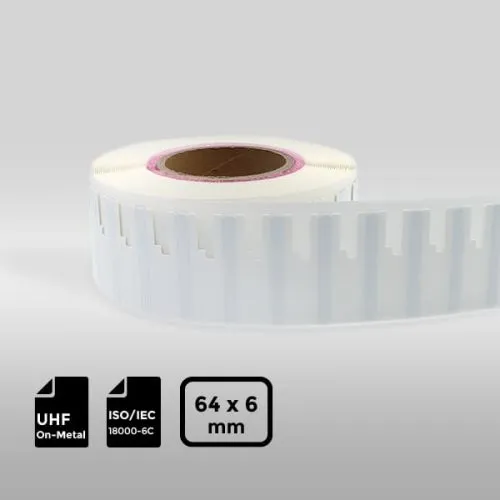
UHF On-Liquid & On-Metal RFID Label NXP UCODE® 8 64x6mm | ISO18000-6C




