


In modern logistics and supply chain management, the management of assets is becoming more and more important, and RFID technology is widely used in various industries through its high efficiency, high accuracy, and automation. However, for some specific environments, such as asset management in metal environments, traditional RFID tags may encounter performance degradation problems. For this reason, RFID metal tags have emerged. This blog will discuss the cost-effectiveness of RFID metal tags and analyze whether it is the best option for users to invest in.
Introduction of RFID metal tags
- Principles of RFID metal tags
RFID metal tags are specifically designed for use in metallic environments. They utilize special materials and designs to overcome metal interference with RFID signals to ensure stable read performance on metal surfaces or in environments.
- Characteristics of RFID metal tags
First of all, RFID metal tag has the characteristics of anti-metal interference. It can work stably on metal surfaces or in metal environments and is not affected by metal interference. Secondly, it is durable. It is usually designed with a rugged case that can withstand complex industrial environments. In addition, it has high reliability. It can still maintain good performance in high temperatures, humidity, and other complex environments.
What is the cost components of RFID metal tags
The cost of RFID metal tags mainly includes the following aspects
- The cost of the tag itself: Because it uses special designs and materials, so it usually costs more per unit than regular RFID tags.
- Installation & Maintenance Costs: Tag attachment and fixing, installation and commissioning of tag readers, and routine maintenance.
- System integration costs: The overheads of integrating an RFID system with an existing management system, including software development and hardware configuration.
- Training costs: Train operators to be familiar with the use and maintenance of the RFID system.
What are the benefits of RFID metal tags
Although the initial investment is high, the benefits they bring may far outweigh the costs in the long run. Here are the main benefits:
- Increased efficiency in asset management
Asset management through automation and rapid stocktaking reduces the time and errors of manual recording and improves the efficiency of asset management.
- Optimizing inventory management
Accurate inventory data helps to optimize the level of inventory management and reduces the occurrence of backlogs and stock-outs. Not only does it control capital expenditures, but it also improves inventory turnover.
- Enhanced data accuracy and visibility
Use data collection and updating to improve the accuracy and visibility of the data and provide better decision-making to the business.
- Improve customer satisfaction
Fast, accurate, and efficient asset management and inquiry effectively enhance customer satisfaction with corporate services and corporate trust.
What is the application cases of RFID metal tags
- Manufacturing industries
In the manufacturing industry, it can be used to track production equipment and tools to ensure the proper functioning of the equipment and availability of the tools, increasing the efficiency of production.
- Warehousing & Logistics
In the field of warehousing and logistics, it can help enterprises to achieve the query of goods and pallet management, to optimize the entire storage space and logistics processes.
- Healthcare sector
In the healthcare industry, it can be used to manage medical devices and equipment, ensuring the quantity and usage of equipment and devices. This is done to improve the quality of healthcare services and meet the needs of healthcare customers.
Is it worth for investment
- Initial investment and long-term benefits
Although the initial investment is high, the long-term benefits it brings, such as improved asset management efficiency, reduced losses, and optimized inventory management, can offset the initial cost over time and even bring additional financial gains.
- Intangible benefits
In addition to direct economic benefits, it brings many intangible benefits. For example, to enhance corporate image, improve customer satisfaction, and enhance market competitiveness, these intangible benefits in the long-term development of the same important value.
Conclusion
A cost-benefit analysis of RFID metal tags shows that despite the high initial investment, it brings significant long-term benefits. Not only can it effectively improve the efficiency and data accuracy of an organization’s asset management, but it can also reduce losses and optimize inventory management. For companies that need to manage assets in a metallic environment, it is undoubtedly one of the best options worth investing in. Through the correct implementation and application, it will bring significant economic and management benefits to enterprises, helping them to achieve sustainable development.
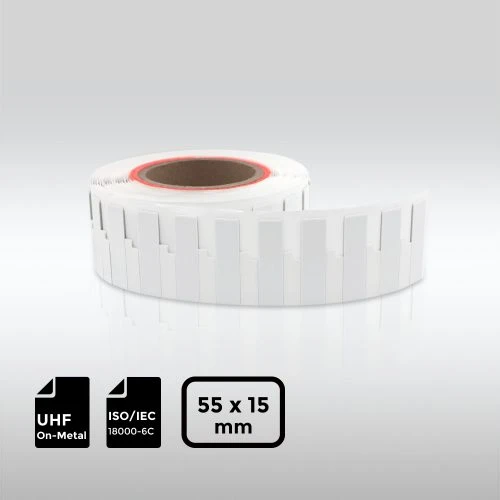
UHF On-Metal RFID Label Impinj® Monza® R6-P 55x15mm | ISO18000-6C

The Flexible & Printable UHF On-Metal Label is a durable, customizable, high-performance RFID label that can be easily printed and encoded. The label is ideal for metallic container tracking, equipment & device tracking, warehouse shelf tracking, automotive components tracking, IT asset tracking, etc. It can be stuck to metallic assets easily, especially on irregular and uneven surfaces.



