


The initial RFID price is often the first metric procurement managers, like our target audience, look at. However, we believe that focusing solely on the upfront cost is a short-sighted approach that can obscure the true, long-term return on investment (ROI) that high-quality RFID solutions deliver. For B2B buyers seeking to optimize their supply chain and inventory management, understanding the total cost of ownership (TCO) is paramount. We will explore how superior quality, customization, and supplier expertise fundamentally shift the conversation from a simple rfid price tag to a strategic business investment.
Understanding the Components of RFID Price
The sticker price of an RFID tag or label is influenced by several key factors. We categorize these into material costs, technology specifications, and manufacturing overhead. A cheaper tag might save money today, but it often compromises on these core components, leading to higher failure rates and operational disruptions down the line.
Material Quality and Durability
The substrate, adhesive, and inlay materials directly impact the tag’s lifespan and performance in various environments. For instance, a high-quality adhesive is crucial for ensuring an RFID label remains securely attached to its asset throughout the supply chain, from warehouse to retail floor. Inferior materials can lead to premature detachment or degradation, forcing costly re-tagging efforts.
Chip and Antenna Specifications
The type of chip (e.g., Monza R6, UCODE 8) and the design of the antenna determine the read range, speed, and reliability of the tag. Tags with advanced chips offer better performance in dense reading environments, which is essential for large-scale inventory checks. Investing in the right specification ensures seamless integration with existing RFID infrastructure, avoiding expensive system overhauls.

The Hidden Costs of Low-Cost RFID Solutions
While a low rfid price may seem attractive, it often masks significant hidden costs that erode profitability and operational efficiency. We have observed that these hidden costs frequently outweigh the initial savings.
| Hidden Cost Category | Description | Impact on TCO |
| Read Inaccuracy | Poor quality tags lead to missed reads and inventory discrepancies. | Increased labor for manual checks, lost sales due to stockouts. |
| Failure Rate | Tags that fail prematurely due to poor materials or manufacturing. | Cost of replacement tags, labor for re-tagging, and supply chain delays. |
| Integration Issues | Non-standard or inconsistent tag performance with existing readers. | Expensive system recalibration, prolonged deployment time. |
| Compliance Risk | Tags that do not meet industry standards (e.g., GS1) or regulatory requirements. | Fines, rejection of goods, and damage to business reputation. |
Customization: A Strategic Investment, Not an Expense
For large-scale B2B operations, off-the-shelf solutions rarely provide optimal performance. Custom RFID label solutions are a strategic investment that maximizes efficiency. We offer extensive customization options, including specific sizes, unique encoding, and specialized materials (like eco-friendly options), ensuring the tag is perfectly suited to the application scenario, whether it’s a hotel key card or a retail hangtag.
Optimizing Performance with Custom Inlays
A custom-designed inlay, tailored to the specific dielectric properties of the item being tagged (e.g., metal, liquid, or fabric), can dramatically improve read rates and range. This optimization directly translates into faster processing times and more accurate inventory data, justifying the slightly higher initial rfid price.

The Value of Supplier Expertise and Quality Control
When evaluating the rfid price, the supplier’s expertise and commitment to quality control must be factored in. As a manufacturer with five production lines and a focus on North American and European markets, we adhere to stringent quality standards. Our wholesale-only, B2B model allows us to focus on delivering consistent, high-quality products with flexible minimum order quantities.
Certifications and Traceability
We ensure that all our products, from RFID wristbands to access control cards, meet international quality certifications. This commitment provides our clients with peace of mind, mitigating the risk of receiving non-compliant products—a major pain point in cross-border procurement. Our robust quality control process ensures every batch is traceable and meets the agreed-upon specifications.
Conclusion: Shifting the Focus from Price to Partnership
Ultimately, the most competitive rfid price is the one that delivers the lowest total cost of ownership and the highest operational efficiency. We believe that our commitment to quality, customization, and reliable supply chain management offers a value proposition that far exceeds a simple low-cost alternative. By partnering with us, you are not just purchasing RFID tags; you are investing in a seamless, reliable, and future-proof inventory solution.
Ready to move beyond the initial rfid price and explore a long-term partnership that guarantees quality and performance? Visit rfidlabel.com today to discuss your custom RFID label solutions and request a wholesale quote.

FAQ
How does RFIDLabel ensure the quality of its wholesale RFID products?
We operate five dedicated production lines and adhere to strict quality control protocols, focusing on the B2B wholesale market. Our commitment to quality is backed by international certifications and a robust process for material sourcing and product traceability, ensuring high performance and durability for demanding markets like North America and Europe.
Can a higher initial RFID price actually reduce my long-term logistics costs?
Absolutely. A higher initial price often reflects superior chip technology and material quality, which translates to a lower failure rate and higher read accuracy. This reliability minimizes the need for manual inventory checks, reduces the cost of replacing failed tags, and prevents shipping delays caused by inaccurate counts, leading to significant savings in labor and logistics over the product lifecycle.
Recommended Product
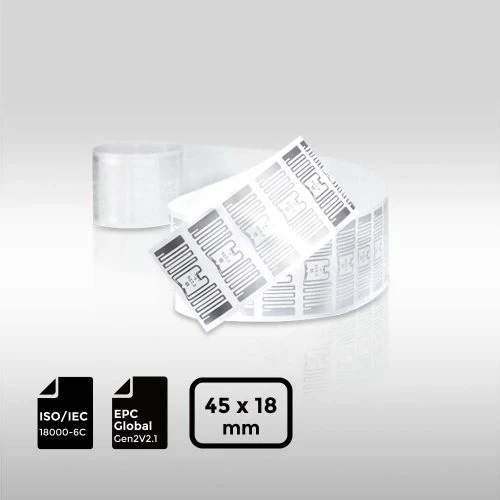
Avery Dennison® ARC Certified NXP® UCODE® 9 RFID Label | 45×18mm

AD Miniweb U9 FCC label is a compact (45×18 mm) ARC-certified RFID solution for retail, industrial, and supply-chain use. It delivers strong read performance on low-detuning materials such as cardboard and plastic, and in close-coupled environments. Powered by NXP® UCODE® 9, it offers 96-bit EPC memory and a self-adjusting feature that optimizes performance in challenging conditions. Widely applied in retail chains like Dillard’s, it ensures accurate inventory tracking, reliable performance, and smooth in-store operations.

ARC Certified Impinj® M730 Coated Paper RFID Label 47x31mm
This ARC-certified RFID label can be used in clothing retail, supply chain management, and brand protection. They not only fully conform to the ISO/IEC 18000-6C and EPCglobal Gen2v2 standards, but their inlays have also completely passed the ARC certification tests, ensuring stable performance and reliable tracking. Ideal for retail chains such as Walmart and Dillard’s, it helps streamline inventory management, enhance supply chain visibility, and maintain brand integrity.

ARC Certified Impinj® M730 Coated paper RFID Label 73x17mm
The ARC-certified RFID tag for Walmart is designed to deliver reliable performance and full compliance with industry standards such as ISO/IEC 18000-6C and EPCglobal Gen2v2. Engineered for large-scale retail and supply chain operations, it offers excellent reading accuracy, stable transmission, and high compatibility with existing RFID infrastructures. This label is ideal for item-level tagging in major retail chains like Walmart and Dillard’s, supporting efficient inventory management, supply chain transparency, and brand protection. By meeting ARC certification requirements, it helps retailers and brand owners achieve seamless integration and operational consistency across global retail networks.



