In the high-stakes world of modern diagnostics and research, lab RFID technology has emerged as the gold standard for ensuring data integrity and operational efficiency. Whether you are managing a single clinical site or a global network of research facilities, the ability to maintain a “universal language” for every specimen is no longer a luxury—it is a necessity. At RFIDLabel, we understand that the foundation of any successful laboratory project lies in the precision of its tracking systems. Our NXP ICODE® SLIX Lab Specimen Tracking RFID Label is engineered to bridge the gap between complex data requirements and the physical constraints of laboratory environments.
Why Lab RFID is the Future of Specimen Management
Traditional barcoding systems often fall short in high-throughput or sensitive environments. Manual scanning is time-consuming and prone to human error, which can lead to costly sample mix-ups. By contrast, lab RFID allows for non-line-of-sight data capture, enabling researchers to identify hundreds of samples simultaneously without ever opening a storage container.

The Advantages of RFID Over Traditional Methods
| Feature | Traditional Barcodes | Lab RFID (NXP ICODE® SLIX) |
| Read Method | Line-of-sight required | Non-line-of-sight (Bulk reading) |
| Data Capacity | Limited to alphanumeric strings | 896 bits of user memory |
| Durability | Prone to smudging/tearing | Chemical-resistant nylon |
| Automation | Manual scanning needed | Fully automated tracking |
| Security | Easily duplicated | 32-bit password protection |
Product Spotlight: NXP ICODE® SLIX Lab Specimen Tracking RFID Label
Our NXP ICODE® SLIX Lab Specimen Tracking RFID Label is specifically designed for the rigors of the laboratory. With a compact form factor of 40×8.7 mm, it fits perfectly on standard test tubes and cryovials without obstructing the view of the contents.
Technical Specifications and Performance
We have optimized this label to meet the highest international standards, including ISO/IEC 15693 and NFC Forum Tag Type 5. This ensures that our lab RFID solutions are compatible with a wide range of HF readers and mobile devices, providing flexibility across different project locations.
- Chip Type: NXP ICODE® SLIX
- Operating Frequency: 13.56 MHz
- Read Range: Up to 1.5 meters
- Material: Medical-grade Nylon with high-performance Acrylic adhesive
- Data Retention: 50 years, ensuring long-term archival stability
- Write Endurance: 100,000 cycles for reusable tracking workflows
Chemical and Environmental Resilience
Laboratories are harsh environments. Samples are often exposed to ethanol, DMSO, and extreme temperatures. Our labels utilize a specialized nylon face stock and acrylic adhesive that provide exceptional resistance to chemical corrosion. This durability ensures that the lab RFID tag remains readable from the moment of collection through years of cold storage.

Real-World Impact: A Case Study in Laboratory Efficiency
This implementation highlights how lab RFID eliminates the risk of lost specimens, preventing invasive re-sampling and critical delays in diagnosis. By adopting the NXP ICODE® SLIX platform, your facility can achieve similar security and excellence.
Enhancing Your Laboratory Workflow with RFIDLabel
As a leading manufacturer with five dedicated production lines, RFIDLabel offers wholesale solutions tailored to the needs of large-scale distributors and procurement managers. We specialize in high-quality, customizable RFID tags that meet the stringent requirements of the North American and European markets.
How to Implement Our Lab RFID Labels
- Selection: Choose the 40×8.7 mm label for standard vials or contact us for custom shapes.
- Encoding: Use a standard HF reader/writer to encode specimen IDs and metadata.
- Application: Apply the self-adhesive label to a clean, dry surface of the container.
- Tracking: Integrate the data with your LIMS for real-time visibility.

Conclusion
The transition to lab RFID is a strategic investment in the accuracy and scalability of your research. The NXP ICODE® SLIX Lab Specimen Tracking RFID Label from RFIDLabel provides the durability, security, and precision required to maintain consistency across diverse projects and locations. By choosing our medical-grade solutions, you are not just buying a tag; you are implementing a robust system that safeguards your most valuable assets—your specimens.
Ready to upgrade your laboratory tracking? Visit rfidlabel.com to explore our full range of products or request a wholesale quote today. Let us help you create a seamless, error-free environment for your next breakthrough.
FAQs
1. Can these RFID labels withstand cryogenic storage temperatures?
Yes, while the standard operating range is -20°C to 50°C, the medical-grade nylon and acrylic adhesive are designed to maintain integrity in typical laboratory cold storage environments. For specialized ultra-low temperature requirements, please contact our technical team for customized material options.
2. Is the NXP ICODE® SLIX chip compatible with my existing NFC-enabled smartphone?
Absolutely. The NXP ICODE® SLIX follows the NFC Forum Tag Type 5 standard, making it fully readable by most modern NFC-enabled smartphones and tablets. This allows for easy “on-the-go” sample verification without the need for specialized industrial readers in every corner of the lab.
Recommended Product
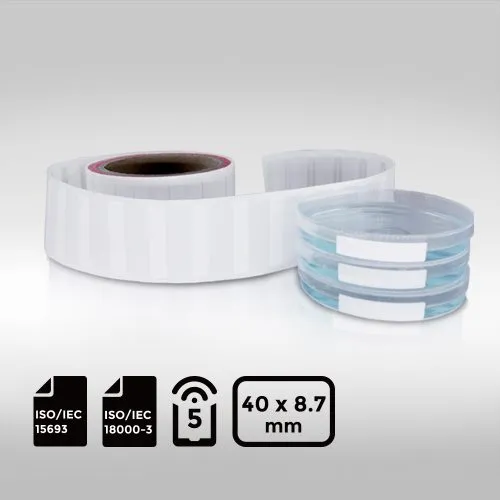
NXP ICODE® SLIX Lab Specimen Tracking RFID Label | 40×8.7mm

Track your laboratory samples using the NXP ICODE® SLIX RFID label, with an exceptionally compact height of just 8.7 mm, making it especially suitable for small laboratory containers. This label is made from medical-grade materials that provide excellent chemical corrosion resistance, and it uses acrylic adhesive for optimal adhesion, to meet the sample management needs of high-standard laboratory environments like embryo cultivation.