


RFID antenna connector types decide whether your read zone stays consistent across shifts—or turns into a “works on my desk” problem once cables, vibration, and cleaning crews get involved. In this guide, we’ll map connector choices to real deployment habits (panel-mounting, quick swaps, outdoor sealing, embedded readers) so your RFID network stays stable and serviceable.
Why RFID antenna connector types matter in day-to-day operations
When we evaluate RFID antenna connector types, we could focus on what teams actually do on-site:
- Swap antennas during layout changes
- Move readers between portals, conveyors, and workstations
- Run long coax cable routes through trays and ceilings
- Mount antennas outdoors or in washdown zones
- Integrate compact modules inside kiosks and cabinets
The connector becomes the “handoff” point between antenna, cable, and reader—so a connector choice should match the environment and the maintenance style.

Common RFID antenna connector types and where they fit best
SMA (and RP-SMA): the “most common” starting point
SMA shows up everywhere in RF hardware—compact, threaded, and familiar. RP-SMA is a lookalike variant often associated with Wi-Fi ecosystems; it’s mechanically similar but uses a reversed pin/socket arrangement that can confuse installs if teams don’t verify the center contact style.
Practical use tips
Use bulkhead SMA for panel-mounted readers/antenna boxes.
Use SMA pigtails (SMA to U.FL) to protect delicate internal connectors.
Type N: outdoor-friendly and physically robust
If we’re building portals near loading docks or placing antennas outdoors, Type N is a common upgrade path because it’s threaded, larger, and widely used for rugged RF interconnects.
TNC and BNC: quick handling vs. vibration discipline
BNC is fast for test benches and lab swaps (bayonet lock), but it’s less “set-and-forget” for vibration-heavy installations.
TNC keeps the threaded feel similar to SMA but in a sturdier form factor for repeated handling.
U.FL / I-PEX: inside-the-box miniature connectors
U.FL (also called I-PEX by many engineers) is tiny and common in compact electronics where space matters. It’s great inside enclosures, but we usually avoid repeated connect/disconnect cycles at the U.FL itself—use a pigtail to a stronger external connector instead.
FAKRA: keyed, color-coded RF for vehicle and transit builds
For transit, automotive, and vibration-sensitive assemblies, FAKRA adds keying + color coding to reduce mis-mating and speed service work.

RFID antenna connector types comparison table
| Connector | Coupling | Best-fit RFID scenarios | Fast takeaway |
| SMA | Threaded | Indoor fixed readers, portals, ceiling antennas | Most common; compact and reliable |
| RP-SMA | Threaded | Mixed Wi-Fi/RF environments | Verify center pin/socket before ordering |
| Type N | Threaded | Outdoor portals, dock doors, long-term installs | Rugged feel; good for harsh environments |
| TNC | Threaded | Industrial areas with vibration | Sturdier handling than SMA |
| BNC | Bayonet | Testing, temporary setups | Very quick swaps; less “permanent install” vibe |
| U.FL / I-PEX | Snap-on micro | Embedded readers/kiosks (internal) | Use pigtails; avoid frequent re-mating adafruit |
| FAKRA | Locked + keyed | Vehicles, transit, vibration-prone enclosures | Prevents wrong connections via keying/colors |
A practical selection checklist for RFID antenna connector types
1.Decide how the antenna will be serviced
Frequent swaps (layout experiments): choose connectors that tolerate handling (SMA/TNC), and standardize across sites.
Rare swaps (fixed portals): prioritize stable mounting (bulkhead + strain relief).
2.Match the connector to the mounting style
Panel-mount (recommended for reliability)
Bulkhead connectors + locknut + washer
Cable strain relief on the inside of the panel
Free-hanging cable (only if needed)
Add a right-angle adapter or a short pigtail to reduce bending force at the port.
3.Keep the “system” consistent
A connector is only one part of the RF path. Standardize:
50-ohm components end-to-end (reader → cable → connector → antenna)
One or two connector families per facility to reduce ordering errors
4.Pick an “interface strategy” for embedded builds
If your kiosk or cabinet uses U.FL internally, we recommend this pattern:
FL (internal) → short pigtail → SMA bulkhead (external)
That way technicians touch the SMA, not the tiny internal connector.

Conclusion
If we choose RFID antenna connector types with service habits, mounting style, and environment in mind, we get RFID networks that stay consistent—easy to maintain, easy to scale, and less prone to “mystery” read-rate drops. After reading this article, you can confidently shortlist RFID antenna connector types for your next rollout and then choose compatible RFID labels and custom solutions by visiting rfidlabel.com to request specs, samples, or a wholesale quote.
FAQs
How do we avoid ordering the wrong parts when comparing RFID antenna connector types like SMA and RP-SMA?
Don’t rely on the threads—check the center pin vs center socket. SMA and RP-SMA look similar but the center contact is reversed, so always specify type + gender (e.g., SMA male, RP-SMA female) and, if possible, test-fit one sample set before placing a bulk order.
For outdoor portals, which RFID antenna connector types usually pair best with weather-resistant antenna housings and long cable runs?
For outdoor or long-run installs, Type N is often the safer choice because it’s physically robust and stays tight. If your system is already standardized on SMA, use an SMA bulkhead (panel-mount) with proper strain relief on the cable so the connector isn’t taking the mechanical load.
Recommended Product
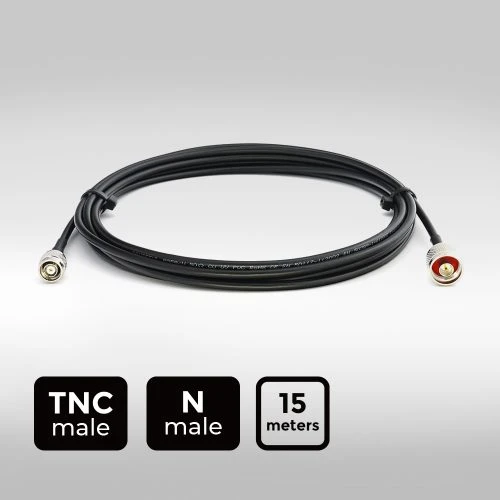
15-Meter Cable for UHF RFID Fixed Reader AZF-M1
RP-TNC male – N male, for AZF-M1 with 9-12 dBi antenna, 15 meters.
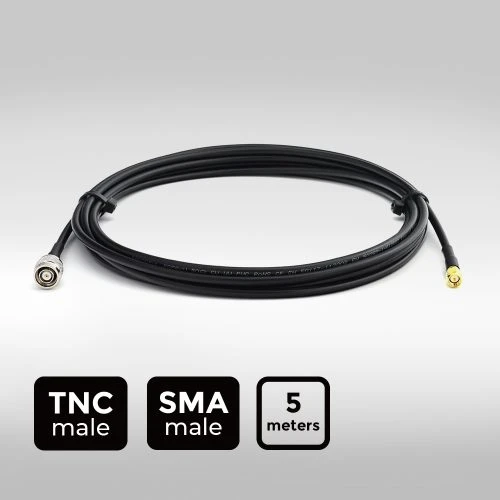
5-Meter Cable for UHF RFID Fixed Reader AZF-M1
RP-TNC male – SMA male, for AZF-M1 with 5 dBi antenna, 5 meters.

UHF 5-dBi RFID Antenna ISO 18000-6C
The UHF RFID antenna 5dBi features a high front-to-back ratio, narrow sidelobes, and a 5dBi gain, ensuring stable performance. It enables accurate and rapid multi-label reading and writing with a moderate read-write distance. Despite its small size, lightweight, and low profile, it provides high data security, making installation convenient.



