
Zara RFID Tags are often used as a reference point when people talk about RFID in fashion retail, and for good reason. Zara’s business model depends on fast stock turnover, frequent replenishment, and accurate store-level inventory. In this kind of fast-moving retail environment, knowing exactly which size, color, and style is available in each store is not just a small operational detail — it directly affects sales performance and customer satisfaction.
Let’s be honest: in apparel retail, inventory mistakes are easy to make. A dress may appear as “available” in the system, but in reality, it could be hanging on the wrong rack, sitting in the stockroom, reserved for an online order, or already sold. RFID helps close this gap by giving each garment a unique digital identity that can be read quickly and in bulk.
That’s why Zara’s RFID approach has become a useful reference for fashion brands, apparel retailers, and supply chain teams looking to improve inventory visibility and make store operations more efficient.
So, What Makes Zara’s RFID System So Special?
RFID, or Radio Frequency Identification, is essentially a clever way of using radio waves to identify and track items. The best part? Unlike old-school barcodes, you don’t need to scan RFID tags one by one with a direct line of sight. Imagine a store associate walking through an aisle with an RFID reader, scanning dozens of garments at once—even if they’re still on the racks, piled on shelves, or hidden in the backroom. Pretty neat, right?
For a fast-fashion giant like Zara, this is absolutely critical. Apparel comes in countless sizes, colors, and styles. New collections drop constantly, and the sales floor is always changing. If store inventory isn’t updated in real-time, customers get frustrated when they can’t find what they want, and online stock information becomes totally unreliable. Nobody wants that.
RFID tags essentially create a direct link between each physical garment and its digital inventory data. In practice, this means retailers get a much clearer picture of what’s in the warehouse, what’s just arrived at the store, what’s currently on the sales floor, and what’s already flown off the shelves.

From Tagging to Replenishment: How RFID Transforms Apparel Retail
In an apparel RFID system, every garment typically gets an RFID tag attached before it even hits the store. This little tag is packed with product info like SKU, style, size, color, or a unique item ID.
Once that product enters the supply chain, RFID starts working its magic at several key stages.
Think about the warehouse or distribution center: RFID readers can quickly verify products during sorting, packing, and shipping. When goods finally arrive at the store, staff can check in incoming items in a flash, instead of tediously scanning each barcode by hand. And during daily store operations, RFID makes stock counting incredibly fast and frequent.
For store teams, this means less time wasted hunting for products and more precious time spent actually helping customers. For management, it means inventory data becomes far more trustworthy. When the system says there’s a black jacket in size M available, you can bet the store actually has it.
This accuracy is a huge deal for omnichannel retail. Customers might browse online, check store availability, order something for pickup, or even return an item to a different store. Without precise, item-level inventory, these services can quickly turn into a chaotic mess.

Why Fashion Retailers Are Ditching Barcodes for RFID
Barcodes are still everywhere in retail, but when it comes to apparel inventory management, their limitations are pretty clear. A barcode needs a direct scan, usually one item at a time. That’s fine for checkout, but try counting thousands of garments that way—it’s a nightmare!
RFID is a whole different ballgame. It lets you read multiple items all at once, which makes inventory checks lightning fast. A store associate can literally stroll down an aisle with a handheld RFID reader and gather all the item data without even touching every single product.
For apparel retailers, it’s not just about speed. The real, game-changing benefit is that stock data can be updated way more often. Instead of those dreaded, occasional manual counts, stores can perform inventory checks frequently, catching discrepancies much earlier. This proactive approach saves a ton of headaches and lost sales.
Here’s a quick look at how they stack up:
| Feature | Barcode | RFID |
| Scanning method | One-by-one scanning | Batch reading |
| Line of sight | Required | Not always required |
| Inventory counting | Slower | Faster |
| Labor requirement | Higher for large stock counts | Lower for frequent stock checks |
| Best use case | Basic product identification | Item-level inventory tracking and retail operations |
For brands juggling huge product volumes, tons of SKUs, and a need for rapid store replenishment, RFID offers a seriously powerful operational edge.
Better Inventory Accuracy Means Happier Customers
We often think of RFID as a behind-the-scenes inventory technology, but its impact is felt directly by customers. Trust me on this one.
In apparel retail, customers usually have pretty simple desires: Is my size here? Is this color in stock? Can I pick it up today? Can someone on staff actually find it quickly?
When inventory records are off, even the most amazing product can lead to a terrible shopping experience. Imagine a customer making a special trip to your store because your website said an item was available, only to find out it’s nowhere to be found. That kind of mismatch doesn’t just hurt customer trust; it actively kills sales.
With RFID, store staff can locate products much more efficiently and keep inventory records incredibly close to the actual stock on hand. This helps eliminate “phantom inventory”—you know, when a product shows up in the system but mysteriously vanishes in the store.
For customers, the outcome is straightforward: fewer frustrating out-of-stock moments, quicker service, and a much smoother, more enjoyable shopping journey.

How RFID Powers the Omnichannel Experience
Modern fashion retail isn’t neatly divided into “online” and “offline” anymore. Customers might discover a product online, try it on in-store, order it from another branch, or even return it through a completely different sales channel.
This creates a massive headache for inventory management. If a retailer doesn’t have real-time insight into every single item’s status, it becomes nearly impossible to confidently promise accurate store pickup, ship-from-store options, or reliable online stock availability.
RFID tags for apparel are the secret sauce here. They make product data visible across the entire supply chain. Because each garment has a unique identity, retailers can track its journey with incredible accuracy—from the distribution center to the store, from the stockroom to the sales floor, and from checkout all the way through to returns.
For brands serious about perfecting their online-to-offline retail strategy, RFID isn’t just some dusty warehouse tool. It’s a fundamental part of the customer experience infrastructure.

RFID and Lightning-Fast Checkout
Here’s another reason retailers are buzzing about RFID: checkout efficiency. Traditional checkout usually means scanning each barcode one by one. For customers buying a handful of items, this can really drag down the process.
RFID, however, can make checkout fly by because multiple tagged products can be read simultaneously. Depending on the store’s setup, RFID can power self-checkout systems, speed up assisted checkout, or even confirm sales at the item level.
Now, this doesn’t mean every store needs a fully automated checkout system right away. For many retailers, the first and most crucial step is simply improving item-level visibility and inventory accuracy. But once those RFID tags are on the products, they open the door to so many more advanced retail applications down the line. It’s an investment in the future.
What Kind of RFID Tags Are Used for Clothes?
For apparel and fashion retail, UHF RFID tags are the go-to choice. Why? Because they offer longer reading distances and can handle batch reading like a champ. The exact tag format you choose will depend on the product itself, the store environment, and your brand’s specific printing needs.
Here are some common RFID tag options you’ll find for apparel:
RFID Hang Tags
These are super popular for garments, shoes, bags, and fashion accessories. They can be custom-printed with your brand logos, barcodes, QR codes, product information, and, of course, the RFID data.
→ Learn more about RFID hang tags
RFID Care Labels
These are perfect when the tag needs to stick with the garment even after it’s sold. They’re often used for long-term identification, laundry management, or tracking a product’s entire lifecycle.
→ Learn more about RFID care labels
RFID Adhesive Labels
More commonly, you’ll see these on packaging, cartons, boxes, or for temporary retail applications.
→ Learn more about RFID adhesive labels
Custom RFID Labels
For fashion brands with unique requirements, RFID labels can be totally customized—think size, material, chip type, antenna design, printing content, and encoding format. The sky’s the limit.
When you’re picking RFID tags for apparel inventory management, retailers usually need to consider things like reading distance, tag size, material compatibility, chip performance, printing method, encoding services, and how well they’ll integrate with existing RFID systems. It’s a lot to think about, but totally worth it.
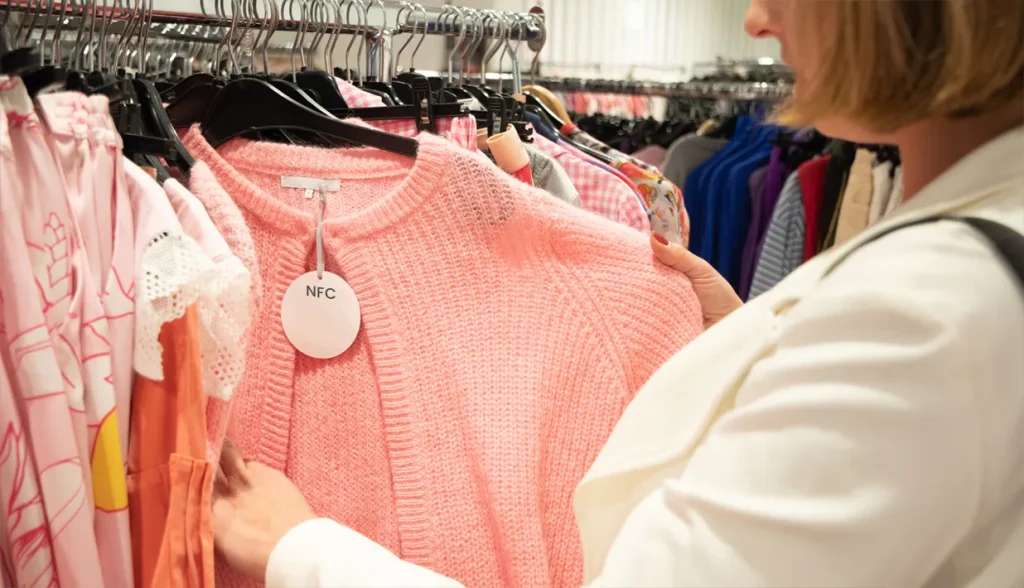
Choosing the Right RFID Tag for Your Fashion Retail Business
Not all RFID tags are created equal, and they certainly don’t perform the same way. In apparel retail, the tag absolutely has to be a perfect match for the product and the environment where it’ll be read.
For instance, a delicate, lightweight garment might need a tiny, discreet RFID hang tag that won’t mess with its display. A luxury fashion brand might prioritize the tag’s appearance and printing quality. Meanwhile, a warehouse application will probably care more about reading distance and how well it performs in bulk scanning.
Chip selection is another biggie. Most apparel RFID applications use UHF RFID chips from well-known suppliers, chosen based on performance needs and system compatibility.
Ultimately, for retailers, the best RFID tag isn’t just the one with the longest reading distance. It’s the one that works reliably, day in and day out, in the real-world retail environment—from the moment it’s printed and encoded, to store reading, checkout, and inventory counting. Reliability is key!
RFID Tags for Apparel: Boosting Inventory and Retail Tracking
For apparel brands, RFID technology can seriously upgrade several aspects of retail operations, including:
- Garment inventory tracking: Knowing exactly where every item is.
- Store stock counting: Making those dreaded counts a breeze.
- Warehouse and distribution management: Streamlining the flow of goods.
- Product replenishment: Keeping shelves stocked with what customers want.
- Self-checkout support: Speeding up the customer journey.
- Return and exchange management: Making returns smooth and efficient.
- Online and offline inventory synchronization: No morephantom inventory.
- Retail supply chain visibility: A clear view of your entire operation.
At RFIDLabel.com, we’re all about providing customizable RFID labels and hang tags for apparel, retail, logistics, and inventory management. Whatever your project needs, we’ve got options: custom printing, chip selection, encoding services, material choices, and different label formats.
Whether you’re looking for RFID hang tags for your fashion retail business, UHF RFID clothing tags for inventory tracking, or custom RFID labels for supply chain management, choosing the right tag is the very first step toward building a more accurate and efficient retail system. Let us help you get it right.

Conclusion
Zara’s use of RFID tags is a brilliant example of how this technology can supercharge fast-moving apparel retail. By giving each garment its own unique digital identity, RFID helps retailers nail inventory accuracy, speed up stock counts, streamline store replenishment, and create a truly seamless online-to-offline shopping experience.
For fashion retailers, RFID isn’t just about tracking products. It’s about making inventory data rock-solid, empowering store teams to work smarter, and ultimately giving customers a much better chance of finding exactly what they’re looking for. Happy customers, happy business.
If you’re on the hunt for RFID tags for apparel, UHF RFID clothing tags, or custom RFID labels for retail inventory management, rfidlabel.com is here to guide you to the perfect solution for your project.
FAQ
1.What exactly are Zara RFID tags?
Zara RFID tags are special RFID-enabled tags that Zara uses to identify and track individual garments. They’re key to improving inventory visibility, making store stock counts faster, helping with replenishment, and generally smoothing out retail operations.
2.Why are apparel retailers adopting RFID tags?
Apparel retailers are jumping on the RFID bandwagon because clothing products often come in a dizzying array of sizes, colors, and styles. RFID helps stores count inventory much faster and keeps stock data incredibly accurate, which is a huge relief for everyone involved.
3.Are RFID tags really better than barcodes?
For batch reading and item-level inventory tracking, RFID tags are definitely superior. Barcodes still have their place, but they typically demand direct, one-by-one scanning, which can be a real drag for large inventories.
4.What RFID frequency is typically used for clothing?
UHF RFID is the standard for apparel inventory management. Why? Because it offers longer reading distances and can read multiple items simultaneously, making it super efficient.
5.Can RFID hang tags be customized?
You bet. RFID hang tags can be fully customized with your brand logos, barcodes, QR codes, product information, various chip options, different materials, specific sizes, and tailored encoding requirements. Make them your own!
6.Is RFID only useful for massive retailers like Zara?
Absolutely not. While Zara is a great example, RFID can be incredibly beneficial for smaller apparel brands too, especially if they manage many different product lines (SKUs), operate multiple stores, handle online orders, or experience frequent stock movement. It’s a powerful tool for businesses of all sizes.
Recommended Product

UHF RFID Hang Tag Impinj® Monza® R6-P 110×37mm | ISO18000-6C

The Impinj® Monza® R6-P RFID Hang Tag is specifically designed for the apparel industry. This hangtag seamlessly integrates into clothing hangtags, ensuring accurate tracking and inventory management. It effectively safeguards merchandise against theft and counterfeiting, while maintaining stability and performance advantages. The Impinj® Monza® R6-P RFID Hang Tag enhances operational efficiency for clothing brands and protects brand integrity.