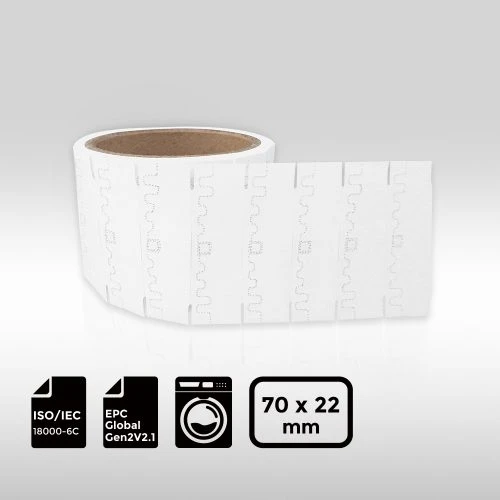
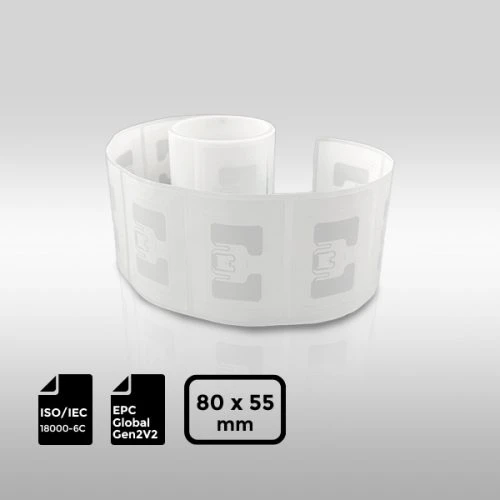
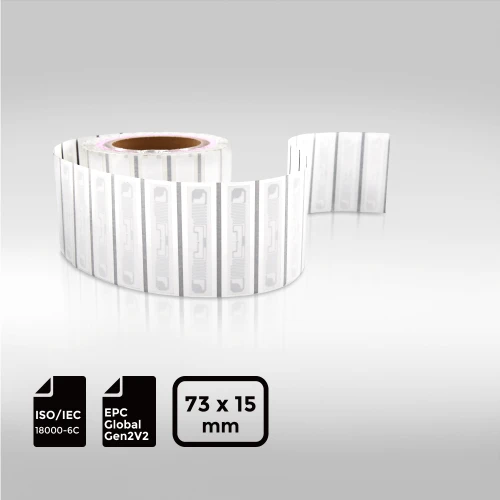
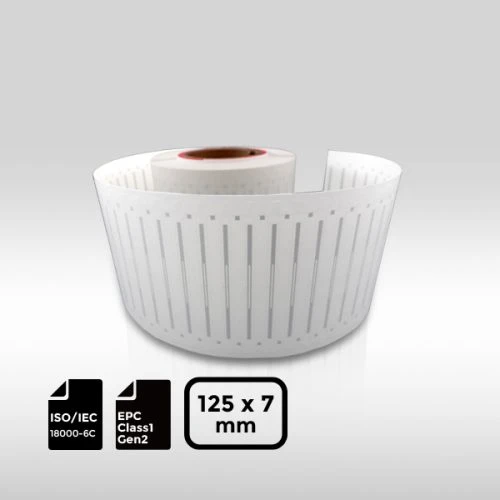
RFID label selection should not start with chip model or unit price. It should start with the product you want to tag.
Two labels may look similar on a datasheet, but they can behave very differently after they are applied. A standard UHF label may work well on a carton but fail near metal. A tag that reads well in open air may lose range on a liquid-filled bottle. A label with the right chip can still peel off if the adhesive is wrong.
Before ordering custom RFID labels, check these seven points first.
Other relevant guidelines:
→ RFID Tag Placement Guide for Retail Products
→ RFID Label and Reader Compatibility Guide
→ RFID Tags and Labels Beginner Guide
1. What Surface Will the RFID Label Be Applied To?
The product surface affects both reading performance and adhesion.
| Product Surface | What to Check |
| Paper carton | Standard UHF RFID labels usually work well |
| Plastic bottle | Curved surface and adhesive need testing |
| Glass bottle | Test with the actual filled product |
| Liquid product | Liquid may reduce read range |
| Metal surface | Usually requires an on-metal RFID label |
| Textile item | Bending, washing, and friction matter |
| Cold-chain packaging | Material and adhesive must handle low temperature |
If the label will be used on metal, liquid, glass, curved packaging, or cold-chain products, do not choose from a datasheet only. Test samples on the real product.

2. Which RFID Type Fits the Application?
Not every project needs the same RFID technology.
| Application | Common Choice | Reason |
| Retail inventory | ARC-certified RFID Label | Bulk reading and longer range |
| Warehouse cartons | UHF RFID label | Fast scanning through logistics flow |
| Asset tracking | UHF or on-metal RFID label | Depends on surface and read distance |
| Library or document tracking | HF RFID label | Stable close-range reading |
| Smart packaging | NFC label | Smartphone tap interaction |
| Jewelry or small items | Small-size RFID label | Limited label space |
For most retail, logistics, apparel, and warehouse projects, UHF RFID is the starting point. For phone interaction, NFC is usually the better direction. For metal or liquid environments, the label structure matters more than the chip name.
3. Does the Label Size Support the Required Read Range?
Label size is not only about appearance.
For UHF RFID labels, the antenna needs enough space to work properly. A smaller label may look better on cosmetics, jewelry, medicine boxes, cables, or compact packaging, but it may also reduce read range.
Before confirming size, check:
- Available label area on the product
- Required read distance
- Inlay size
- Printing area for barcode or text
- Flat or curved surface
- Manual or automatic application
- Roll format, gap, and core size
A small RFID label can work well, but it should be tested under the real reading condition.

4. Which Face Material Should Be Used?
The face material affects printing, durability, and appearance.
| Material | Best For | Notes |
| Coated paper | Retail, cartons, logistics | Low cost and easy to print |
| Thermal paper | Short-term labels | No ribbon needed, but shorter print life |
| PP synthetic | Product labels, moisture-resistant use | More durable than paper |
| PET | Assets, electronics, industrial use | Stronger durability and stability |
| Fragile material | Anti-tamper labels | Breaks or distorts when removed |
| Textile material | Apparel and laundry labels | Needs washing and friction tests |
Paper is suitable for many standard carton and retail labels. PET, PP, or other synthetic materials are safer when the label may face moisture, abrasion, cleaning, cold chain, or long service life.
5. Is the Adhesive Suitable for the Surface?
Adhesive failure is one of the most common RFID label problems.
A standard permanent adhesive may work on clean cardboard, but not on every surface. It may fail on frozen packaging, oily containers, curved bottles, rubber, low-energy plastics, rough metal tools, or outdoor products.
Before ordering, confirm whether the label needs:
- Permanent adhesive
- Removable adhesive
- Low-temperature adhesive
- High-tack adhesive
- Adhesive for curved surfaces
- Adhesive for low-energy plastic
- Tamper-evident construction
If the label lifts, curls, or falls off, the RFID function is already lost.

6. Will the Label Be Printed and Encoded?
RFID labels are often printed, encoded, or both. These details should be confirmed before production.
| Item | Examples |
| Printing | Logo, barcode, QR code, SKU, serial number |
| Encoding | EPC, user memory, password, lock settings |
| Data matching | Printed barcode matches encoded EPC |
| Printer | Zebra or other RFID printer model |
| Roll format | Core size, winding direction, label gap |
| Sensor mark | Gap, black mark, notch |
Many RFID label issues happen because print direction, EPC rules, barcode matching, printer compatibility, or roll format were not confirmed early enough.
7. Has the Label Been Tested in the Real Application?
A quick desktop scan is not enough.
Before mass production, test the RFID label:
- On the actual product
- With the actual reader
- At the required read distance
- In the real packaging condition
- With the real printer or encoder
- After handling, storage, or environmental exposure
The goal is not to get one impressive read distance in perfect conditions. The goal is stable performance in the real workflow.
Quick RFQ Checklist
When requesting a quote, send these details:
| Information | Example |
| Application | Retail, logistics, asset tracking, packaging |
| Frequency | UHF, HF, NFC |
| Surface | Carton, plastic, glass, metal, textile |
| Label size | Finished size and shape |
| Material | Paper, PP, PET, thermal paper |
| Adhesive | Permanent, removable, low-temperature |
| Printing | Blank, logo, barcode, serial number |
| Encoding | EPC, user memory, lock, verification |
| Packaging | Roll size, core size, winding direction |
| Quantity | Trial order or mass production |
| Application method | Manual, printer, or automatic labeler |
Clear application details help avoid wrong label recommendations and repeated sample changes.
Summary
Choosing the right RFID label is not about finding one universal tag. It is about matching the label to the product surface, read range, material, adhesive, printing, encoding, and real use environment.
For simple carton or retail use, a standard paper UHF RFID label may be enough. For metal, liquid, cold chain, assets, healthcare, jewelry, or industrial products, the label structure should be selected more carefully.
Before mass production, test samples on the actual product with the actual reader, printer, and encoding process. This helps avoid weak reads, failed encoding, poor adhesion, unreadable printing, and unnecessary rework.
Need help choosing RFID labels for your application? Visit rfidlabel.com and share your product surface, label size, read range, printing needs, and application environment. Our team can help recommend a suitable RFID label solution for your project.
Other relevant guidelines:
→ RFID Tag Placement Guide for Retail Products
→ RFID Label and Reader Compatibility Guide
→ RFID Tags and Labels Beginner Guide