


Food traceability is no longer a niche concept; it’s a fundamental expectation for consumers and a critical operational necessity for businesses. In an increasingly interconnected world, understanding the journey of our food from farm to fork is paramount for safety, quality, and sustainability. We believe that technology can democratize this process, making it accessible to everyone. This article explores how RFID-enabled smartphone applications are revolutionizing food traceability, empowering both businesses and consumers.
The Evolution of Food Traceability: From Manual Logs to Digital Chains
Historically, tracking food products involved cumbersome manual logs and paper trails, prone to errors and inefficiencies. The digital age brought about significant improvements, with databases and barcodes streamlining data collection. However, these systems often lacked real-time capabilities and the granular detail needed for truly effective food traceability. The advent of RFID technology, combined with the ubiquitous nature of smartphones, marks a new era.
Why RFID is a Game-Changer for Food Traceability
RFID (Radio-Frequency Identification) technology offers distinct advantages over traditional methods like barcodes. RFID tags can store more data, be read without a direct line of sight, and enable faster, more accurate inventory management. When integrated with smartphone applications, RFID empowers users to instantly access comprehensive product information.
How RFID-Enabled Apps Work: A Seamless Traceability Experience
Imagine a scenario where a consumer can simply tap their smartphone on a product and instantly retrieve its entire history. This is the power of RFID-enabled apps. These applications leverage the Near Field Communication (NFC) capabilities present in most modern smartphones to read RFID tags embedded in packaging or directly on products. The data, often stored in a cloud-based system, is then presented to the user in an easy-to-understand format.
Key Features of Effective RFID Traceability Apps
- Instant Data Access: Real-time information on origin, processing, and distribution.
- User-Friendly Interface: Intuitive design for both consumers and supply chain personnel.
- Secure Data Management: Blockchain or other secure technologies to ensure data integrity.
- Alerts and Notifications: Proactive alerts for recalls or quality issues.
- Integration Capabilities: Seamless integration with existing ERP and supply chain management systems.

Real-World Impact: Enhancing Safety and Trust
The practical applications of smartphone-as-scanner technology for food traceability are vast. Consider the fresh produce industry, where rapid identification of contaminated batches is crucial. With RFID, a recall can be executed with unprecedented speed and precision, minimizing health risks and economic losses. This level of transparency builds immense trust between producers and consumers.
Case Study: Blockchain-Powered Food Traceability in Action
One notable example is Walmart’s use of blockchain technology for leafy greens traceability. In 2018, Walmart mandated its leafy green suppliers to upload their data to a blockchain-based system. This initiative, while not solely reliant on RFID, demonstrates the industry’s move towards more robust and transparent traceability. The system allows for tracing produce back to its farm in seconds, a process that previously took days. While this specific example uses blockchain, the principle of rapid, verifiable data access is directly applicable to RFID-enabled smartphone scanning. The goal is to enhance food traceability and consumer confidence.
Beyond Safety: Optimizing Supply Chains and Reducing Waste
Beyond immediate safety concerns, RFID-enabled traceability offers significant operational benefits. Businesses can gain real-time visibility into their inventory, optimize logistics, and reduce waste due to spoilage or expired products. This leads to increased efficiency and profitability across the entire food supply chain.
Benefits for Businesses
•Improved Inventory Management: Accurate, real-time stock levels.
•Reduced Waste: Better management of perishable goods.
•Enhanced Compliance: Easier adherence to regulatory requirements.
•Stronger Brand Reputation: Demonstrating commitment to transparency and quality.

The Future is Now: Empowering Consumers and Businesses
The integration of RFID technology with smartphone applications is transforming food traceability from a complex, backend process into an accessible, interactive experience. We are moving towards a future where every consumer can be an informed participant in their food’s journey, and every business can operate with unparalleled efficiency and transparency.
We at RFIDLabel are at the forefront of providing high-quality, customizable RFID solutions that enable this future. Whether you are a large hotel chain, a retail giant, or a business looking to enhance your supply chain, our RFID cards, tags, and labels are designed to meet your specific needs. Explore our comprehensive range of products and discover how our solutions can elevate your operations and build greater trust with your customers. Visit rfidlabel.com today to learn more or to discuss your custom RFID label solutions.
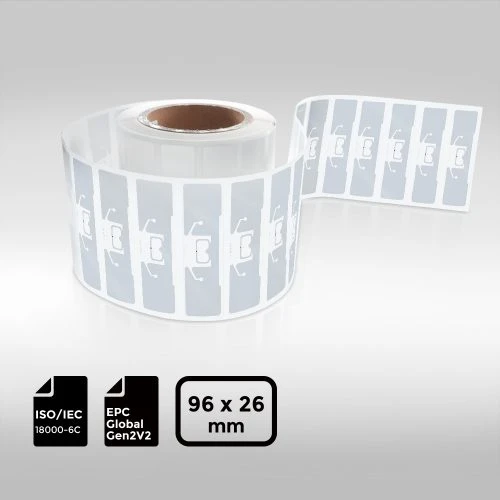
Avery Dennison® ARC Certified Impinj® M830 UHF RFID Label | 96×26mm

The 96×26 mm Avery Dennison® ARC Certified Impinj® M830 RFID Label is designed for reliable item-level identification in retail, logistics, and supply chain applications. Built with the advanced Impinj® M830 chip, this UHF RFID label delivers stable read performance, fast inventory capture, and dependable data accuracy across high-volume RFID operations. With its ARC-certified inlay, it provides a practical solution for inventory management, shipment tracking, retail tagging, and supply chain visibility.

Dogbone® Impinj® Monza® R6-P PET UHF RFID Wet Inlay | 97×27mm
The Impinj® Monza® R6-P UHF Dogbone® RFID wet inlay is designed for high-performance UHF RFID applications across global supply chains. It features the Impinj® Monza® R6-P chip and supports EPC Global Gen2v2 and ISO/IEC 18000-6C protocols for fast, accurate reads. Operating in the 860–960 MHz UHF band, the label uses a clear PET facestock and measures 97 × 27 mm, optimized for long read range and reliable performance.
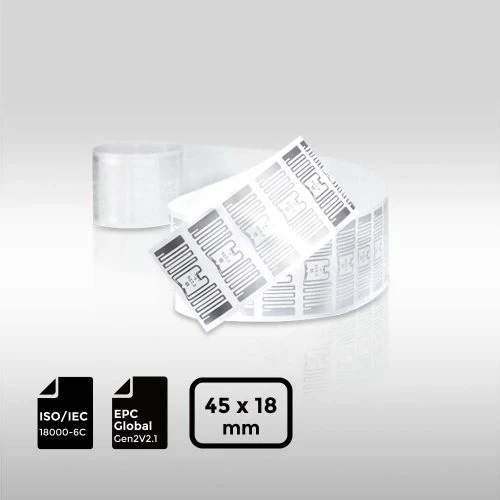
Avery Dennison® ARC Certified NXP® UCODE® 9 RFID Label | 45×18mm
AD Miniweb U9 FCC label is a compact (45×18 mm) ARC-certified RFID solution for retail, industrial, and supply-chain use. It delivers strong read performance on low-detuning materials such as cardboard and plastic, and in close-coupled environments. Powered by NXP® UCODE® 9, it offers 96-bit EPC memory and a self-adjusting feature that optimizes performance in challenging conditions. Widely applied in retail chains like Dillard’s, it ensures accurate inventory tracking, reliable performance, and smooth in-store operations.



