RFID tamper-evident labels play a vital role in modern supply chain management. With the advancement of globalization, the speed and scope of product circulation continue to expand. How to ensure that products are not tampered with during transportation, storage and sales has become an important challenge facing enterprises. This article will combine actual cases and problems to deeply discuss the application of tamper with tamper-evident labels, the use of well-known companies and the issues that need to be paid attention to during the use.
Application Scenarios of Tamper-Evident Labels
- Food and Beverage Industry
Food safety has always been a focal point for both consumers and businesses. Nestlé employs induction seals on their baby food and coffee containers. This sealing method requires users to peel off a layer of foil to access the product. Once the foil is removed, clear evidence of tampering is left behind. This not only increases consumer trust, but also ensures product safety.
- Pharmaceutical Industry
The pharmaceutical industry has strict requirements for product safety and integrity. Faller Packaging has developed a recyclable fiber-based tamper-evident label that shows clear signs of tampering upon first opening. This label is not only environmentally friendly but also ensures that medicines remain untampered before use, thereby protecting consumer health.
- Electronics
Electronics manufacturers like Apple use tamper-evident labels on accessory packaging to prevent tampering during transportation and sales. The use of these labels not only protects the safety of the products but also maintains the brand’s reputation.
- Food Services and Delivery
In the food service industry, brands like Lipton use shrink bands and tamper-evident labels to ensure that food remains unopened until it reaches the consumer. These labels clearly show tampering evidence, thereby ensuring food safety.
Case Analysis
- Tylenol Incident
In 1982, a series of poisoning incidents involving Tylenol led to the deaths of seven people. This tragedy prompted its parent company, Johnson & Johnson, to swiftly introduce tamper-evident caps. These caps break upon first opening, leaving clear evidence of tampering. This measure not only restored the brand’s reputation but also set an industry standard for product safety.
- Hershey’s
Chocolate manufacturer Hershey’s uses these labels on its product packaging. These labels tear or leave residue when the packaging is opened, indicating potential tampering. The use of these labels not only protects consumers but also upholds the brand’s high-quality image.
- Unilever (Lipton)
Lipton uses shrink bands on its tea products to prevent tampering and enhance consumer trust in the brand. This simple yet effective tamper-evident measure not only ensures product safety but also boosts consumer purchasing confidence.
Points of concern when using tamper-evident labels
- Visible and irreversible
Tamper-evident labels should be designed to be obvious enough and cannot be restored once tampered with. For example, many labels display “VOID” or other warning signs when torn, a design that can clearly alert consumers whether the product has been tampered with.
- Material Selection
Selecting the right materials is the key to ensuring the effectiveness of tamper with tamper-evident labels. Common materials include recyclable fiber-based materials and breakable vinyl. These materials can be significantly damaged or cannot be re-applied when tampered with, providing a reliable anti-counterfeiting effect.
- Quality Control
Strictly control the quality of tamper tamper-evident labels during the manufacturing process to ensure their correct application and function. This requires strict monitoring and testing at every stage of production to ensure that the label can play its due role in practical applications.
- Consumer Education
It is important to educate consumers on how to identify tampered with tamper-evident labels and take appropriate action when a product is suspected to have been tampered with. Enterprises should promote the identification methods and processing steps for tampering with tamper-evident labels to consumers through various channels to enhance consumers ‘awareness of prevention.
- Traceability
Implementing a product tracking system is an important measure to ensure product safety. By tracking every step of a product from manufacturing to distribution, the source of problems can be quickly located and remedial measures taken in a timely manner when tampering occurs.
Summary
Tampering with tamper-evident labels is of great significance in modern supply chain management. Through widespread use in industries such as food, pharmaceuticals, electronics and catering services, these labels not only protect product safety, but also enhance consumers ‘trust in the brand. Success stories from well-known companies have proved that tampering with tamper-evident labels is an important tool to ensure product safety and maintain brand reputation. In actual use, companies need to pay attention to label visibility, material selection, quality control, consumer education and product traceability to ensure that tampering with the labels plays its best role.
Through continuous improvement and innovation, tamper-evident label labels will continue to play an important role in various industries, providing safer products and better services to consumers around the world.
For more product information, please visit our official website of rfidlabel.com.
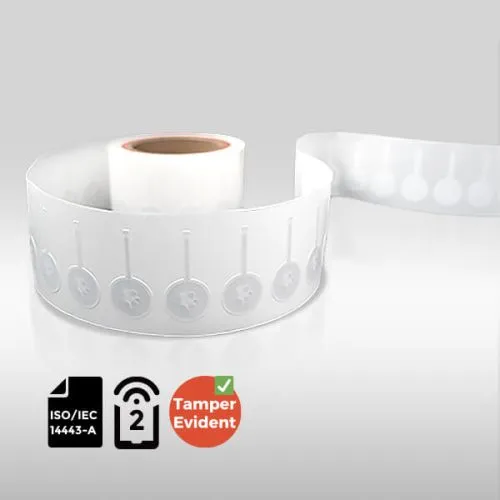
ISO14443A 13.56MHz NFC Label/Inlay NXP NTAG® 213 TagTamper

NTAG® 213 TagTamper offers several features to protect brands and enable advanced anti-counterfeiting as well as tamper-proofing. Furthermore, it lets brand owners have a direct engagement with consumers.