In RFID tagging, precision and efficiency matter at every step, black lines may look simple, but they play an important role in helping RFID printers and applicators identify the correct label position. This printed black indicator, typically found on the release liner or in the gap between RFID tags, plays a pivotal role in the tag printing and encoding process. This article delves into the functions of black lines, their necessity in various applications, and alternative positioning methods. Specifically, we will explore how a printer printing black lines contributes to the overall efficiency and accuracy of RFID tagging.
The Indispensable Role of Black Lines
Printer printing black lines (black marks) serve several critical functions that streamline RFID tag production and application:
1. Positioning and Gap Sensing
One of the primary roles of a black lines is to facilitate accurate positioning. When using RFID printers or label applicators, optical sensors detect the black line’s position. This detection allows the machine to precisely identify the separation line between tags, ensuring:
- Accurate Printing and Encoding: By knowing the exact start and end points of each tag, the printer can apply data and graphics with high precision, preventing misalignment.
- Prevention of Skewing and Misprints: The consistent detection of black lines helps to maintain the correct alignment of tags as they pass through the printer or applicator, significantly reducing errors such as skewed prints or complete misprints.
→ If you want to understand how RFID label pitch and gap affect printing accuracy, encoding stability, and automatic application, read our guide:
RFID Label Pitch and Gap: What They Mean and Why They Matter

2. Preventing Overlapping and Missed Tags
Without black lines, especially when dealing with transparent or semi-transparent tag materials, or when tag spacing is inconsistent, sensors can struggle to accurately detect individual tags. This can lead to a range of issues, including:
- Overlapping Prints: If the printer cannot correctly identify tag boundaries, it may print over the edges of one tag onto the next, rendering both unusable.
- Tag Misalignment: Inaccurate sensing can cause tags to be applied or printed in the wrong positions, leading to wasted materials and production delays.
- Encoding Failures: For RFID tags, precise positioning is vital for successful encoding. If the tag is not correctly aligned, the encoding process may fail, resulting in unreadable or faulty tags.
3. Assisting Device Recognition of Tag Start Positions
For rolled RFID tags, particularly in high-speed labeling or automated applications, black lines significantly enhance recognition accuracy. The clear visual contrast provided by the black mark allows reading devices to quickly and reliably identify the beginning of each tag, which is essential for continuous and efficient operation.
When Are Black Lines Necessary?
While not all RFID tags require black lines, their use is highly recommended in specific scenarios to ensure optimal performance and prevent common issues:
- Transparent or Semi-Transparent Tag Materials: When the tag material itself is not opaque, traditional gap sensors may struggle to differentiate between the tag and the liner. Black lines provide a clear, high-contrast reference point.
- Automated Labeling Equipment: Automated applicators and high-speed printers rely heavily on consistent and reliable tag detection. Black lines provide the necessary visual cue for these sophisticated machines.
- Tags with Minimal Gaps: If the spacing between tags is very small, making it difficult for sensors to distinguish individual tags, black lines offer a distinct and easily detectable boundary.
- Printers Relying on “Black Line Sensing” for Positioning: Some RFID printers are specifically designed to use black line sensors for tag positioning. For these devices, black marks are a prerequisite for proper operation.

Alternatives to Black Lines
Although black marks offer significant advantages, they are not the only method for tag positioning. In fact, the majority of current orders and stock samples do not feature black lines. Other common positioning methods include:
| Positioning Method | Requires Black Line? | Description |
| Gap Sensor | NO | Relies on a clear gap between tags, using a “through-light” sensor to detect the tag edge. |
| Notch/Die-cut | NO | Utilizes a small notch or die-cut on the tag liner to identify the tag’s position. |
| Black Line Sensor | YES | Determines the tag’s starting position by recognizing a black line on the liner. |
Conclusion
Black marks, or black lines, are a valuable tool in the RFID tagging industry, offering enhanced precision, preventing errors, and improving the efficiency of printing and encoding processes. While not universally required, their benefits are particularly evident in applications involving transparent materials, automated equipment, or minimal tag spacing. Understanding the role of black lines and their alternatives allows for informed decisions in RFID tag production, ultimately leading to more reliable and cost-effective solutions. For more information, please visit the official website rfidlabel.com.
Recommended Product
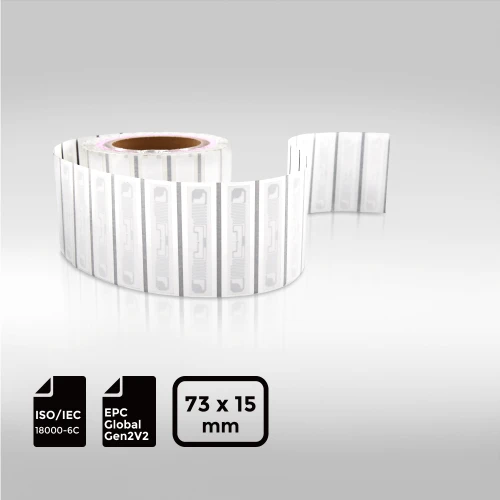
ISO18000-6C 73x15mm UHF RFID label EM4126

Discover efficiency with our 73x15mm UHF RFID label featuring the versatile EM4126 chip. Perfect for precise tracking and asset management. Elevate your operations with seamless RFID technology.