The era of smart retailing has arrived. The convergence of RFID (Radio Frequency Identification) and IoT (Internet of Things) technologies has given a strong impetus to this change. The combination of these two technologies has completely reshaped the retail industry’s operation model. And provided consumers with an unparalleled personalized shopping experience. From smart shelves to real-time inventory management, RFID and IoT are revolutionizing the retail industry. They are driving it into a new era of efficiency, intelligence, and customer orientation. In this article, we’ll take a closer look at how these two technologies are complementing each other to drive the continued development of smart retail.
Basic Concepts of RFID and IoT Technologies
What is RFID technology?
RFID technology transmits information through radio waves, realizing automatic identification and data collection of items. The RFID system is mainly composed of labels, readers, and data processing systems. The label has a built-in chip. It can store a large amount of information, and the reader is responsible for reading and writing the label data. The data processing system then analyzes and processes the collected data.
What is IoT technology?
The Internet of Things refers to a network that connects any object to the Internet through information-sensing devices. These devices include radio frequency identification, infrared sensors, global positioning systems, laser scanners, and other technologies for information exchange and communication. The goal is to realize intelligent identification, positioning, tracking, monitoring, and management. The core of IoT lies in the “interconnection of everything”, providing intelligent services for various industries through data collection, transmission, processing, and analysis.
Advantages of Combining RFID and IoT Technologies
By combining RFID and IoT technology, what effect will be produced? Let’s understand the following five aspects.
- Real-time data collection and transmission
RFID labels enable real-time collection of inventory data, such as item quantities and locations, while IoT technology ensures the instant transmission of this data to the cloud or local processing systems, enabling rapid data updates and sharing.
- Improve operational efficiency and accuracy
With the combination of RFID and IoT, retailers can get an accurate picture of their inventory, reduce human error, and improve inventory turnover and order processing speed. The system can automatically trigger replenishment requests, optimize inventory structure, and reduce inventory costs.
- Accurate merchandise tracking and location
RFID labels enable merchandise to be accurately tracked at every step of the way in the warehouse, on the shelves, and even in the hands of customers, improving the level of refinement in merchandise management.
- Enhanced Customer Experience
RFID labels enable merchandise to be accurately tracked in the warehouse, on the shelves, and even in the hands of customers at every step of the process, improving the level of refinement of merchandise management. It is also convenient for retailers and customers to find goods quickly. And. Also through the collection of customer shopping behavior data, retailers can provide personalized recommendations and precision marketing, while achieving fast checkout and a seamless shopping experience.
RFID and IoT technologies in smart retailing
As RFID and IoT technologies continue to evolve, all aspects of smart retail are undergoing profound changes. From supply chain management to consumer interaction, the application of these technologies is continuously optimizing the way retail operates, bringing unprecedented efficiency and convenience.
- Intelligent Inventory Management System
The system is able to monitor inventory levels in real time and forecast sales trends. It automatically adjusts inventory strategies to ensure sufficient and non-excessive supply of goods, reducing the risk of stock-outs and backlogs.
- Intelligent Shelf and Electronic Labeling
Intelligent shelves combined with RFID technology can display real-time product information, inventory status and promotional information to enhance the customer shopping experience. Electronic labels can be dynamically updated according to demand, improving the efficiency of information transfer.
NXP ICODE SlIX2 NFC label: the right assistant for smart retailing
- Fast data transfer: NXP ICODE SlIX2 RFID labels are equipped with fast data transfer capability, which can significantly improve inventory counting efficiency and reduce manual operation time.
- High-capacity storage: The label has a high-capacity storage function, which can record detailed information about the goods, including production date, shelf life, price, etc., for easy management and inquiry
- High security: NXP ICODE SlIX2 RFID labels have high security, which can effectively prevent merchandise loss and theft and protect the interests of retailers.
- High compatibility: The label complies with ISO/IEC 15693, ISO/IEC 18000-3, and EPC Global standards, providing good compatibility for various application scenarios.
- Intelligent Functions: By combining with IoT technology, the label can realize real-time inventory management, automatic replenishment and smart shelf functions to improve operational efficiency.
- Data analysis: By analyzing the label data, it is possible to understand market trends, optimize sales strategies, and increase sales and customer satisfaction.
Conclusion
The application of RFID and IoT technologies in smart retailing brings great advantages to retailers, not only improving operational efficiency but also enhancing customer experience. In the future, retail enterprises should actively adopt these technologies to realize comprehensive business upgrades and maintain competitive advantages.
FAQs
1. What are the main components of an RFID system?
An RFID system typically consists of three main components: labels, readers, and data processing systems. Labels have built-in chips that store data, readers read and write data to these tags, and data processing systems analyze and process the collected data.
2. How does IoT technology enhance the functionality of RFID in retail?
IoT technology enhances RFID functionality by enabling real-time data collection, transmission, and processing. This integration allows for real-time inventory management, precise tracking of goods, automated replenishment, and personalized customer experiences through data analysis.
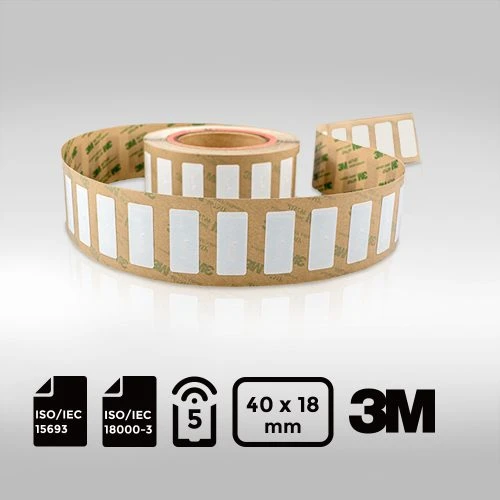
NFC Label 40x18mm NXP ICODE® SLIX2 | ISO15693

The NXP ICODE® SLIX2 RFID Label is a 40×18 mm high-frequency label operating at 13.56 MHz. It offers 2528 bits of user memory, enhanced anti-collision features, and reliable performance up to a 1.5 meter read range, making it ideal for library management, document tracking, and asset management. The label uses 3M adhesive for secure and firm attachment.